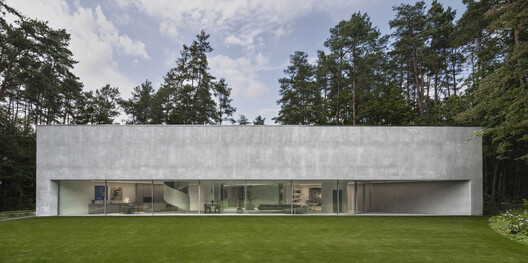
In the outskirts of Vilnius, Lithuania, the Trim House stands as a testament to the rigorous geometric logic that has come to define the work of Robert Konieczny and his firm, KWK Promes. Completed in 2025, the residence spans just under 300 square meters, offering a compact but highly articulated response to its environment. Konieczny, known for projects that often challenge the traditional boundaries between structure and landscape, here focuses on the "trim" — a concept that suggests both a reduction of excess and a precise alignment with the site's physical constraints.
The architecture of Trim House is characterized by its clean, uncompromising edges and a material palette that emphasizes form over ornament. By utilizing a footprint of 299 square meters, the design maximizes internal volume while maintaining a modest profile from the exterior. Captured in the photography of Juliusz Sokołowski and Jakub Certowicz, the project reveals a sophisticated interplay of light and shadow, where the sharp angles of the roofline and walls create a changing visual dialogue throughout the day.
Restraint as Method
KWK Promes has built its reputation on houses that treat the relationship between building and ground as a design problem in its own right. The firm's earlier residential projects in Poland — including the well-known Safe House and the Konieczny's Ark — used kinetic elements, shifting planes, and dramatic topographic integration to blur where architecture ends and landscape begins. Trim House operates in a related but distinct register. Rather than mechanical movement or theatrical landform manipulation, the Vilnius project achieves its effect through subtraction: sharp edges, disciplined volumes, and a refusal to let the building exceed what the site demands.
This approach places Trim House within a broader current in European residential architecture that privileges site-specific calibration over stylistic signature. The trend is visible across practices in Scandinavia, the Low Countries, and the Baltics, where architects increasingly treat the single-family house not as a canvas for formal invention but as an exercise in precise negotiation with terrain, orientation, and local climate. In Lithuania, where postwar suburban development often defaulted to generic forms, a project of this specificity registers as a quiet corrective — architecture that derives its logic from the particular conditions of its plot rather than from imported typologies.
The modest scale of the house is itself a statement. At 299 square meters, Trim House is generous by most European standards but deliberately restrained compared to the expansive villas that dominated high-end residential commissions in the region over the past two decades. The choice signals a shift in what constitutes ambition in domestic architecture: not the accumulation of square footage, but the density of intention per square meter.
Vilnius as Testing Ground
Vilnius has emerged in recent years as a city where architectural experimentation finds receptive ground. The Lithuanian capital's relatively open planning environment and a growing cohort of private clients willing to commission distinctive houses have made it a destination for practices working at the intersection of craft and concept. For a Polish firm like KWK Promes, building across the border in Lithuania also represents a kind of regional dialogue — an exchange of architectural ideas within a Baltic and Central European context that shares climatic conditions, material traditions, and a common postwar inheritance of standardized housing.
Konieczny's decision to name the project "Trim" invites a reading that extends beyond the physical. In architecture, trimming implies editing — the removal of what is unnecessary to reveal what is essential. It is a word borrowed from craft traditions where precision is measured not by what is added but by what is taken away. Whether this philosophy of reduction can sustain the complexity of domestic life over time is a question every minimalist house must eventually answer. The tension between geometric discipline and the inevitable disorder of habitation is one that Trim House, for now, holds in careful balance.
The project adds another data point to a growing body of evidence that the most interesting residential work in Northern and Central Europe is happening not in capital-city centers but on suburban and periurban sites, where architects have the freedom to engage directly with landscape and light. Whether this pattern reflects a durable shift in architectural culture or simply the economics of land availability remains an open question — one that projects like Trim House make worth watching.
With reporting from ArchDaily.
Source · ArchDaily