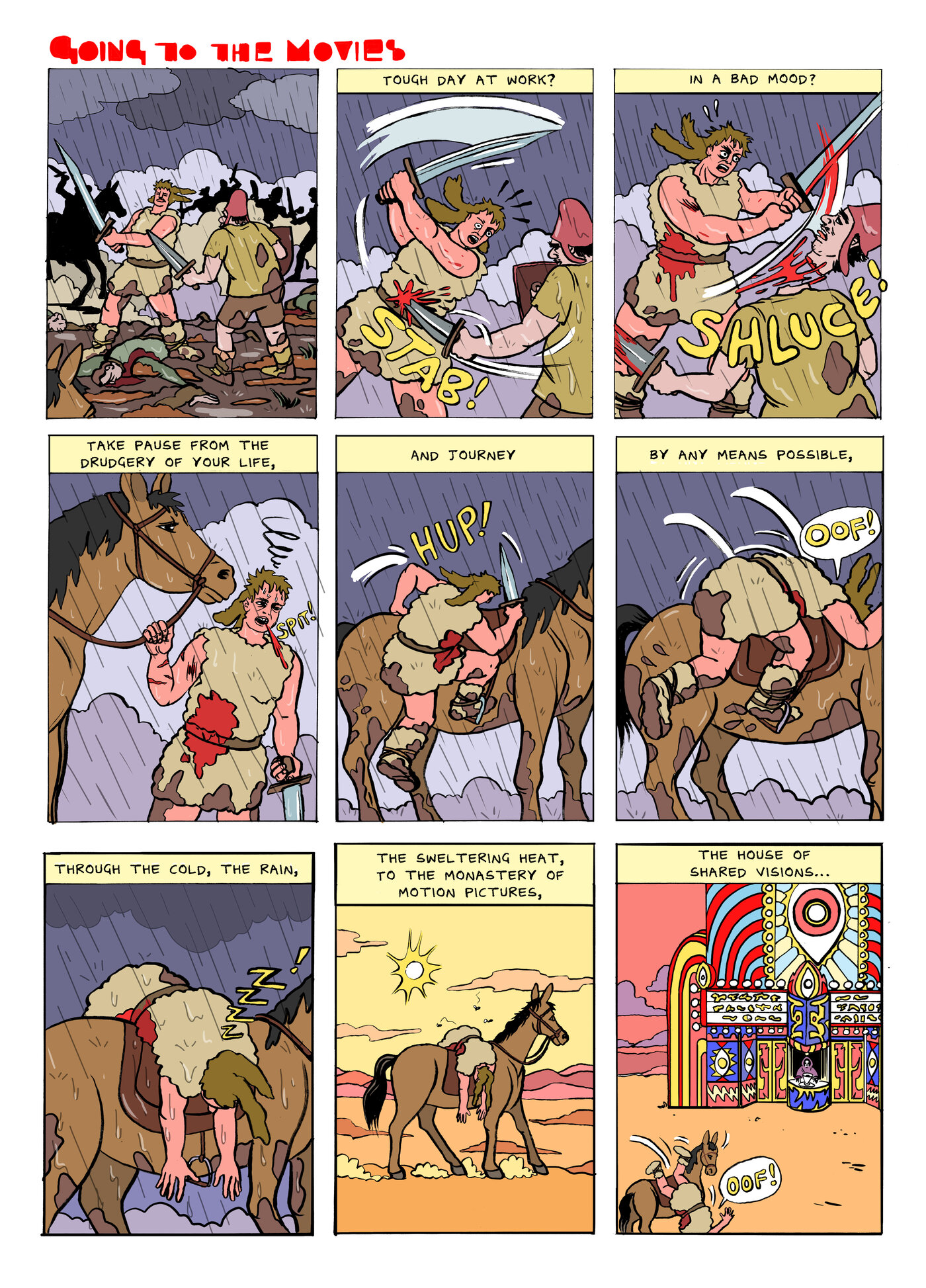
The act of "going to the movies" has long been more than a simple transaction for a ticket. It is a choreographed ritual — one involving shared space, silent observation, and a particular quality of attention that no home setup fully replicates. Even as the boundary between the private living room and the public cinema continues to blur, the specific atmosphere of the theater remains a primary subject for those documenting the evolution of modern spectatorship. MUBI Notebook's "Funnies" series, notably the installments from April 2026, utilizes the medium of the comic strip to distill these experiences into a few well-placed lines and panels, treating the moviegoing ritual as both subject and form.
The series appears within MUBI's broader editorial ecosystem — a platform that has, over the past decade, positioned itself at the intersection of streaming distribution and curatorial taste. MUBI Notebook, the publication's editorial arm, has long served as a venue for criticism, interviews, and visual essays that sit outside the mainstream film-media apparatus. The transition of the "Funnies" illustrations from the digital newsletter Weekly Edit to a broader archival context signals something worth noting: film commentary is migrating across formats, and the comic strip — a medium with its own rich history of cultural observation — is finding new relevance in that migration.
The Comic Strip as Critical Medium
The use of sequential art to comment on cinema is not without precedent. Cartoonists and illustrators have long turned their attention to the social theater of the movie house — the etiquette, the architecture, the shared darkness. What distinguishes the "Funnies" series is its placement within a platform that is itself reshaping how audiences encounter film. MUBI does not operate like a traditional streaming library; its model has historically emphasized limited, rotating selections, foregrounding editorial judgment over algorithmic recommendation. The comic series, in this context, functions as an extension of that curatorial philosophy: it does not merely depict the cinema experience but frames it as something worth slowing down for.
By rendering the moviegoing experience through graphic design and sequential art, the series captures the subtle humor and occasional absurdity of modern cinephilia — the hushed anticipation before the lights dim, the glow of the screen reflected on upturned faces, the collective focus of a room full of strangers choosing, for a few hours, to pay attention to the same thing. These are small observations, but they carry weight precisely because the conditions they describe are no longer universal. Theatrical attendance patterns have shifted substantially since the pandemic years, and the default mode of film consumption for many viewers is now domestic and solitary.
Curation Against the Algorithm
In a landscape where content discovery is increasingly driven by algorithmic efficiency — recommendation engines optimizing for engagement metrics rather than aesthetic experience — these illustrated dispatches serve as a humanistic counterpoint. They remind the viewer that film is not merely "content" to be processed but an event to be inhabited, a social form with its own spatial and temporal logic.
The tension here is structural, not merely nostalgic. Platforms like MUBI occupy an unusual position: they are digital distribution services that nonetheless argue, through their editorial choices, for the primacy of the physical and the communal. The "Funnies" series embodies that contradiction. It is consumed on a screen, often alone, yet its subject is the irreducible experience of being in a room with others. Whether this amounts to a genuine preservation of theatrical culture or a stylized elegy for something already receding depends, in part, on how seriously platforms and audiences continue to invest in the spaces where film was designed to be seen.
The comic strip, for its part, remains a vital if understated tool for reflecting on these dynamics. Its economy of form — a few panels, a handful of lines — mirrors the economy of the theatrical experience itself: constrained, deliberate, and dependent on the viewer's willingness to meet it halfway. Whether the ritual of the cinema endures as lived practice or persists mainly as illustrated memory is a question the series raises without pretending to answer.
With reporting from MUBI Notebook.
Source · MUBI Notebook