In the late 1970s, the distance between a director's vision and a studio's marketing department was often measured in the gap between a film's title and its poster. Joan Micklin Silver's 1979 adaptation of Ann Beattie's debut novel, Chilly Scenes of Winter, serves as a quiet monument to this friction. Fearing the original title was too somber for a romantic comedy, United Artists insisted on a rebrand. After 20th Century Fox refused to relinquish the title Laura, the studio settled on Head Over Heels—a name the producers had originally suggested as a sarcastic placeholder.
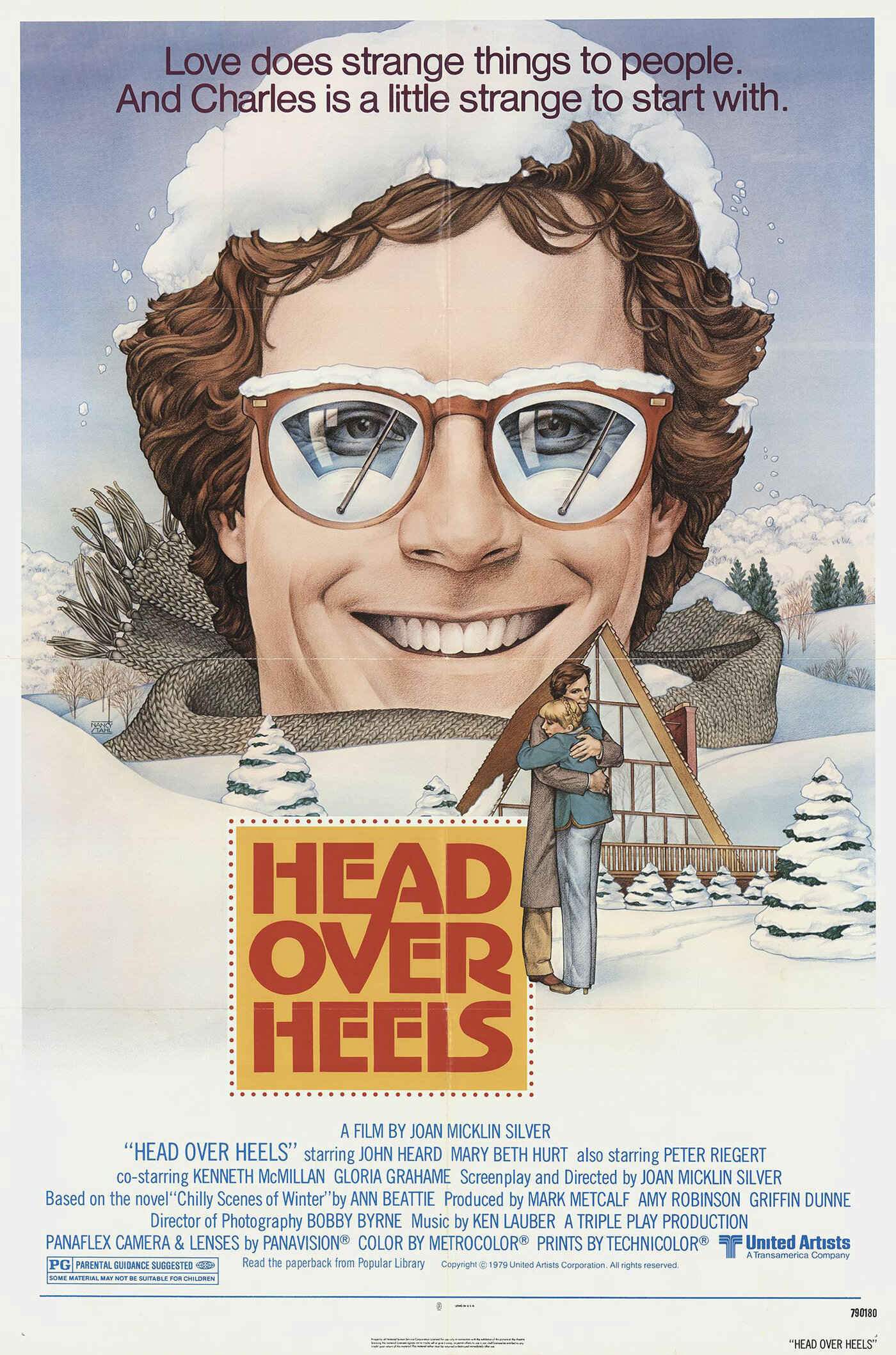
The marketing campaign that followed was anchored by a striking one-sheet illustration by Nancy Stahl. While the title suggested a generic, buoyant romance, Stahl's work offered a more nuanced visual entry point—a piece of commercial art that hinted at the emotional undertow running through Beattie's prose. It was a sophisticated composition that managed to survive a chaotic release cycle, which saw the film competing for attention against Blake Edwards's blockbuster 10. Ironically, Edwards himself publicly lamented the "vulgar, sexist" nature of his own film's marketing that same month, highlighting a period where directors felt increasingly alienated from the way their work was sold.
The Studio Logic of Misbranding
The decision to rename Chilly Scenes of Winter was not an isolated act of marketing malpractice. It belonged to a broader pattern in late-1970s and early-1980s Hollywood, where studios routinely softened or repackaged literary adaptations to fit audience expectations shaped by genre conventions. The logic was straightforward: a title that signaled melancholy risked narrowing the opening-weekend audience. A title that signaled romance, however misleading, widened it. The same impulse led distributors to cut trailers that emphasized comedic beats in otherwise dramatic films, or to foreground a love story in material where romance was incidental.
Silver, who had already navigated the independent distribution landscape with Hester Street in 1975, understood the commercial pressures better than most. Her earlier work had demonstrated that films outside the studio mainstream could find audiences through careful positioning. But Head Over Heels presented a different problem: the positioning was not careful—it was contradictory. The title promised lightness. The film delivered ambiguity, emotional stasis, and the particular brand of aimless longing that defined Beattie's fiction. Audiences expecting a conventional romantic comedy encountered something closer to a character study of obsession and inertia.
The result was a film that struggled to find its constituency on first release, despite maintaining a respectable nine-week run at Manhattan's Trans-Lux East before being replaced by Roller Boogie—a substitution that, in retrospect, reads as a small allegory for the era's commercial priorities.
Stahl's Illustration as Countertext
What makes the episode endure as more than an industry footnote is Stahl's poster. Where the title misdirected, the illustration quietly corrected. Stahl's graphic work across this period occupied a space between editorial illustration and fine art, bringing a painterly sensibility to commercial assignments. Her one-sheet for Head Over Heels carried a tonal specificity that the title actively worked against—a visual register closer to the film's actual emotional temperature than anything else in the marketing apparatus.
This tension between image and text on a single poster is worth noting because it reflects a broader dynamic in film marketing of the era. Before the dominance of photographic composites and digitally assembled key art, illustrated posters granted individual artists a degree of interpretive latitude. The illustrator functioned, in effect, as an unsanctioned critic—offering a reading of the film that could diverge from the studio's official pitch. Stahl's work for Head Over Heels is a case where that divergence served the film better than the campaign it was embedded in.
The film was eventually re-released under its original title, Chilly Scenes of Winter, allowing Beattie's melancholic prose and Silver's direction to finally align with their public identity. The restored title validated what Stahl's illustration had communicated from the start. Whether the re-release changed the film's commercial fortunes or merely its critical reception is a distinction that speaks to a persistent question in film distribution: how much of a movie's fate is sealed not by what it is, but by what its packaging tells audiences it should be.
With reporting from MUBI Notebook.
Source · MUBI Notebook