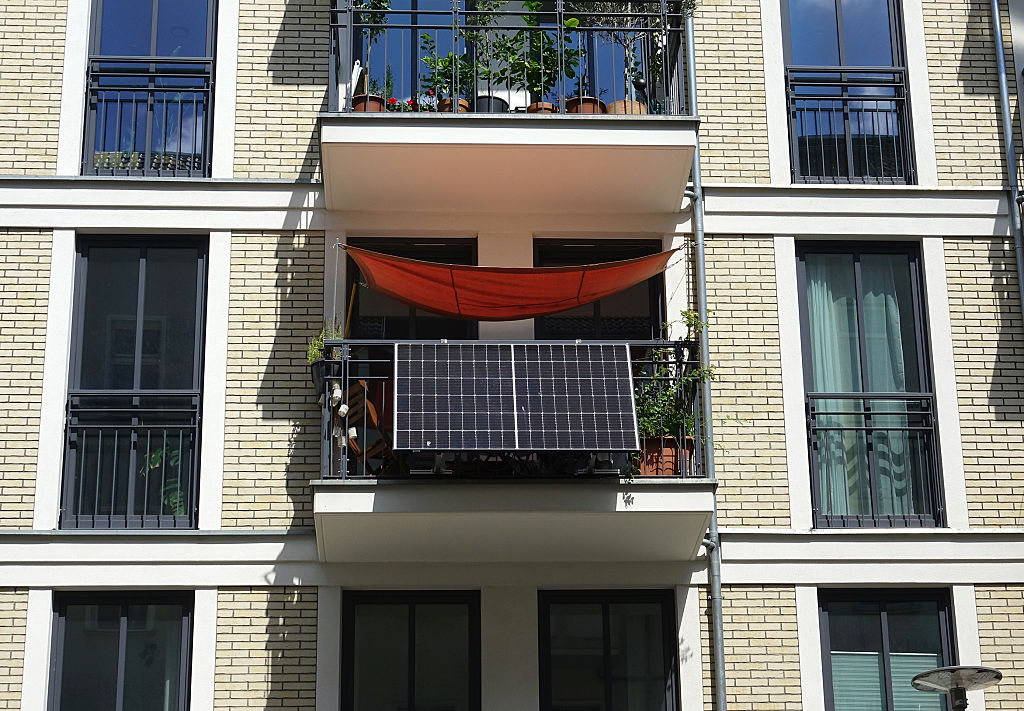
For years, the barrier to residential solar power in the United States has been a matter of architecture and capital. A traditional rooftop installation typically requires a $30,000 investment, a long-term mortgage, and ownership of a single-family home. But a legislative shift originating in Utah is beginning to dismantle that barrier, favoring a more modular, "plug-and-play" approach known as balcony solar.
The concept is deceptively simple: small-scale solar panels that feed electricity directly into a home's grid through a standard wall outlet. Popularized in Germany — where balcony solar added significant capacity to the national grid amid the energy pressures of the Russia-Ukraine war — the technology offers a portable, low-cost alternative for renters and homeowners alike. In Utah, Republican State Representative Raymond Ward saw the European trend as a pragmatic solution for energy affordability and sponsored HB 340 to legalize the practice. The bill passed with unanimous, bipartisan support, making Utah the first state to formally permit residents to bypass complex utility hurdles for small-scale plug-in systems.
Why the traditional model left most Americans behind
The residential solar market in the United States has long been structured around a particular homeowner profile: someone who owns a detached house with a suitable roof, has strong credit, and can either pay upfront or commit to a multi-year financing arrangement. That profile excludes a large share of the population. Renters, apartment dwellers, and owners of older homes with structural or shading limitations have had few practical options. Even in states with generous net-metering policies — which allow homeowners to sell excess solar generation back to the grid — the upfront cost and permitting complexity have kept adoption concentrated among higher-income households.
Balcony solar sidesteps much of this friction. The panels are small enough to mount on a balcony railing, a patio, or a south-facing wall. They require no permanent modification to a building's structure and no professional electrician for installation. The electricity generated feeds directly into the home circuit, offsetting consumption in real time rather than flowing back to the grid. This means the regulatory and technical apparatus that governs traditional rooftop solar — interconnection agreements, utility inspections, building permits — largely does not apply.
Germany's experience offers the clearest precedent. When energy prices surged across Europe following Russia's invasion of Ukraine, German consumers turned to balcony solar in large numbers. The German government responded by simplifying registration requirements and raising the maximum capacity allowed for plug-in systems. The result was a rapid, consumer-driven expansion of distributed solar capacity that operated largely outside the traditional utility framework.
A legislative template — and the tensions ahead
Utah's HB 340 removed the legal ambiguity that had discouraged plug-in solar adoption in the state. By explicitly permitting small-scale systems to connect through standard outlets without the permitting gauntlet required for conventional installations, the law effectively democratized solar access. The "Utah model" is now serving as a blueprint: 30 states and the District of Columbia have drafted similar legislation, according to the advocacy group Bright Saver.
The bipartisan appeal is notable. The bill's framing as a property-rights and consumer-choice measure — rather than a climate policy — gave it traction among Republican legislators who might otherwise resist renewable energy mandates. That political positioning may prove as important as the technical merits in determining how far the model spreads.
Still, the expansion raises questions that Utah's law does not fully resolve. Utilities have historically resisted distributed generation because it complicates grid management and erodes the rate base from which they recover infrastructure costs. As plug-in solar scales from a novelty to a meaningful source of distributed capacity, utilities and regulators will face pressure to define how these systems interact with the broader grid — particularly around safety standards, insurance liability, and the economics of net consumption.
There is also the question of scale. A single balcony panel offsets a modest share of a household's electricity use. The value proposition depends heavily on local electricity prices, sunlight availability, and whether regulators allow the technology to remain free of the permitting overhead that burdens conventional solar.
The tension, then, is between the simplicity that makes plug-in solar accessible and the regulatory complexity that tends to follow any technology once it reaches meaningful adoption. Whether balcony solar remains a lightweight on-ramp to distributed energy — or becomes encumbered by the same institutional friction it was designed to avoid — will depend on choices that state legislatures and utility commissions have only begun to confront.
With reporting from Grist.
Source · Grist