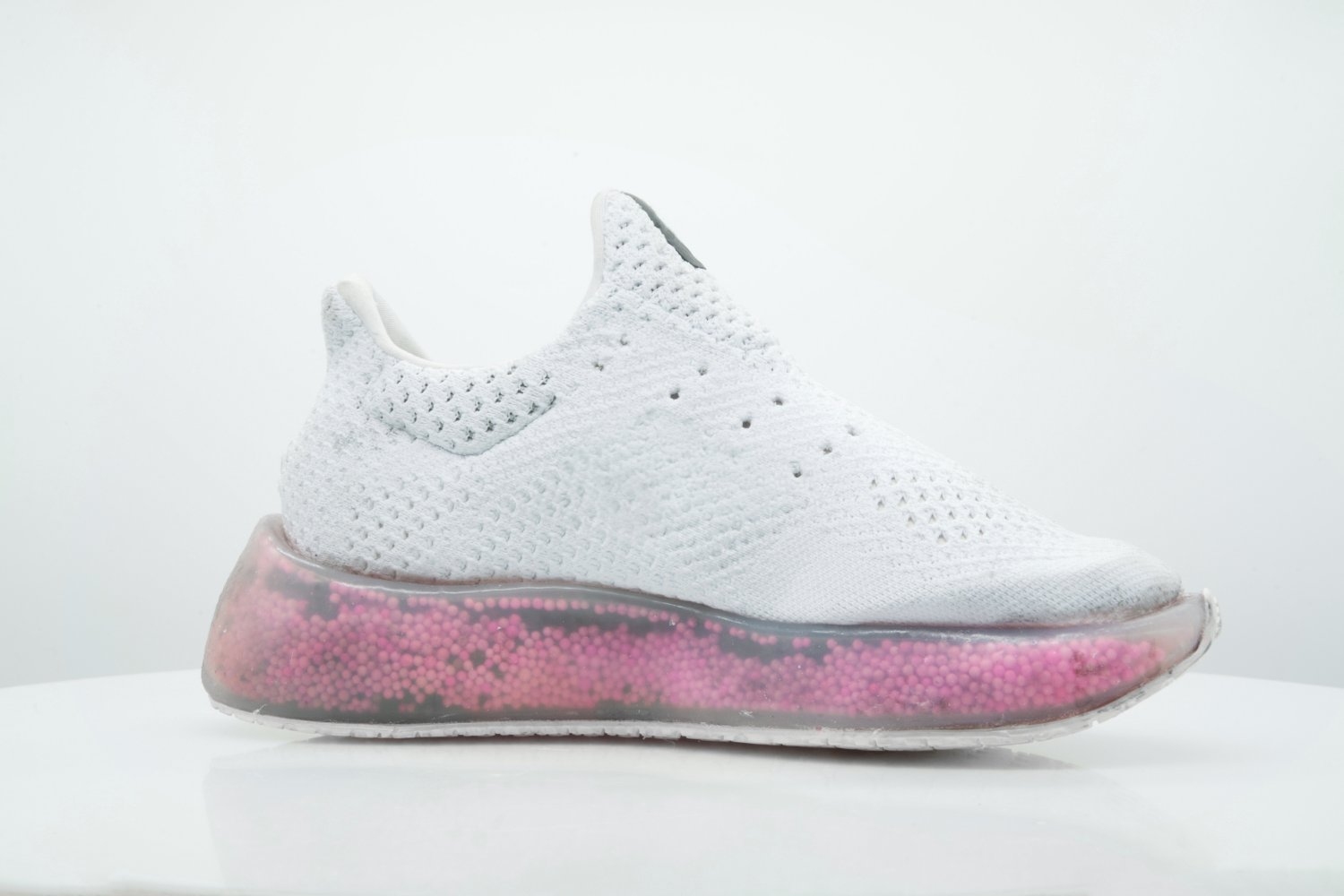
Granular convection is a physical phenomenon in which agitation causes larger particles to migrate to the top of a mixture, regardless of their density. Commonly known as the "Brazil nut effect" — after the observation that the largest nuts in a container of mixed snacks invariably surface when shaken — it has been studied for decades in physics and materials science. Researchers at MIT's Self-Assembly Lab are now attempting to put that phenomenon to practical use in an unlikely domain: the midsole of a running shoe.
The project, led by associate professor Skylar Tibbits, aims to replace the static foam or elastomer layers found in conventional footwear with granular materials capable of reorganizing themselves during the act of running. As the runner's foot strikes the ground repeatedly, the resulting agitation drives particles within the midsole to shift and settle according to the specific pressure map of that individual's gait. Over time, the shoe effectively develops a personalized support structure — not through digital scanning, custom molding, or algorithmic design, but through the unassisted physics of motion.
From factory average to field adaptation
Modern athletic footwear is, for the vast majority of consumers, a product designed around statistical averages. Midsole geometries, cushioning densities, and arch profiles are calibrated for broad populations, not individual biomechanics. Elite athletes and professional runners often work with custom-fitted shoes, but the cost and logistics of bespoke manufacturing place that option well beyond the reach of recreational runners.
The industry has explored several paths toward mass personalization. 3D-printed midsoles, lattice structures tuned by software, and pressure-mapped insoles have all emerged in recent years as attempts to close the gap between off-the-shelf and custom fit. Each of these approaches, however, locks in a design at the point of manufacture. A 3D-printed lattice may be optimized for a scan taken on a Tuesday afternoon, but it cannot account for the way a runner's gait shifts over the course of a long training block, or the asymmetries that emerge with fatigue.
The Self-Assembly Lab's approach differs in a fundamental respect: it defers the moment of customization from the factory to the field. The shoe arrives in a neutral state and evolves through use. The granular material inside the midsole is not pre-arranged; it finds its arrangement in response to the forces the runner actually applies. In principle, this means the shoe could continue to adapt as the runner's biomechanics change — whether from training adaptation, injury recovery, or simple wear over time.
Physics as design tool
The concept sits within a broader research agenda at the Self-Assembly Lab, which has spent years investigating how materials can be programmed to organize themselves without external electronics, sensors, or computation. Previous work from the lab has explored self-assembling furniture, textiles that respond to moisture, and construction materials that settle into predetermined configurations through vibration. The running shoe project extends that logic to a wearable product with a potentially large consumer market.
The engineering challenges remain considerable. Granular systems are sensitive to particle size, shape, friction, and the frequency and amplitude of agitation. Translating a well-understood laboratory phenomenon into a product that performs reliably across different body weights, running speeds, terrain types, and environmental conditions is a nontrivial problem. Durability is another open question: whether a granular midsole can maintain its adaptive properties over hundreds of miles of use, or whether the particles degrade, compact, or lose their capacity to reorganize.
There is also the question of where this sits in the competitive landscape of athletic footwear, an industry where marketing narratives around technology — carbon-fiber plates, nitrogen-infused foam, energy-return systems — carry significant commercial weight. A shoe that adapts through a passive physical process, with no app, no sensor, and no digital interface, represents a strikingly different value proposition.
Whether the physics of granular convection can scale from a research prototype to a viable consumer product remains to be demonstrated. But the underlying tension the project exposes is worth watching: the gap between what mass manufacturing can deliver and what individual biomechanics actually demand, and whether the solution lies in more computation — or in letting matter do what it already knows how to do.
With reporting from MIT News.
Source · MIT News