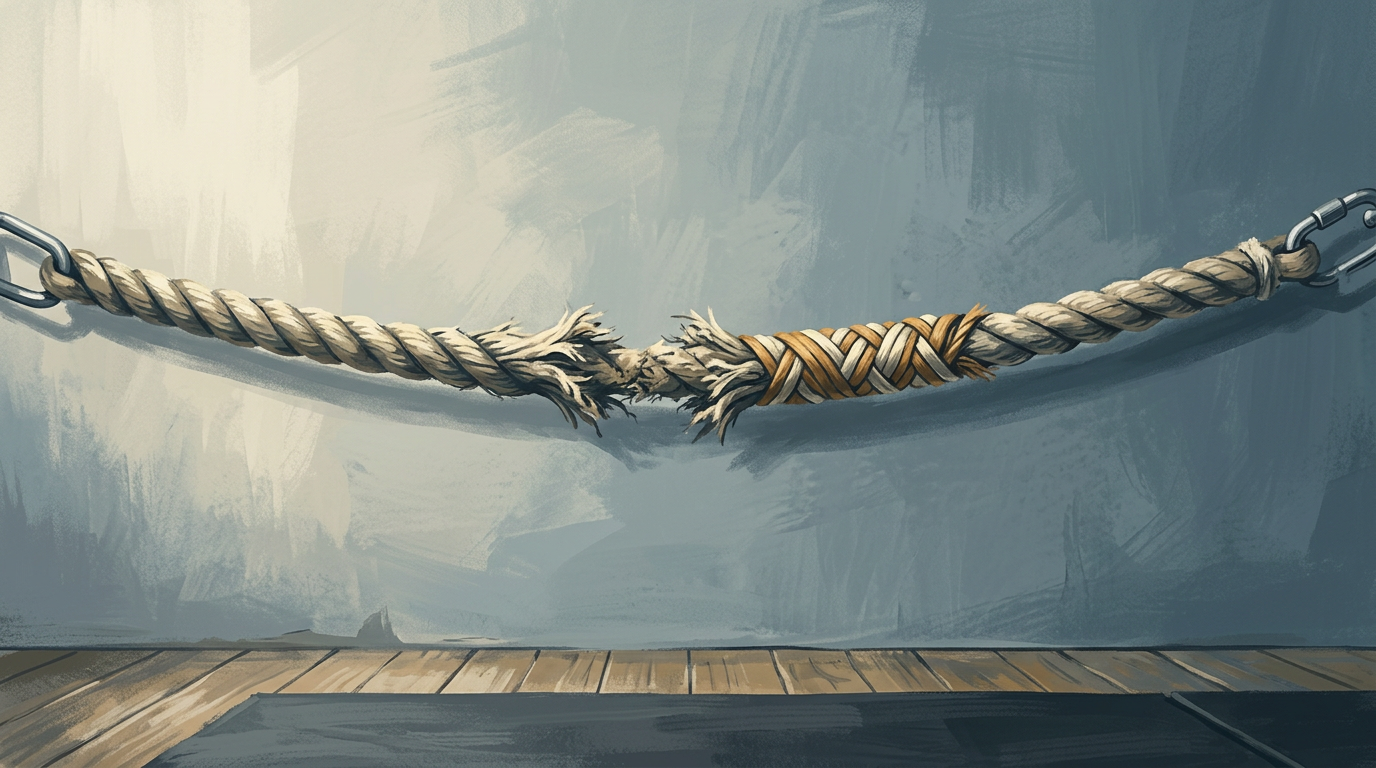
President Donald Trump has extended the ceasefire with Iran indefinitely, a move that provides a temporary reprieve from direct military escalation but leaves the underlying structural crisis unresolved. While the cessation of hostilities suggests a diplomatic cooling, the reality on the water remains fraught. Both nations continue to maintain a rigid posture over the Strait of Hormuz, one of the world's most critical maritime corridors. The blockade persists, and with it, a slow economic squeeze that neither side appears willing to relieve.
At the heart of this friction is a persistent blockade that has effectively turned the strait into a geopolitical pressure cooker. By restricting passage through this vital artery, Iran and the United States have entered a high-stakes game of attrition, testing the pain thresholds of international trade. The strait, which handles roughly a fifth of the world's oil supply, is no longer just a shipping lane — it is a lever of influence in a conflict that has shifted from kinetic threats to economic endurance.
A chokepoint with no substitute
The Strait of Hormuz has occupied a singular position in global energy security for decades. Connecting the Persian Gulf to the Gulf of Oman and the open Indian Ocean, it is the only maritime route through which oil and liquefied natural gas from Iraq, Kuwait, Qatar, the United Arab Emirates, and Iran itself can reach global markets by sea. No pipeline network or alternative corridor exists at a scale sufficient to replace it. When passage through the strait is disrupted — or even credibly threatened — the effects ripple outward through commodity markets, shipping insurance premiums, and the fiscal planning of energy-importing nations from Tokyo to Berlin.
Iran has long understood this asymmetry. Its coastline dominates the northern shore of the strait, and its naval doctrine, built around fast-attack craft, mines, and anti-ship missiles, is designed precisely for the confined waters of the Persian Gulf. Threatening or restricting transit through Hormuz has been a recurring element of Iranian strategic signaling since the 1980s, when the so-called Tanker War between Iran and Iraq demonstrated how quickly localized hostilities could metastasize into a global energy crisis. The current standoff, while different in form, draws from the same logic: the strait's geography grants Tehran leverage disproportionate to its conventional military power.
For Washington, the calculus is more layered. The United States maintains a substantial naval presence in the region, anchored by the Fifth Fleet headquarters in Bahrain. Yet projecting force through a narrow, mine-susceptible waterway against a determined adversary carries risks that extend beyond military planning into domestic politics and alliance management. An indefinite ceasefire, in this context, may function less as a diplomatic achievement and more as a holding pattern — a way to avoid escalation without conceding the strategic question.
The economics of patience
The longer the blockade endures, the more its costs distribute unevenly. Oil-importing economies in Asia and Europe face sustained upward pressure on energy costs, which feeds into inflation and constrains monetary policy flexibility. Gulf producers, meanwhile, find their primary export route constricted, reducing revenue even as global demand persists. The United States, now a major hydrocarbon producer in its own right, is somewhat insulated from supply disruption but not from the price volatility that accompanies it.
Historical precedent suggests that prolonged maritime disruptions tend to accelerate structural shifts. The Suez Canal crises of 1956 and 1967 prompted investment in supertankers and alternative routing that reshaped global shipping for a generation. Whether the current Hormuz standoff triggers analogous adaptation — expanded pipeline capacity, accelerated energy diversification, or new diplomatic architectures — depends in part on how long the blockade holds and how much economic pain accumulates before one side recalibrates.
What remains unclear is where each side's threshold lies. Iran absorbs sanctions pressure with a degree of institutional familiarity built over decades of isolation, but a prolonged blockade also restricts its own export revenue. The United States faces no existential economic threat from the disruption, yet the political costs of sustained high energy prices in an already polarized domestic environment are not trivial. The ceasefire removes the most visible risk — open conflict — but it does not resolve the underlying contest over who controls the economic tempo of the standoff.
The strait remains open as a question, even as it remains closed as a corridor.
With reporting from Dagens Nyheter.
Source · Dagens Nyheter