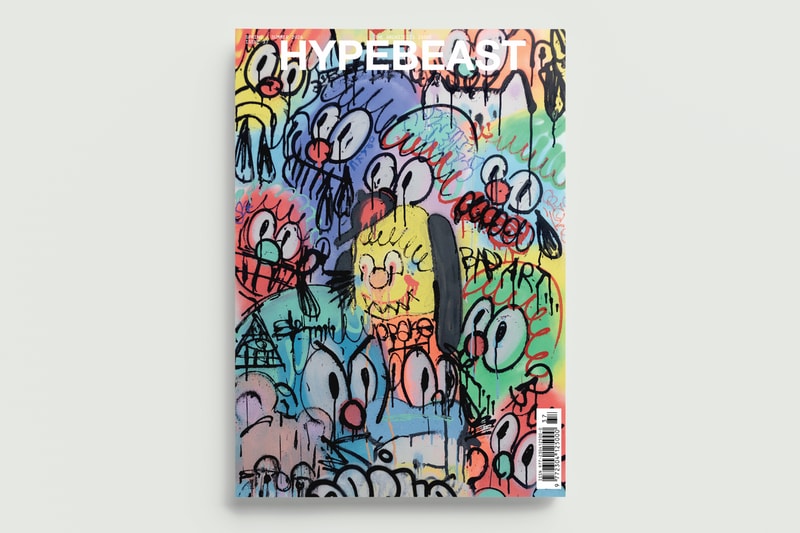
Identifying the defining figures of an era is usually a retrospective exercise, a luxury afforded only by the passage of time. Hypebeast Magazine's 37th issue, titled "The Architects," attempts something more immediate: documenting the individuals currently drafting the blueprints for contemporary culture while the ink is still wet. The premise is straightforward but ambitious — rather than waiting for history to sort signal from noise, the publication has chosen to make its selections in real time.
The issue arrives at a moment when the boundaries between art, sport, fashion, and commerce have grown difficult to locate. The figures it profiles do not fit neatly into legacy categories. They are not simply artists, athletes, or designers. They are, in the magazine's framing, architects — people who do not merely inhabit the existing cultural landscape but actively restructure it.
The Cultural Architect as a New Archetype
Leading the issue is Slawn, the artist and provocateur whose career over the past decade has traced a path far beyond the traditional gallery circuit. Slawn has applied his distinct visual language to Formula 1 cars for Red Bull and held high-profile residencies at Saatchi Yates, building what amounts to a self-contained creative ecosystem. His trajectory reflects a broader pattern in the creative economy: the emergence of figures who bypass traditional gatekeepers entirely, constructing parallel infrastructures of production, distribution, and meaning.
This model — the artist as platform, not just practitioner — has precedent. Takashi Murakami's Superflat enterprise and Virgil Abloh's cross-disciplinary career both demonstrated that creative authority could be exercised across industries simultaneously. What distinguishes the current generation is the degree to which digital infrastructure and direct audience relationships have lowered the cost of building such ecosystems. The gatekeepers have not disappeared, but their monopoly on access has eroded.
The issue's other cover star, professional skateboarder Tyshawn Jones, represents a different but complementary version of the same phenomenon. Jones has translated the raw credibility of skate culture into a multifaceted brand that spans streetwear and luxury fashion — appearing on the cover in Louis Vuitton. His career offers a working model for the athlete-mogul that differs from earlier templates. Where previous generations of crossover athletes often relied on endorsement deals structured by established brands, Jones appears to operate with greater creative agency, treating skateboarding not as a platform to be monetized by others but as a foundation for a broader commercial and cultural identity.
Beyond the Cover: Mapping a Broader Landscape
The issue extends well beyond its two headliners. It surveys creators working across disciplines that rarely share editorial space: the product design of Benjamin Paulin, the airbrush mastery of Ryota Daimon, and the wig artistry of Tomihiro Kono, among others. The editorial logic is curatorial rather than hierarchical — placing a skateboarder alongside a wig artist implies that cultural architecture is not confined to any single medium or market tier.
This approach mirrors a shift visible across media more broadly. Publications that once organized their coverage around discrete verticals — fashion, art, sport, technology — increasingly find that the most interesting work happens at the intersections. The challenge, of course, is that real-time curation carries real-time risk. Not every figure profiled in a forward-looking issue will prove to have lasting structural influence. Some blueprints get built; others get filed away.
What makes the exercise worthwhile is less the accuracy of any individual selection than the underlying argument about how cultural influence now operates. The traditional model — in which a small number of institutions conferred legitimacy on a small number of creators — has given way to something more distributed and harder to map. By attempting to map it anyway, Hypebeast Magazine is making a bet not just on specific individuals but on a particular theory of how culture gets made: from the edges inward, across disciplines, and increasingly on the architect's own terms.
Whether that theory holds — or whether the old gatekeeping structures prove more resilient than they currently appear — remains the open question.
With reporting from Hypebeast.
Source · Hypebeast