The construction industry accounts for a substantial share of global carbon emissions, driven largely by the production of concrete and steel. At the same time, a persistent housing shortage across much of the world demands faster, cheaper building methods. These two pressures — environmental accountability and the need for scale — have historically pulled in opposite directions. A research team at MIT is now testing whether recycled plastic, one of the most abundant waste streams on the planet, can help reconcile them.
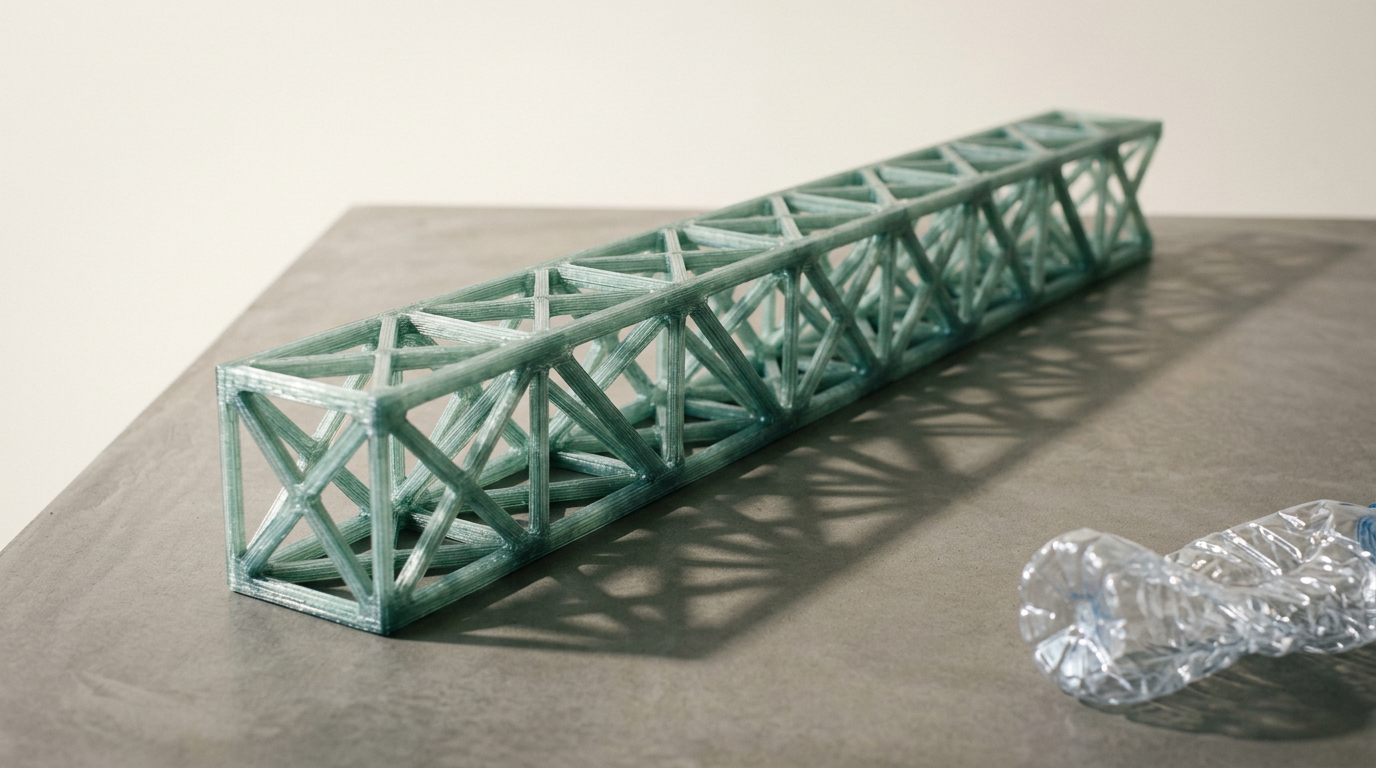
Led by Professor David Hardt and research scientist AJ Perez, the group has developed a process for 3D-printing load-bearing trusses from recycled PET polymers reinforced with glass fibers. PET — polyethylene terephthalate — is the polymer found in most single-use beverage bottles and food packaging, and it is among the most widely collected recyclable plastics. In laboratory tests, the printed trusses were integrated into a standard plywood-topped floor frame and demonstrated a load-bearing capacity exceeding 4,000 pounds, comfortably surpassing the thresholds required for residential construction.
From Waste Stream to Structural Member
The idea of using additive manufacturing in construction is not new. Over the past decade, several companies and research groups have experimented with 3D-printing walls and facades, typically using concrete or clay-based mixtures. Those efforts address the envelope of a building — its outer shell — but often rely on materials whose production is itself carbon-intensive. Concrete alone is responsible for roughly eight percent of global CO₂ emissions, a figure that has made it a recurring target for decarbonization efforts.
The MIT approach differs in focus. Rather than printing walls, the team targets the structural skeleton: the beams, joists, and trusses that form the internal framework of a building. In conventional residential construction, this skeleton is almost always made of dimensional lumber. The printed trusses replicate the diagonal, ladder-like geometry of traditional wooden floor supports, a design optimized over centuries for distributing loads efficiently. By substituting recycled PET for timber, the project sidesteps both the carbon cost of concrete printing and the growing tension between housing demand and forest conservation.
Glass fiber reinforcement is central to the material's performance. Unreinforced PET, while durable in packaging applications, lacks the stiffness and tensile strength required for structural use. The addition of glass fibers — a technique borrowed from the composites industry — transforms the polymer into a material that can rival wood in load-bearing applications. The fabrication process uses a room-sized 3D printer capable of producing trusses at a scale relevant to actual construction, not merely laboratory demonstration.
Obstacles Between Lab and Jobsite
Promising test results do not, on their own, constitute a building material. Several significant hurdles stand between the MIT lab and a construction site. Building codes in most jurisdictions are written around well-characterized materials — wood, steel, concrete, masonry — and the certification process for a novel structural polymer would be lengthy. Regulators would need data not just on static load capacity but on long-term creep behavior, fire resistance, UV degradation, and performance under dynamic loads such as wind and seismic forces. PET, like most thermoplastics, softens at elevated temperatures, a property that raises obvious questions about fire safety without additional treatment or encapsulation.
There is also the question of feedstock reliability. Recycled PET varies in quality depending on its source and processing history. Structural applications demand consistent material properties batch to batch — a standard that the current recycling infrastructure, designed primarily to serve packaging markets, may not easily meet at scale.
Still, the underlying logic is difficult to dismiss. The world produces hundreds of millions of tons of plastic waste annually, much of which is landfilled or incinerated. Converting even a fraction of that stream into construction-grade material would simultaneously address a disposal problem and reduce demand for virgin timber and carbon-intensive alternatives. Whether the engineering can clear the regulatory and industrial barriers remains the open question — one that will likely depend as much on policy frameworks and market incentives as on the material science itself.
With reporting from MIT Technology Review.
Source · MIT Technology Review