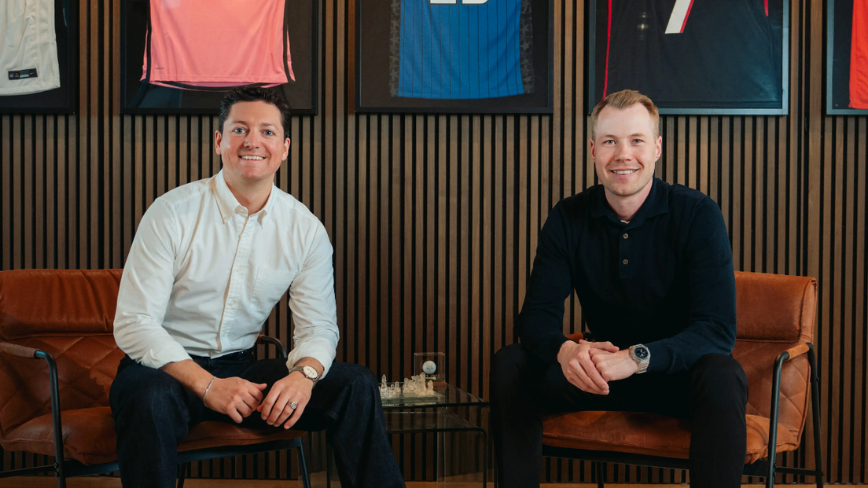
VisioLab, a startup based in Osnabrück, Germany, has raised $11 million in a Series A round to scale its computer-vision-based checkout systems. The round, led by eCAPITAL and Simon Capital, will fund the company's expansion beyond its current footprint, which already spans roughly a third of Germany's university campuses and the Orlando Magic's NBA arena in Florida. The technology uses an iPad-based setup to identify food and beverage items in under ten seconds — no barcodes, no manual entry, no overhead sensor arrays.
The funding arrives at a moment when the retail and food-service industries are actively sorting through the wreckage of earlier, more ambitious attempts at checkout-free commerce. Amazon's "Just Walk Out" technology, which relied on dense networks of ceiling-mounted cameras and shelf sensors, was quietly scaled back from several Amazon Fresh locations in 2024 after years of operational complexity and reported reliance on human reviewers to verify transactions. The lesson was not that computer vision fails at retail — it was that the infrastructure required to make it work across an entire store floor remains prohibitively complex for most operators.
A narrower problem, a simpler stack
VisioLab's approach sidesteps much of that complexity by constraining the problem. Rather than tracking every customer movement through a full retail environment, the system focuses on a single moment: the point at which a tray of food is placed on a surface. The camera identifies the items, calculates the total, and presents it for payment. The hardware footprint is minimal — an iPad and a camera module — which makes it easier to retrofit into existing cafeteria lines and concession counters without significant construction or integration work.
This narrower scope is well suited to the environments where VisioLab operates. University canteens and stadium concession stands share a common operational pressure: high volume concentrated in short windows of time. A campus dining hall may serve thousands of meals within a ninety-minute lunch period. An arena concession stand faces similar surges during halftime. In both cases, the bottleneck is rarely the kitchen — it is the register. Any system that shaves even a few seconds per transaction can meaningfully increase throughput across a rush period.
The challenge, however, is accuracy. Food is among the most visually variable product categories a recognition system can encounter. A portion of pasta looks different depending on the serving, the lighting, the plate, and the angle. Sauces overlap. Side dishes cluster. Training models to handle this variability at production-grade accuracy requires substantial and continuously updated datasets, particularly as menus rotate — a daily occurrence in most institutional food-service settings.
The economics of the invisible register
The broader market context for VisioLab's raise is the steady compression of labor availability in food service and hospitality across both Europe and the United States. Operators in these sectors have faced persistent staffing shortages since the pandemic, and wage floors have risen in many jurisdictions. Automation at the checkout counter is not merely a convenience play — it is increasingly a cost-management strategy. A system that allows one attendant to oversee multiple checkout points, rather than staffing each register individually, changes the labor math for high-volume venues.
There is also a data dimension. Every transaction processed through a vision-based system generates structured information about what customers are selecting, in what combinations, and at what times. For institutional food-service operators — particularly those managing large campus dining programs — this data can inform procurement, reduce waste, and optimize menu planning in ways that manual checkout systems never could.
The tension VisioLab will need to navigate as it scales is the one that has tripped up nearly every checkout automation company before it: the gap between controlled-environment performance and messy real-world deployment. A system that works reliably in a well-lit German university cafeteria with a fixed menu may behave differently in a dimly lit arena concession stand serving dozens of items under time pressure. Whether the company's constrained, hardware-light approach proves robust enough to hold accuracy across a wider range of venues — or whether it encounters the same friction it promises to eliminate — will determine whether this $11 million round marks the beginning of a broader rollout or the peak of a niche deployment.
With reporting from The Next Web.
Source · The Next Web