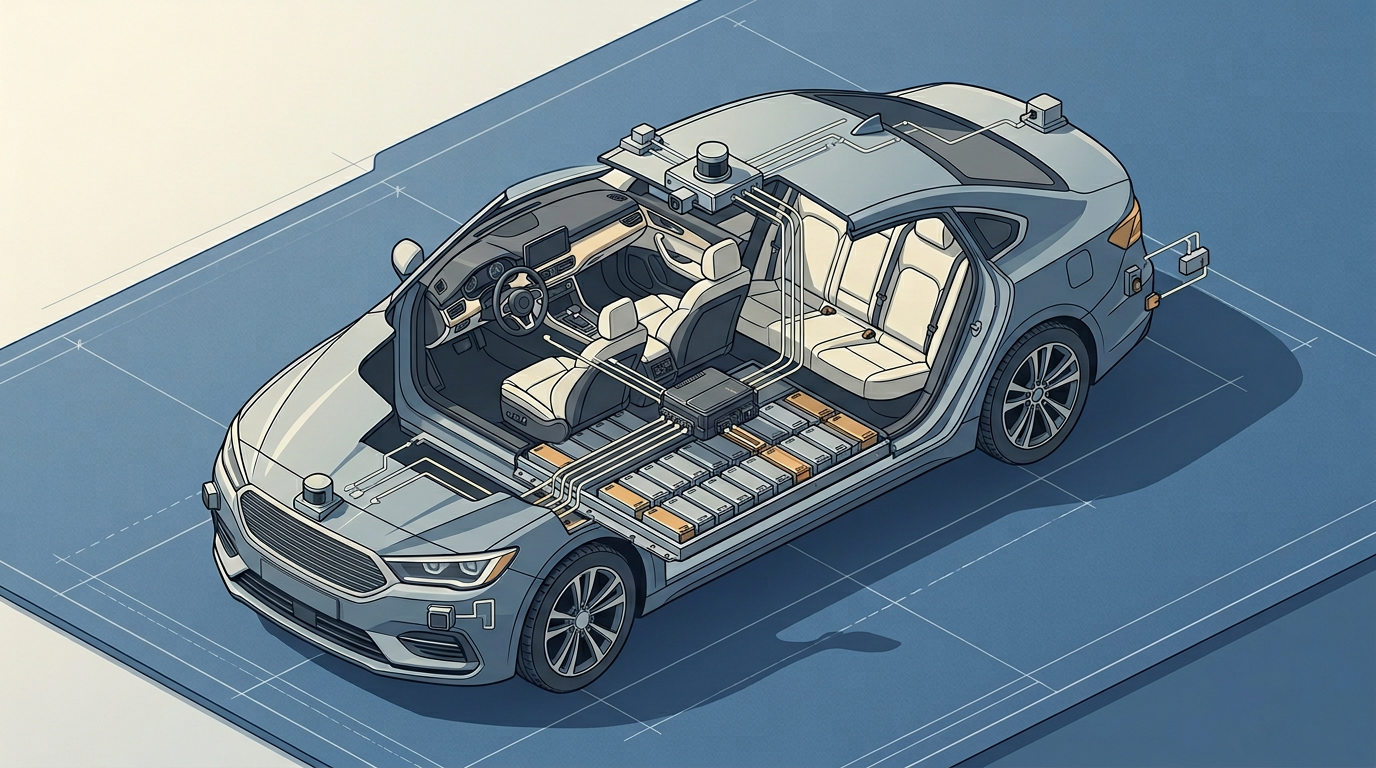
Volkswagen is facing a quiet reckoning in China. Once a dominant force in the world's largest automotive market — where it sold more vehicles than in any other single country for decades — the German automaker now finds itself trailing domestic manufacturers who have redefined the car as a high-tech mobile platform. To bridge this widening gap, Volkswagen announced at a pre-Beijing Auto Show event that it will begin deploying "onboard AI agents" in its China-market vehicles starting in the second half of this year.
These agents represent a step change from the standard voice-activated assistants that have become commonplace in modern dashboards. Built on a China-exclusive electronic architecture, the system is designed for "highly intuitive and human-like interaction." Unlike basic assistants that respond to discrete queries, these AI agents are intended to manage complex decision-making and logistical tasks — securing dinner reservations, coordinating parking arrangements, or handling multi-step errands autonomously.
The competitive logic behind localization
The strategic context is difficult to overstate. Chinese automakers such as BYD, NIO, and Xpeng have spent years building vehicles around software-first architectures, treating infotainment, autonomy, and connectivity not as add-ons but as core product differentiators. Their pace of iteration — often measured in months rather than the multi-year cycles traditional in Detroit or Wolfsburg — has reshaped consumer expectations. Chinese car buyers, particularly younger demographics in tier-one cities, increasingly evaluate vehicles on the sophistication of their digital ecosystems as much as on powertrain or build quality.
For legacy automakers, this shift has been punishing. The playbook that sustained Volkswagen's dominance in China for the better part of three decades — reliable engineering, brand prestige, extensive dealer networks — has lost much of its edge against competitors who ship over-the-air updates and integrate popular Chinese super-apps directly into their dashboards. Volkswagen's decision to build on a China-exclusive architecture, rather than adapting a global platform, signals an acknowledgment that the Chinese market now demands bespoke digital solutions. A single global software stack, however efficient from a cost perspective, cannot keep pace with local competitors building specifically for Chinese digital habits and infrastructure.
The choice of AI agents — rather than incremental improvements to an existing voice assistant — also reflects a broader industry bet. The concept of an agentic AI, one capable of chaining together multiple actions to accomplish a goal without step-by-step user instruction, has gained traction across sectors from enterprise software to consumer electronics. Applying it to the vehicle cabin is a logical extension: a car occupant stuck in traffic should, in theory, be able to delegate a sequence of tasks — find a restaurant, book a table, reroute navigation, notify a contact — through a single conversational exchange.
Data, trust, and the road ahead
Vehicle-embedded AI of this kind, however, raises a familiar tension. The more capable the agent, the more personal data it must ingest: location history, contact lists, payment credentials, behavioral patterns. Volkswagen emphasized that the system would feature "robust protection of personal data," a claim that will face scrutiny in a regulatory environment where China's Personal Information Protection Law (PIPL) imposes strict requirements on data handling and cross-border transfers. For a foreign automaker operating on Chinese soil, demonstrating compliance is not merely a legal obligation but a competitive necessity — domestic rivals can more easily position themselves as aligned with local data governance norms.
Whether AI agents in the cabin prove to be a genuine differentiator or a feature that sounds better in a press conference than in daily use remains an open question. The gap between demo-ready AI and production-grade reliability is well documented across industries. Volkswagen's challenge is twofold: the technology must work well enough to justify the marketing promise, and it must arrive fast enough to matter in a market where the competitive window is measured in quarters, not years. The forces pulling in opposite directions — the need for speed against the imperative of reliability, the ambition of localization against the economics of global scale — will determine whether this bet marks a genuine inflection point or another chapter in a long retreat.
With reporting from Olhar Digital.
Source · Olhar Digital