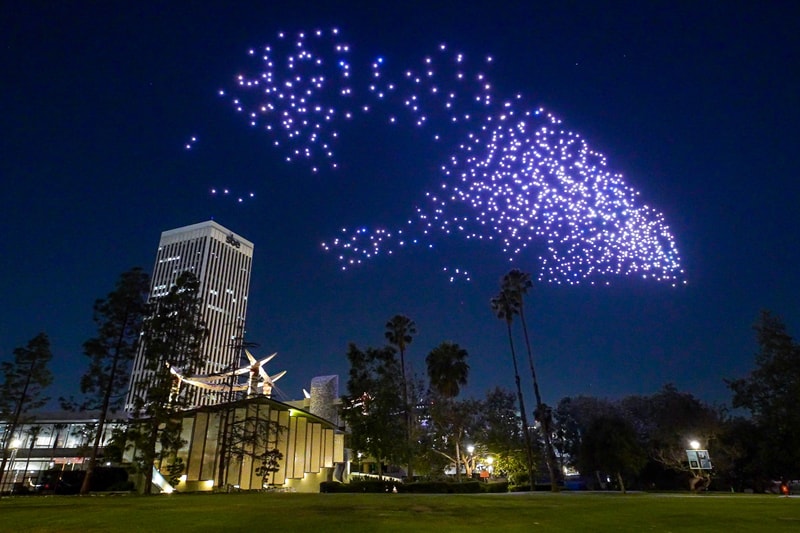
To celebrate the completion of the Los Angeles County Museum of Art's (LACMA) $742 million David Geffen Galleries, the museum looked upward. As the gala for the Peter Zumthor-designed building concluded, the Amsterdam-based studio DRIFT staged "Franchise Freedom," an aerial performance involving 1,000 drones that transformed the Wilshire Boulevard skyline into a canvas of kinetic light. The piece, which has become something of a signature for the Dutch art duo, arrived at a moment calibrated for maximum symbolic resonance — a new building, a new chapter for one of the largest art museums in the western United States, and an opening act that existed only in the air above it.
The performance is the result of two decades of research into starling murmurations — the complex, undulating patterns formed by bird swarms in which each individual responds only to the handful of neighbors nearest to it, yet the collective produces movement of striking coherence. By translating these biological rhythms into algorithmic flight paths, DRIFT creates a tension between the rigid capabilities of hardware and the organic unpredictability of the natural world. The drones do not move in the synchronized, grid-like fashion typical of commercial light shows; instead, they pulse and drift with a collective intelligence that mimics biological logic.
Art at the Scale of Infrastructure
Founded by Lonneke Gordijn and Ralph Nauta in 2007, DRIFT has long occupied the intersection of technology and environmental philosophy. Since "Franchise Freedom" first debuted at Art Basel Miami Beach in 2017, the studio has used the medium to challenge the boundary between the synthetic and the sentient. The work belongs to a broader lineage of land art and environmental installation — practices that treat landscape, sky, and atmosphere as exhibition space rather than backdrop. Artists such as James Turrell and Robert Irwin, both of whom have deep ties to the Southern California art world, pioneered the idea that perception itself could be the subject of a work. DRIFT extends that tradition into programmable airspace.
What distinguishes "Franchise Freedom" from the growing universe of commercial drone spectacles — now commonplace at product launches, sporting events, and national celebrations — is the underlying logic. Commercial shows typically rely on precise coordinate mapping: each drone occupies a fixed point in a predetermined image. DRIFT's system instead encodes behavioral rules, allowing each unit a degree of autonomy within a shared set of constraints. The result is emergence rather than choreography in the strict sense, and the visual difference is immediately legible. Where commercial formations feel mechanical, DRIFT's swarms feel alive.
Above the museum's new 110,000-square-foot concrete expanse, the display served as a meditative counterpoint to the permanence of architecture, suggesting that our most advanced systems are often just echoes of older, natural patterns. Zumthor's building — a horizontal, tar-colored structure that replaces several older LACMA pavilions — is itself a statement about weight, materiality, and duration. Placing an ephemeral, airborne work above it sharpened the contrast: stone against sky, permanence against disappearance.
The Drone as Cultural Medium
The broader question raised by performances like "Franchise Freedom" concerns the status of the drone as an artistic medium. Drones carry heavy connotations — military surveillance, commercial delivery logistics, regulatory battles over urban airspace. When repurposed for art, those associations do not vanish; they become part of the work's texture. A swarm that behaves like a flock of birds is also, inescapably, a swarm of machines capable of other tasks entirely. DRIFT's achievement is to hold both readings in suspension without resolving the tension.
As drone technology becomes cheaper and more capable, the gap between spectacle and art will likely become a site of increasing contestation. Museums, biennials, and public art commissions will face recurring decisions about what separates a meaningful use of the medium from a decorative one. DRIFT's long investment in biological modeling offers one answer — rooting the technology in a research question rather than a visual effect — but it is not the only possible framework.
For LACMA, the choice to inaugurate its most significant architectural project in decades with a work that vanished minutes after it began says something about institutional ambition. The building will remain on Wilshire Boulevard for generations. The drones are already gone. Which of the two lingers longer in memory is not a settled matter.
With reporting from Hypebeast.
Source · Hypebeast