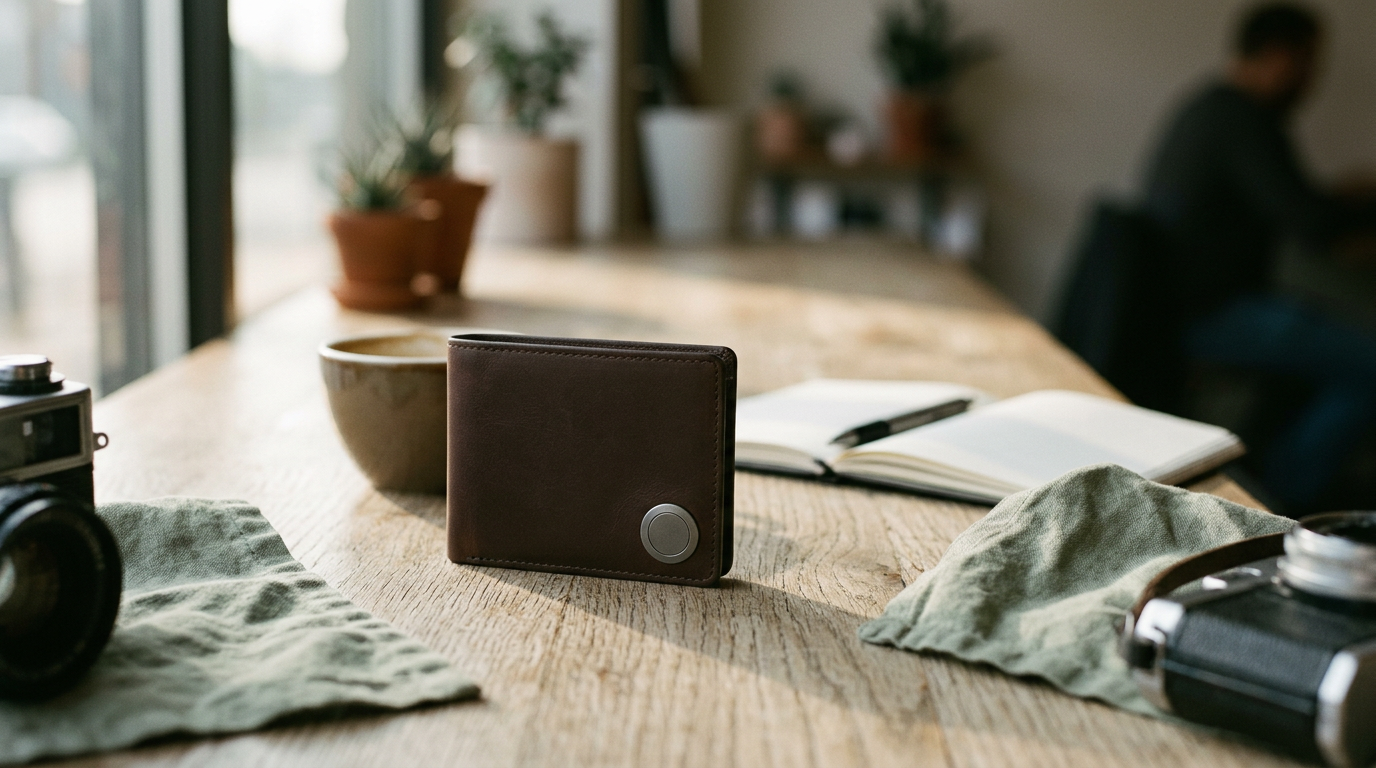
The ecosystem of findable objects has moved well beyond the standalone Bluetooth dongle. Since Apple launched its Find My network and Google followed with Find My Device, the infrastructure for locating misplaced belongings has become ambient — embedded in hundreds of millions of smartphones worldwide. The competitive frontier is no longer the tracker itself but how seamlessly it disappears into the objects people already carry. A new collaboration between Chipolo, the Slovenian tracking specialist, and Secrid, the Dutch wallet manufacturer known for its aluminum card-protector design, marks a deliberate step in that direction. The Chipolo x Secrid Miniwallet Trackable integrates a thin, rechargeable tracker directly into the wallet's frame, treating location technology as a core design feature rather than an aftermarket add-on.
The product arrives at a moment when the broader tracker market is consolidating around two dominant networks. Apple's Find My and Google's Find My Device together cover virtually every modern smartphone, giving any compatible accessory a detection mesh that spans most populated areas on Earth. For hardware makers like Chipolo, which has long competed against Apple's own AirTag and Samsung's SmartTag, the strategic logic is clear: differentiate not on network reach — which is largely a platform-level commodity — but on form factor, integration quality, and user experience.
Engineering Around the Constraints of Previous Smart Wallets
Earlier attempts to build tracking into wallets typically involved sliding a card-shaped Bluetooth beacon into an existing slot. The results were functional but compromised. Audio alerts were muffled by layers of leather and cards, battery replacement was awkward, and the tracker often felt like an intrusion on the wallet's primary purpose. The Chipolo x Secrid collaboration appears designed to address each of these friction points at the architectural level.
The wallet's structure is engineered to amplify the tracker's speaker by three decibels — a meaningful gain when the goal is to hear a ping from inside a bag or between couch cushions. The tracker's "Find" button sits on the wallet's exterior, enabling reverse-paging: a user can press the button to ring a misplaced smartphone, a feature that inverts the typical tracker relationship and adds practical value for everyday use. These are not radical innovations individually, but together they suggest a product where the tracking function was considered from the first sketch rather than bolted on at the end.
The choice of Qi-standard wireless charging, with a full charge reached in roughly two hours, eliminates the disposable-battery cycle that has defined most consumer trackers since Tile popularized the category a decade ago. For a device meant to live inside a wallet carried daily, the ability to recharge rather than replace aligns the product's lifecycle with the durable goods it aspires to be.
Durable Goods as an IoT Strategy
At a price point of $140, the Miniwallet Trackable sits firmly in the premium accessories market — well above both a standard Secrid wallet and a standalone Chipolo tracker purchased separately. The pricing signals a bet that a segment of consumers will pay a meaningful premium for integration, sustainability credentials, and build quality over the cheapest functional option.
The sustainability angle is worth noting in context. The tracker is constructed from 50 percent recycled plastic and manufactured in the European Union from responsibly sourced materials. As the European Union tightens regulations around electronic waste and product repairability — the EU's Ecodesign for Sustainable Products Regulation being the most prominent example — building rechargeable, longer-lasting electronics into durable physical goods may prove to be not just a marketing advantage but a regulatory necessity.
The broader question the product raises is whether the Internet of Things will ultimately express itself through dedicated gadgets or through the quiet integration of connectivity into objects that already occupy pockets, wrists, and bags. The tracker dongle attached by a keyring solved an early problem. The next phase appears to involve making the tracker invisible — present in function, absent in form. Whether consumers will consistently pay the premium that such integration demands, or whether standalone trackers will remain the default for most buyers, is a tension the market has yet to resolve.
With reporting from Engadget.
Source · Engadget