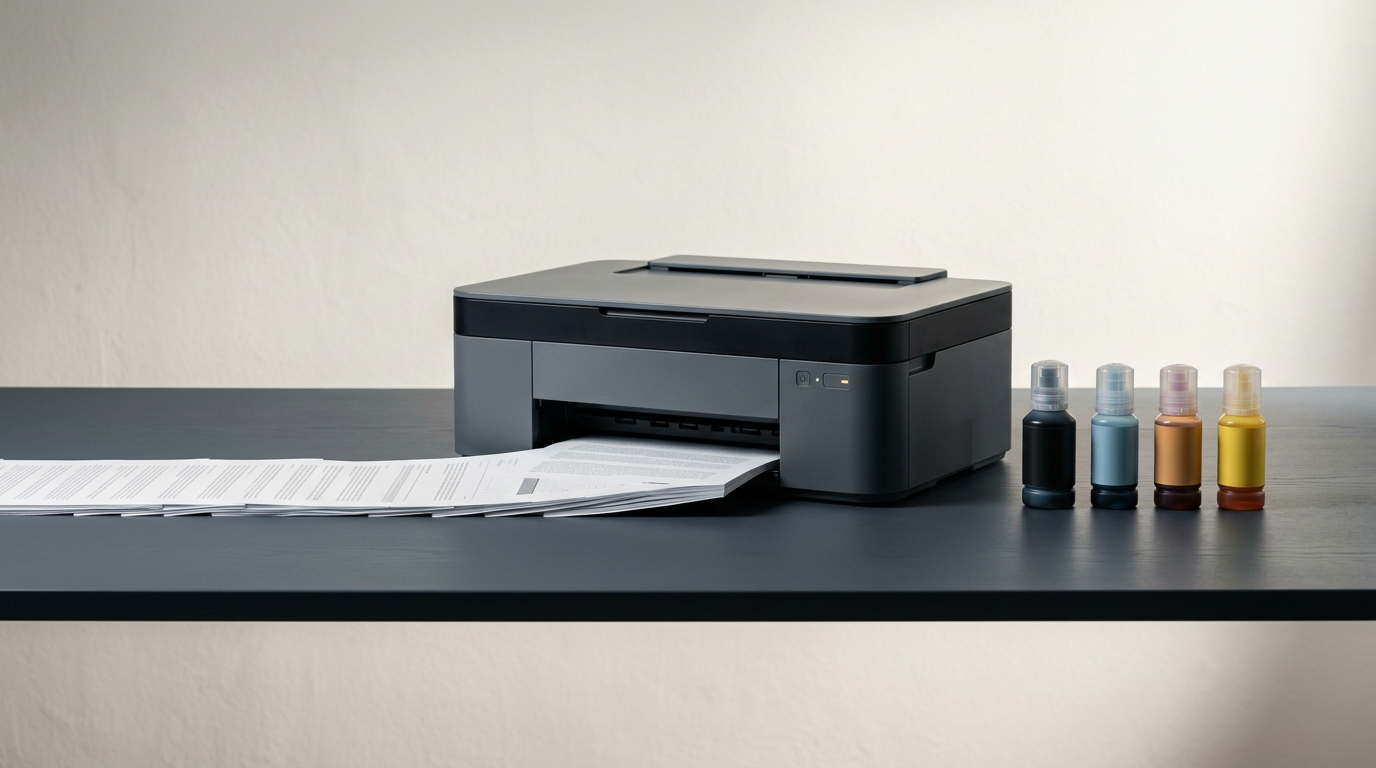
The domestic printer, long the most temperamental inhabitant of the home office, is undergoing a quiet shift in both its economic and functional design. For years, the industry relied on a "razor-and-blades" model — affordable hardware paired with expensive, low-capacity cartridges that generated recurring revenue for manufacturers at the consumer's expense. That model, while durable, has begun to erode. A new cohort of machines, led by Epson's EcoTank and HP's Smart Tank series, suggests a pivot toward higher-volume, refillable systems that prioritize a lower cost-per-page over the life of the device.
Models like the Epson EcoTank L3250 and the HP Smart Tank 581 series represent this move toward what might be called industrial efficiency scaled for the household. By replacing disposable cartridges with integrated ink reservoirs, these devices cater to the sustained demands of hybrid work and home-based education — two forces that accelerated sharply during the pandemic years and have shown little sign of fully retreating.
The economics of the ink tank
The razor-and-blades pricing strategy has a long lineage in consumer hardware. Gillette popularized it in personal grooming; Keurig adapted it for coffee pods; and printer manufacturers refined it into one of the most reliable margin engines in consumer electronics. The logic was straightforward: sell the printer at or near cost, then recoup profits through a steady stream of proprietary cartridge purchases. For the manufacturer, the model created predictable, high-margin aftermarket revenue. For the consumer, it produced a familiar frustration — the realization that a set of replacement cartridges could approach or exceed the cost of the printer itself.
The ink tank model inverts this equation. The initial hardware price is typically higher, but the ink supplied at purchase is designed to last for thousands of pages rather than hundreds. The refill bottles themselves are substantially cheaper than cartridge equivalents. The design philosophy is one of longevity: the upfront investment is offset by reduced maintenance friction and a meaningfully lower per-page cost over time.
This shift did not emerge in a vacuum. The rise of remote and hybrid work arrangements created a class of home users whose printing volumes more closely resemble those of a small office than a casual household. For someone printing school assignments, tax documents, and work reports on a regular basis, the economics of cartridge replacement become untenable quickly. The ink tank addresses this by aligning the printer's cost structure with actual usage patterns rather than with the manufacturer's aftermarket revenue goals.
Connectivity as baseline infrastructure
Beyond the ink delivery system, the current landscape of printing technology is defined by its quiet disappearance into the home network. Wireless integration is no longer a premium feature but a baseline requirement. Devices such as the HP DeskJet Ink Advantage 2975 and the various Smart Tank iterations utilize Wi-Fi Direct and dedicated mobile applications to bypass the traditional router, allowing for a seamless handoff between smartphones and physical paper.
This reflects a broader pattern in consumer hardware: the most successful devices are those that reduce the cognitive overhead of their own operation. A printer that requires a USB cable, a driver installation, and a desktop computer to function is a printer that belongs to a previous era. The expectation now is that a document on a phone screen can become a document on paper with minimal intermediary steps. In the modern workspace, the printer is less a peripheral and more a quiet, connected utility — one that functions best when it demands the least attention.
What remains to be seen is whether the ink tank model represents a stable new equilibrium or a transitional phase. Manufacturers built substantial businesses around cartridge revenue, and the shift toward refillable systems necessarily compresses those margins. Whether the industry compensates through higher hardware prices, subscription-based ink delivery services, or some other mechanism will shape the next chapter of this market. The consumer, meanwhile, is voting with purchasing decisions — and the direction of that vote appears, for now, to favor economy over convenience theater.
With reporting from Olhar Digital.
Source · Olhar Digital