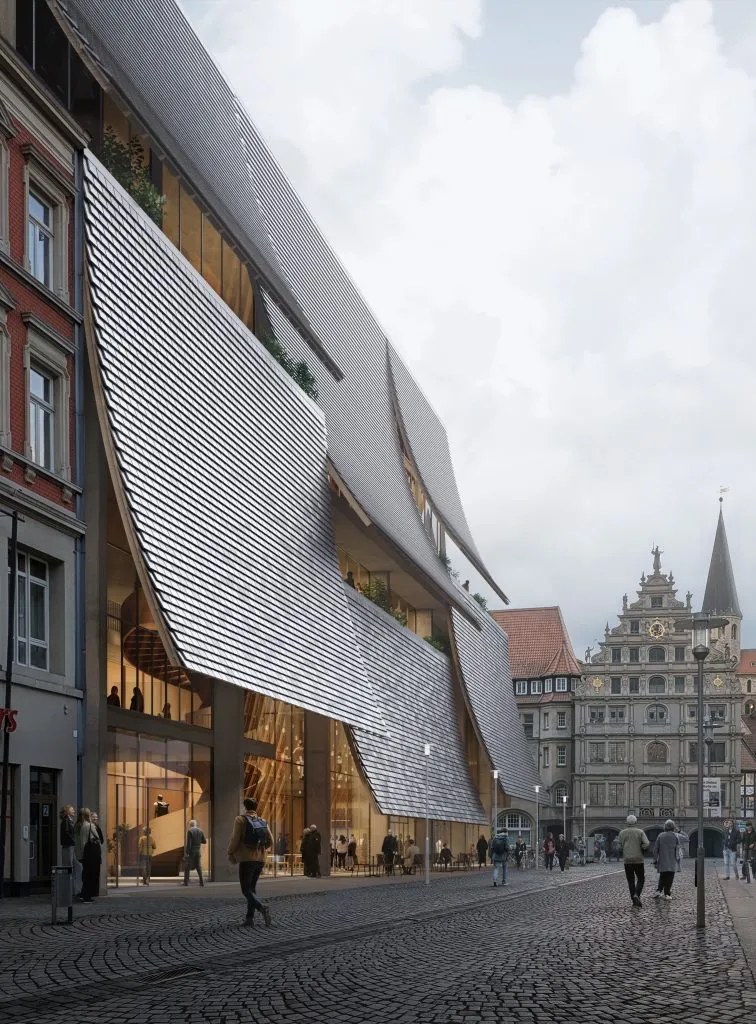
The Architectural Review has named ADEPT's Haus der Musik, a concert and cultural venue planned for Braunschweig, Germany, as the overall winner of the 2026 AR Future Projects Awards. The annual program, now in its second decade, recognizes excellence in unbuilt architectural design — projects that exist on paper or in renders but have not yet broken ground or reached completion. Two additional projects, located in Canada and India, received high commendations from the jury.
The award positions ADEPT, a Copenhagen-founded studio known for civic and cultural buildings across Northern Europe, at the center of a broader conversation about how new performance spaces are conceived in mid-sized cities. Braunschweig, a city of roughly 250,000 in Lower Saxony, is not typically associated with marquee architectural commissions, which makes the selection noteworthy in itself.
What the AR Future Projects Awards Signal
The AR Future Projects Awards occupy a particular niche in architecture's ecosystem of recognition. Unlike the Pritzker Prize or the RIBA Stirling Prize, which honor completed buildings or lifetime achievement, the Future Projects program evaluates design intent before construction delivers its verdict. That distinction matters. It foregrounds architectural ambition at the stage where it is most legible — before budgets are cut, materials substituted, or programs revised by clients mid-stream.
The program typically draws entries across categories such as civic, residential, cultural, and infrastructure, with a jury selecting category winners and one overall recipient. By spotlighting unbuilt work, the awards also function as a barometer of where the profession's energy is directed. In recent cycles, cultural buildings, adaptive reuse schemes, and climate-responsive housing have featured prominently among winners and commendations, reflecting shifting priorities in practice and pedagogy alike.
ADEPT's selection continues a pattern in which the overall prize gravitates toward public or cultural programs — buildings intended to serve broad constituencies rather than private clients. The firm's portfolio includes projects such as the Västerås Travel Center in Sweden and urban master plans in Scandinavia, work that tends to emphasize legibility of public space and restrained material palettes. Haus der Musik appears to extend that sensibility into the domain of performance architecture, a building type that carries its own set of acoustic, programmatic, and civic demands.
The Broader Stakes of Cultural Building Design
Designing a house of music in a European city of moderate scale invites comparison with a generation of cultural venues that reshaped their host cities' identities — from the Elbphilharmonie in Hamburg to Snøhetta's Oslo Opera House. Those projects, however, arrived with budgets and political profiles that mid-sized cities rarely command. The more relevant precedents may be smaller-scale cultural buildings that succeed not through spectacle but through careful integration with existing urban fabric: venues that become part of daily civic life rather than destination landmarks.
The challenge for any unbuilt project honored at this stage is execution. The history of architecture awards for unrealized designs includes schemes that were never built, projects that changed substantially during construction, and a smaller number that emerged largely as envisioned. The gap between design recognition and built reality is not a flaw in the awards' premise — it is the premise. The program asks whether a design idea has merit on its own terms, independent of whether delivery will preserve it.
That the jury also commended projects in Canada and India underscores the geographic breadth the program seeks. Architecture's major awards circuits have long been criticized for concentrating attention on a narrow band of Western European and North American practices. A shortlist that spans three continents, even modestly, gestures toward a wider lens.
Whether Haus der Musik will ultimately reshape Braunschweig's cultural infrastructure or join the long list of awarded designs that stall in development remains an open question. What the award does confirm is that the architectural conversation around civic music spaces — how they are funded, how they relate to their cities, and what they owe to publics beyond concert-goers — continues to command serious design attention. The tension between ambition at the drawing board and reality at the construction site is one the profession has never fully resolved, and one worth watching as this project moves toward its next phase.
With reporting from Architectural Review.
Source · Architectural Review