For years, the New York City Museum of Contemporary Art (NYC MOCA) existed primarily as a provocation — a "museum" with no permanent collection, no endowment, and no physical address. Conceived by artist Adam Himebauch in 2022 as part of a year-long performance titled "Back to the Future," the institution functioned as a critique of the gatekeeping and manufactured prestige that define the high-art world. By adopting the nomenclature and aesthetic authority of a major cultural pillar, Himebauch invited audiences to question what, exactly, makes an institution "real."
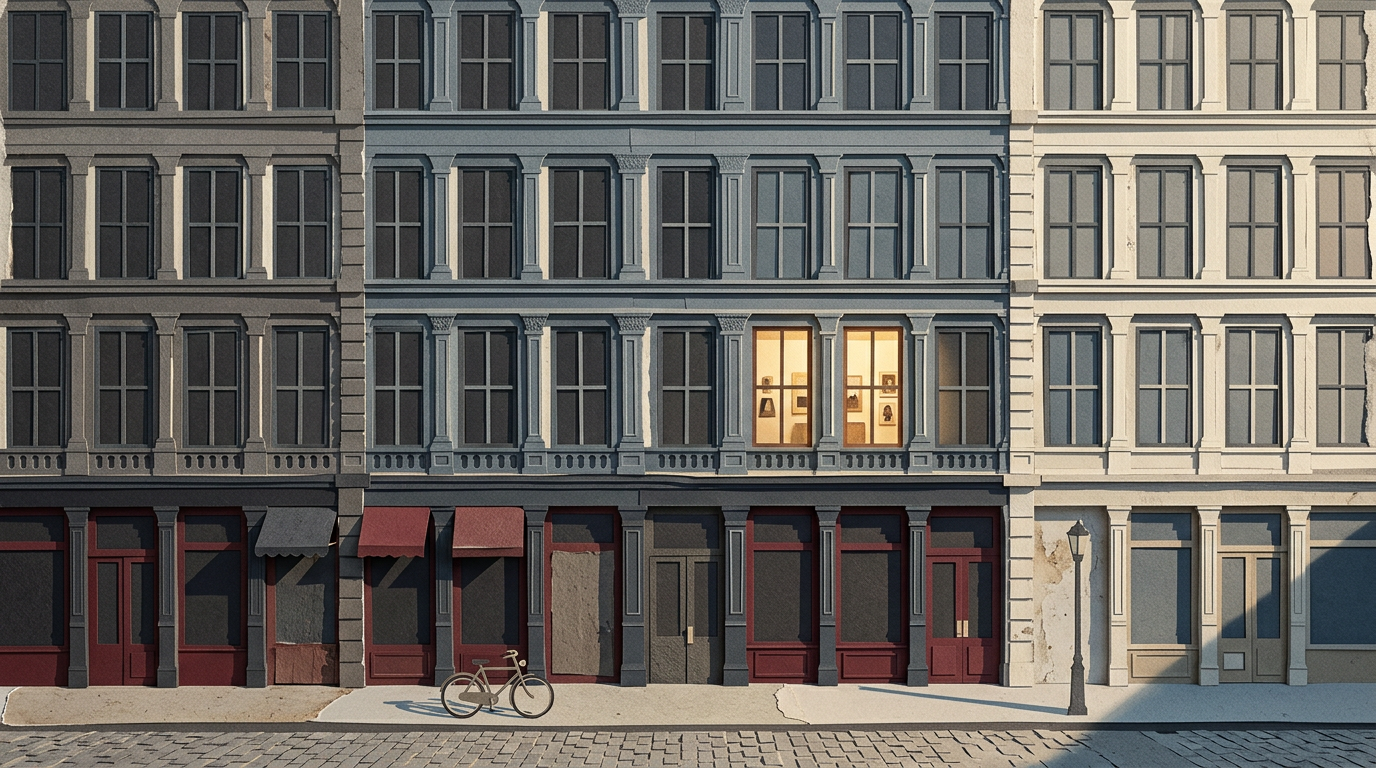
Now, that question is acquiring a concrete dimension. NYC MOCA is opening its first permanent location — a window gallery at 79 Walker Street in Tribeca. The space debuts on April 23 with "Is This Yours," an exhibition by Olivia Gossett Cooper, signaling that while the museum's origins may be satirical, its role as a platform for emerging artists is becoming increasingly tangible.
From fabrication to fixture
Himebauch's practice has long toyed with the malleability of history. In previous works, he doctored archival footage to insert himself into the 1960s and 70s art scenes, effectively retrofitting his own legacy. NYC MOCA was a natural extension of this impulse: a fabrication that relied on the collective participation of an audience willing to treat a conceptual project as a legitimate entity. It was an open secret that the museum was a performance, yet its presence in the cultural conversation suggested that the trappings of institutionalism are often as much about perception as they are about infrastructure.
The move into Tribeca — one of Manhattan's premier gallery districts, home to established commercial spaces and a neighborhood whose cultural identity was reshaped by decades of artist migration and subsequent real-estate escalation — places NYC MOCA in proximity to the very ecosystem it was designed to interrogate. A window gallery is, by definition, modest: it collapses the boundary between exhibition and street, offering art to passersby without the ritual of entry, admission, or institutional mediation. In that sense, the format is consistent with Himebauch's project. The institution remains porous, its walls literally transparent.
There is a long lineage of artists who have created fictitious or semi-fictitious institutions as a way of exposing the mechanics of cultural authority. Marcel Broodthaers's Musée d'Art Moderne, Département des Aigles, founded in 1968, operated for four years as a conceptual museum that questioned the classificatory power of the institution itself. More recently, projects like the Museum of Non-Visible Art have tested how far audiences will extend belief when the scaffolding of legitimacy — a name, a press release, a location — is in place. NYC MOCA sits within this tradition, but its trajectory is unusual: most institutional fictions remain fictions. Few acquire leases.
The paradox of becoming real
The transition from performance to physical space introduces a productive tension. A critique of institutional prestige derives much of its force from operating outside institutional structures. The moment NYC MOCA occupies a gallery in Tribeca, programs exhibitions, and platforms artists like Olivia Gossett Cooper, it begins to function as the thing it once parodied. Whether that constitutes a contradiction or a deepening of the original argument depends on how the project evolves — and on whether the art world treats it as a curiosity or a peer.
The scale remains modest compared to the giants of Museum Mile. There is no board of trustees, no gala circuit, no permanent collection to anchor a canonical narrative. But the contemporary art world has, over the past two decades, increasingly blurred the line between alternative spaces, commercial galleries, and institutions proper. Project spaces and artist-run initiatives have launched careers and shaped discourse with resources that would have seemed insufficient a generation ago. NYC MOCA may be arriving at a moment when the distance between a fabricated institution and an emerging one is narrower than it has ever been.
What remains open is whether the project's critical edge survives its own materialization. A provocation that becomes permanent risks domestication — absorbed into the landscape it once disrupted. Alternatively, a physical presence could sharpen the question Himebauch originally posed, offering a standing reminder that the authority of any institution is, in the end, a collective agreement. The gallery at 79 Walker Street will test which of those forces proves stronger.
With reporting from Hypebeast.
Source · Hypebeast