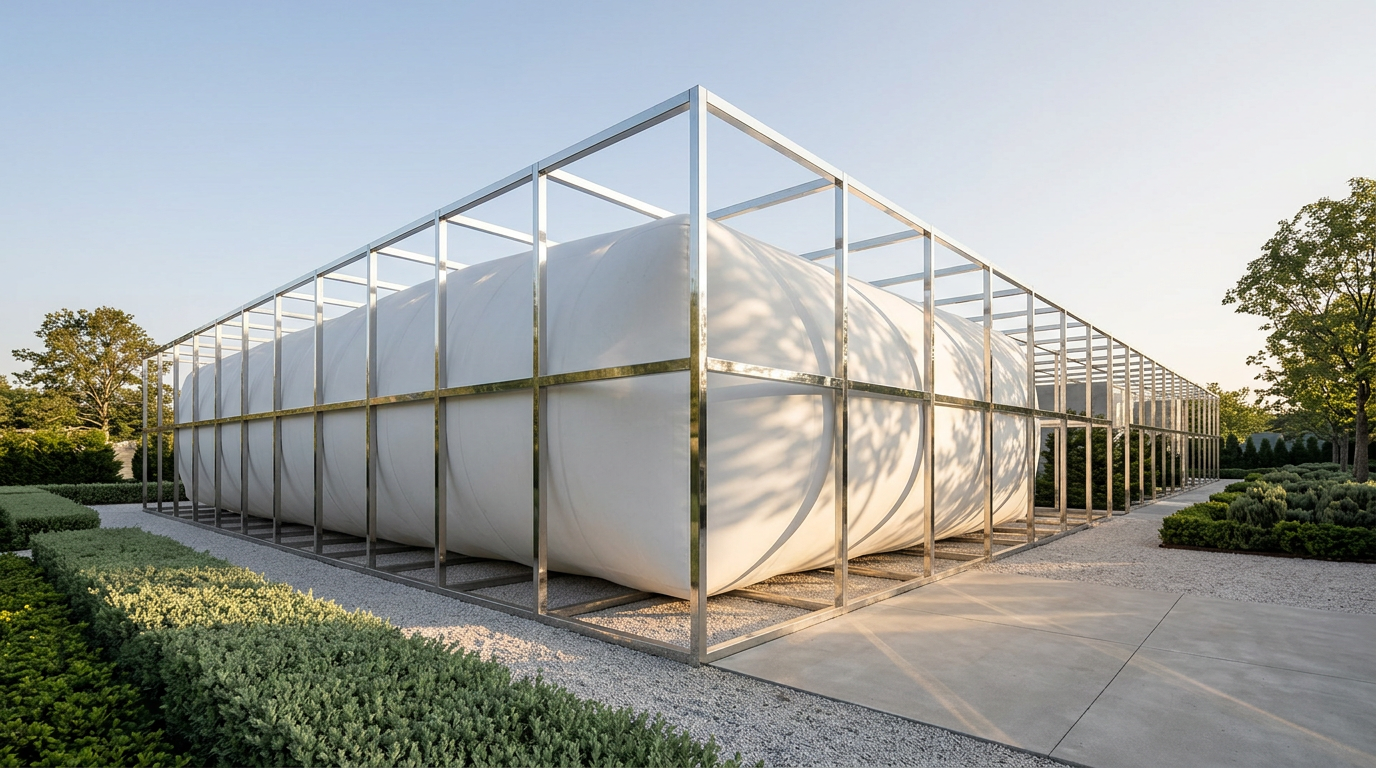
In the manicured gardens of Milan's Fondazione Luigi Rovati, a peculiar dialogue between the industrial and the organic has taken shape. "Renaissance of the Real," a collaborative installation by the architectural firm Snøhetta and the Swiss modular furniture specialists USM, serves as a sensory inquiry into how we perceive structure and the body. The project juxtaposes the unwavering, grid-based logic of USM's Haller system — a modular steel furniture framework first developed in the late 1960s — with "oozing" metallic inflatables that defy traditional architectural geometry. The result is an environment that refuses to settle into a single register, oscillating between discipline and softness.
The installation arrives during Milan's annual design week, the global calendar's most concentrated moment for spatial experimentation. For decades, the event has served as a proving ground where furniture manufacturers, architects, and artists test propositions that would be too speculative for a showroom floor. Snøhetta and USM's entry fits squarely within that tradition, though its ambitions lean closer to phenomenology than product demonstration.
The choreography of rigidity and flux
The experience is choreographed to build momentum as visitors meander from the lawn into a structured interior. It begins with a skeletal grid of open USM frameworks that guide guests toward a large, white membrane designed by Snøhetta. This interior form acts as a living skin — a malleable wall that shifts with external stimuli while being held in place by the rigidity of the steel frames. Inside, the play of light and shadow from the surrounding trees creates a shifting landscape of curved surfaces and modular seating.
The pairing of collaborators is deliberate. USM's Haller system has become something of a design-world archetype for rational modularity: chrome-plated steel tubes locked into ball joints, infinitely reconfigurable yet always legible as a grid. Snøhetta, by contrast, has built its reputation on buildings and landscapes that privilege sensory immersion — the Oslo Opera House's sloping marble roof, the underwater restaurantUnder on Norway's southern coast. Placing these two vocabularies in direct physical contact creates a productive friction. The steel grid reads as skeleton; the inflatable membrane reads as breath.
What makes the installation noteworthy is not the novelty of either material on its own but the insistence on their coexistence. Inflatables have a long lineage in experimental architecture, stretching back to the pneumatic structures of Haus-Rucker-Co and Ant Farm in the late 1960s and early 1970s, when air-filled forms were deployed as countercultural provocations against Modernism's concrete permanence. USM's grid, meanwhile, descends from the same postwar Swiss rationalism those inflatables once opposed. Staging both within a single installation collapses that historical antagonism into a shared frame.
Physicality as counterargument
By blending these disparate materials, the installation prompts a recalibration of attention. It moves beyond the utilitarian nature of furniture to explore the gray area between the softness of the human form and the hard precision of industrial design. In an era increasingly dominated by the digital, the project invites a re-centering of the self within the immediate, tactile physical environment.
This emphasis on bodily presence resonates with a broader current in contemporary design discourse. As generative AI tools reshape how objects and spaces are conceived — enabling rapid iteration on screen but flattening the sensory feedback loop — a growing number of practitioners have turned toward installations that foreground material encounter. The argument, implicit in projects like "Renaissance of the Real," is that spatial design's irreducible value lies in what cannot be rendered: the give of a surface under a hand, the temperature shift between steel and air, the way light bends through a translucent membrane.
The choice of venue reinforces the proposition. Fondazione Luigi Rovati, housed in a nineteenth-century palazzo, layers Etruscan archaeology beneath contemporary art programming. It is a building already structured around the tension between deep material history and present-day interpretation — a fitting host for an installation that asks whether modular systems designed for office efficiency can become instruments of sensory awareness.
Whether that question finds a lasting answer or remains a week-long provocation depends on what Snøhetta and USM choose to do with the vocabulary they have established here. The grid and the membrane each pull toward a different logic of space. Neither concedes. That unresolved tension may be the installation's most honest statement.
With reporting from Hypebeast.
Source · Hypebeast