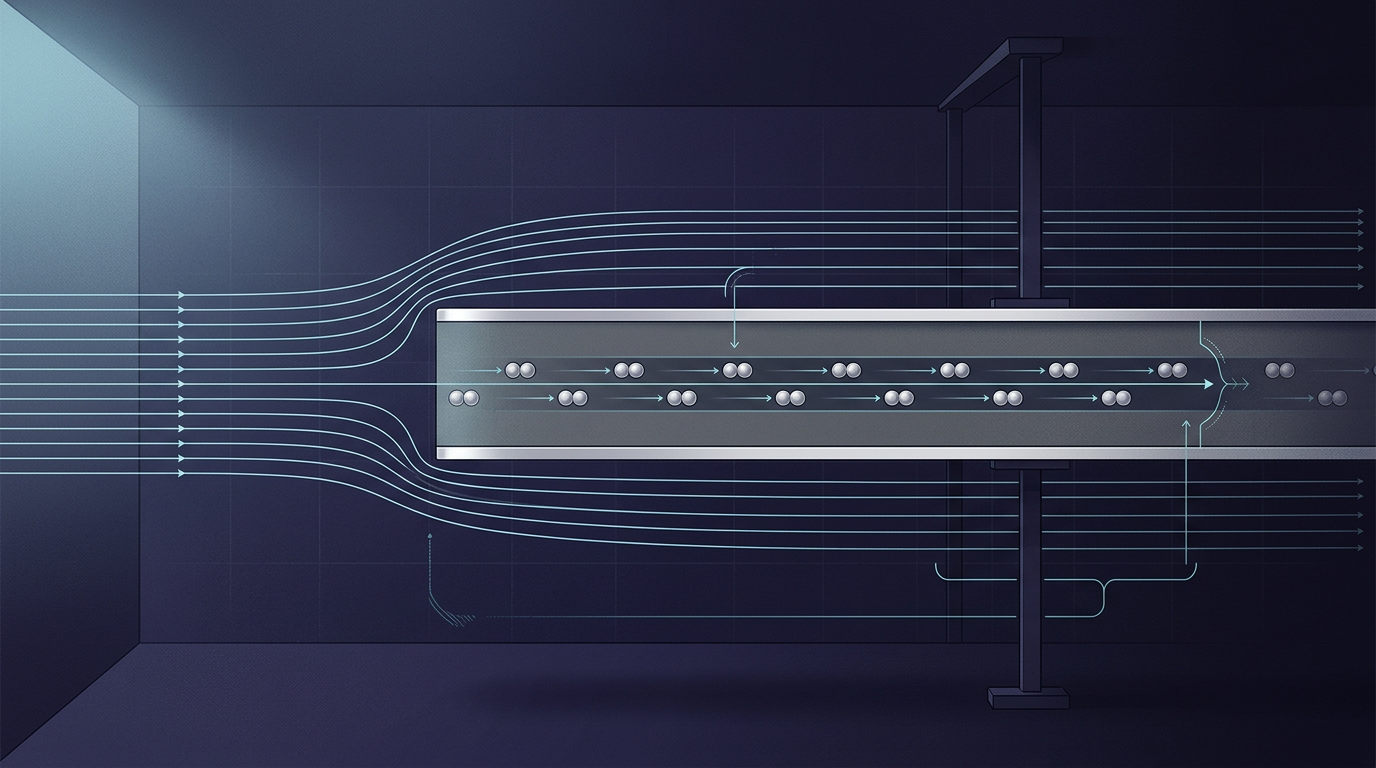
In the standard narrative of modern physics, the world is divided by scale. On the macroscopic level, classical mechanics dictates the predictable arc of a thrown ball or the orbit of a planet. But at the atomic level, these rules break down, replaced by the probabilistic, often bizarre equations of quantum mechanics. For nearly a century, these two realms have been treated as distinct territories requiring entirely different mathematical maps.
A new study from MIT, published in the Proceedings of the Royal Society, challenges that partition. Researchers have demonstrated that the principle of "least action" — a foundational concept in classical physics — can be used to precisely calculate the motion of quantum objects. By applying this classical framework, the team arrived at the same solutions provided by the Schrödinger equation, the cornerstone of quantum theory. The researchers tested their formulation against several hallmark quantum scenarios, including the double-slit experiment and quantum tunneling. In each case, the classical math successfully described phenomena that were once thought to be purely the domain of quantum mechanics.
A principle older than quantum theory itself
The principle of least action has deep roots. First articulated in the eighteenth century by Pierre-Louis Maupertuis and later refined by Euler, Lagrange, and Hamilton, it states that a physical system evolves along the path that minimizes — or, more precisely, renders stationary — a quantity called the action. In classical mechanics, this principle provides an elegant alternative to Newton's force-based equations: instead of tracking forces at every instant, one considers all possible trajectories and selects the one that satisfies the variational condition. It is the mathematical backbone of Lagrangian and Hamiltonian mechanics, and it extends naturally into electromagnetism and general relativity.
Quantum mechanics, however, appeared to break the pattern. When Erwin Schrödinger formulated his wave equation in 1926, the language shifted from deterministic trajectories to probability amplitudes. Richard Feynman later reintroduced the action into quantum theory through his path-integral formulation, which sums over all possible paths rather than selecting a single extremal one. Feynman's approach preserved the vocabulary of the action but changed its grammar: every path contributes, weighted by a phase factor. The MIT result occupies different territory. Rather than summing over all paths in Feynman's style, the researchers appear to have shown that a direct variational application of the least-action principle — closer in spirit to classical Lagrangian reasoning — can reproduce quantum predictions exactly. If the result holds under broader scrutiny, it narrows the conceptual gap between the two formulations in a way that decades of theoretical work have sought but not achieved.
What changes — and what remains open
The significance of the finding is less about practical computation than about foundational understanding. Physicists already possess reliable tools for solving quantum problems; the Schrödinger equation and Feynman's path integrals are not in dispute. What the MIT work offers is a reinterpretation of why those tools work. If quantum behavior can be derived from the same variational principle that governs planetary orbits, the implication is that the apparent rupture between classical and quantum physics may be an artifact of formalism rather than a feature of nature.
That distinction matters for ongoing debates in the philosophy of physics and for practical fields such as quantum computing and quantum chemistry, where intuition about system behavior still guides algorithm design. A unified variational language could, in principle, make certain quantum problems more tractable by allowing researchers to import techniques honed in classical mechanics.
Still, important questions remain. The study tested its framework against canonical quantum scenarios — the double-slit experiment and tunneling — but the quantum world contains far more exotic territory: entanglement, decoherence, many-body systems with strong correlations. Whether the least-action formulation scales to these regimes without losing its elegance or its exactness is not yet established. There is also the interpretive question: does the result favor one interpretation of quantum mechanics over another, or is it interpretation-neutral?
The history of physics is punctuated by moments when apparently separate domains turned out to share deeper structure — Maxwell's unification of electricity and magnetism, Einstein's equivalence of gravity and geometry. Whether the MIT result belongs in that lineage or represents a more modest formal insight depends on how far the framework extends. The bridge has been sketched; its load-bearing capacity is the next thing to test.
With reporting from MIT News.
Source · MIT News