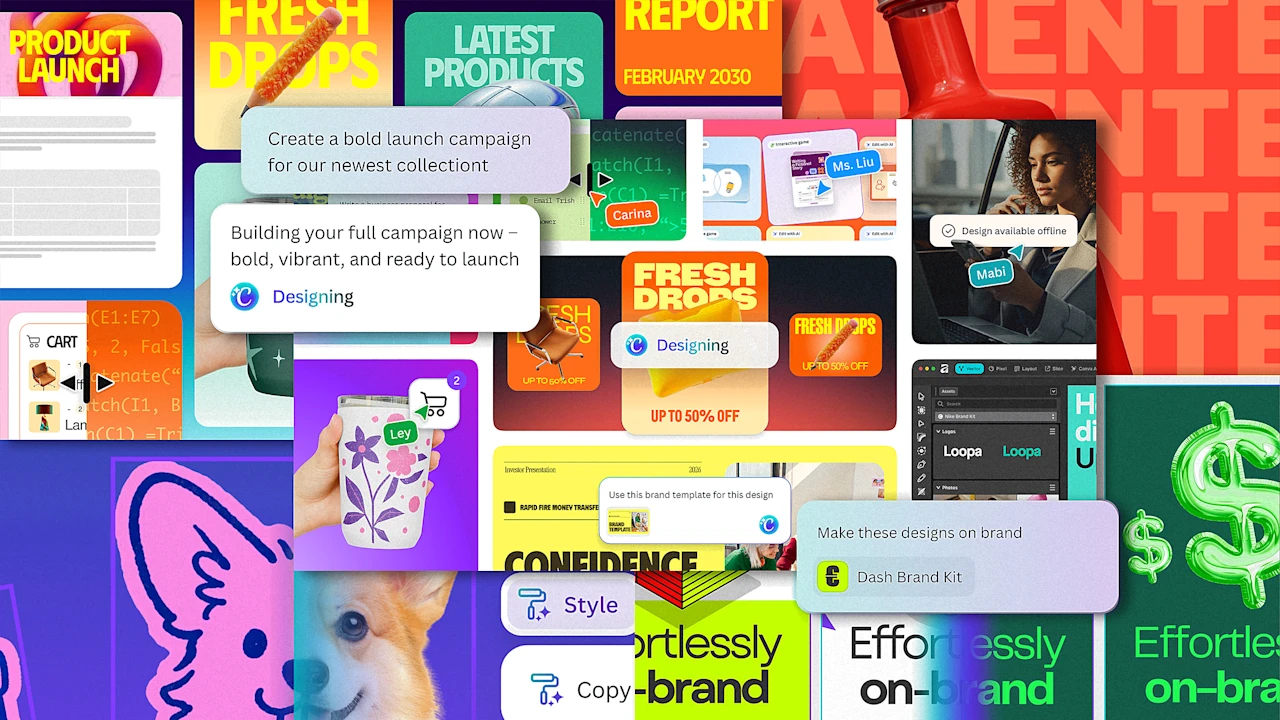
For over a decade, Canva built its business on a single, compelling promise: make design accessible to anyone. With a library of templates and a drag-and-drop interface, the Australian company attracted 265 million users who needed professional-looking visuals without professional-grade skills. The launch of Canva AI 2.0 marks a deliberate departure from that identity. The company is no longer a design platform that layers on artificial intelligence features; it is repositioning itself as an AI platform whose primary output happens to be design.
The shift is more than branding. Canva has become one of the largest consumers of compute power from major large language model providers, while simultaneously developing proprietary models and acquiring specialized AI startups. The strategic aim is to replace the blank canvas — and even the pre-made template — with a prompt-driven workflow in which generative intelligence serves as the primary engine of creation rather than a supplemental editing layer.
From templates to orchestration
Canva's original contribution to the design industry was lowering the barrier to entry. Templates turned a discipline that once required years of training into a matter of selection and customization. That model worked because most users did not need originality — they needed adequacy at speed. A social media post, a pitch deck, an event flyer: the template library covered the long tail of visual communication needs with minimal friction.
The move to an AI-first architecture represents a different theory of value. Rather than offering a curated menu of pre-built options, Canva AI 2.0 envisions a system where the user describes an outcome and the platform generates it. The distinction matters. In a template model, the platform's intelligence is embedded in the catalog — human designers create the options, and users choose among them. In a prompt-driven model, the intelligence is embedded in the generation layer itself. The user's role shifts from selector to director.
This trajectory echoes a concept CEO Mel Perkins first explored in 2011 under the working name "Canvas Chef," which imagined a search-like interface where users could describe their needs and receive a finished product. That the idea predates the current generative AI wave by more than a decade suggests the pivot is less a reaction to market pressure than the fulfillment of a long-held architectural vision — one that only recently became technically feasible.
The flattening of creative roles
Canva's bet arrives at a moment when the boundaries between traditional creative roles are becoming increasingly porous. The distinction between designer, product manager, and marketing generalist has eroded as tools grow more capable and organizations expect individuals to operate across disciplines. In this environment, the competitive advantage shifts from mastering a specific tool to orchestrating outputs across multiple domains.
This is the landscape Canva appears to be designing for: one in which the ability to articulate intent matters more than the ability to execute technique. It is a logic already visible in adjacent sectors. Code generation tools have begun to redefine what it means to be a software developer; AI writing assistants are reshaping editorial workflows. Design, with its heavy reliance on pattern recognition and combinatorial aesthetics, is a natural candidate for the same transformation.
The risk, however, is not trivial. Template-based design succeeded because it offered predictability — users knew what they were getting before they committed. Prompt-driven generation introduces variability, and variability introduces friction. Whether Canva can maintain its core appeal to non-expert users while fundamentally changing the interaction model remains an open question. There is also the matter of differentiation: as generative design capabilities become available across platforms — from Adobe's Firefly integrations to emerging open-source alternatives — the defensibility of an AI-first position depends on the quality and specificity of the underlying models, not merely on the decision to adopt them.
Canva's pivot frames a tension that extends well beyond one company's product roadmap. If creative tools increasingly center on orchestrating intelligence rather than exercising craft, the definition of design competence itself is under negotiation — and the answer is far from settled.
With reporting from Fast Company Design.
Source · Fast Company Design