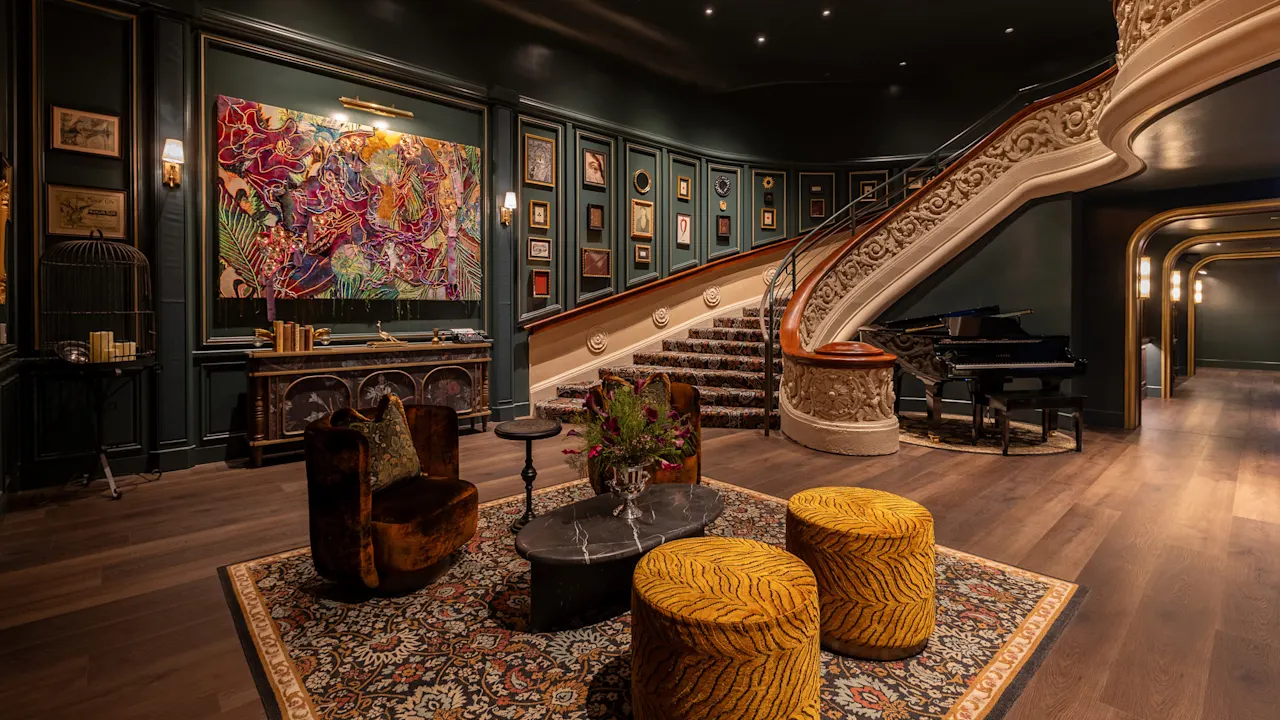
In Chicago's Michigan Avenue corridor, the McCormick mansion has long stood as a relic of the Gilded Age, most recently serving a utilitarian stint as a Lawry's steakhouse. A $50 million intervention has stripped away the white tablecloths and stodgy dining rooms, replacing them with a 35,000-square-foot immersive environment titled The Hand & The Eye — now the largest magic venue in the world. The project represents one of the more ambitious exercises in adaptive reuse to emerge from a major American city in recent years, trading culinary tradition for choreographed wonder.
The transformation was led by the architecture firm Rockwell Group and the design firm Pentagram. Together they reimagined the historic mansion as a series of nested, tactile experiences. Guests enter through sliding wooden doors and engage with physical prompts — such as a ringing telephone — to begin a three-hour journey. The $225 entry fee buys a strictly analog evening: cameras are prohibited, forcing a rare, unmediated focus on the illusions performed across a sequence of intimate chambers and grand theaters.
The economics of friction
Behind the project is Glen Tullman, a Chicago venture capitalist and lifelong magic enthusiast who describes the venue as a "100-year venture." The framing is deliberate. Where most entertainment investments are measured in quarterly returns or opening-weekend receipts, Tullman is positioning The Hand & The Eye as a permanent cultural institution — closer in ambition to a museum or a landmark theater than to an escape room or a pop-up experience.
The bet is counterintuitive. The dominant logic of consumer entertainment over the past decade has favored frictionless access: streaming on demand, algorithmic recommendation, infinite scroll. The Hand & The Eye moves in the opposite direction. A three-hour commitment, a prohibition on phones, a fixed price point north of $200 — every design choice introduces deliberate friction. The thesis is that scarcity of attention, not scarcity of content, is the binding constraint of modern leisure. By removing the option to document or multitask, the venue forces a mode of engagement that most digital platforms are structurally incapable of offering.
This logic has precedent. The rise of high-end experiential dining — multi-course tasting menus at fixed prices with no-phone policies — demonstrated over the past decade that a segment of affluent consumers will pay a premium for structured, undistracted encounters. Immersive theater productions such as "Sleep No More" in New York showed that audiences would accept unusual rules of participation if the environment rewarded their commitment. The Hand & The Eye sits at the intersection of these trends, layering the spatial ambition of immersive theater onto the intimacy of close-up magic.
Adaptive reuse as cultural statement
The choice of the McCormick mansion is not incidental. Gilded Age mansions along Michigan Avenue have cycled through identities for over a century — private residences, commercial restaurants, institutional offices — each conversion reflecting the economic priorities of its era. Repurposing such a structure as an entertainment venue rather than luxury condominiums or a boutique hotel signals a particular reading of what urban real estate can become when cultural ambition, rather than yield optimization, drives the program.
Rockwell Group, known for large-scale theatrical environments, brings a portfolio that spans Broadway set design and hospitality interiors. The firm's involvement suggests that the spatial choreography of The Hand & The Eye — the sequencing of rooms, the calibration of sight lines, the integration of illusion mechanics into architectural fabric — was treated with the rigor of a stage production rather than a conventional renovation.
Whether the model proves durable depends on variables that remain unresolved. A $50 million capital outlay requires sustained demand at a price point that limits the addressable audience. Magic, as a performance art, depends on a pipeline of skilled practitioners whose craft resists easy scaling. And the prohibition on documentation, while central to the experience, removes the organic social-media amplification that most new venues rely on for discovery.
The tension at the core of The Hand & The Eye is whether an entertainment proposition built on deliberate constraint can sustain itself in a market that overwhelmingly rewards accessibility. Tullman is wagering that the answer lies in the very scarcity the venue enforces — that an experience which cannot be captured, replayed, or streamed acquires a value precisely because it resists the logic of digital reproduction.
With reporting from Fast Company.
Source · Fast Company