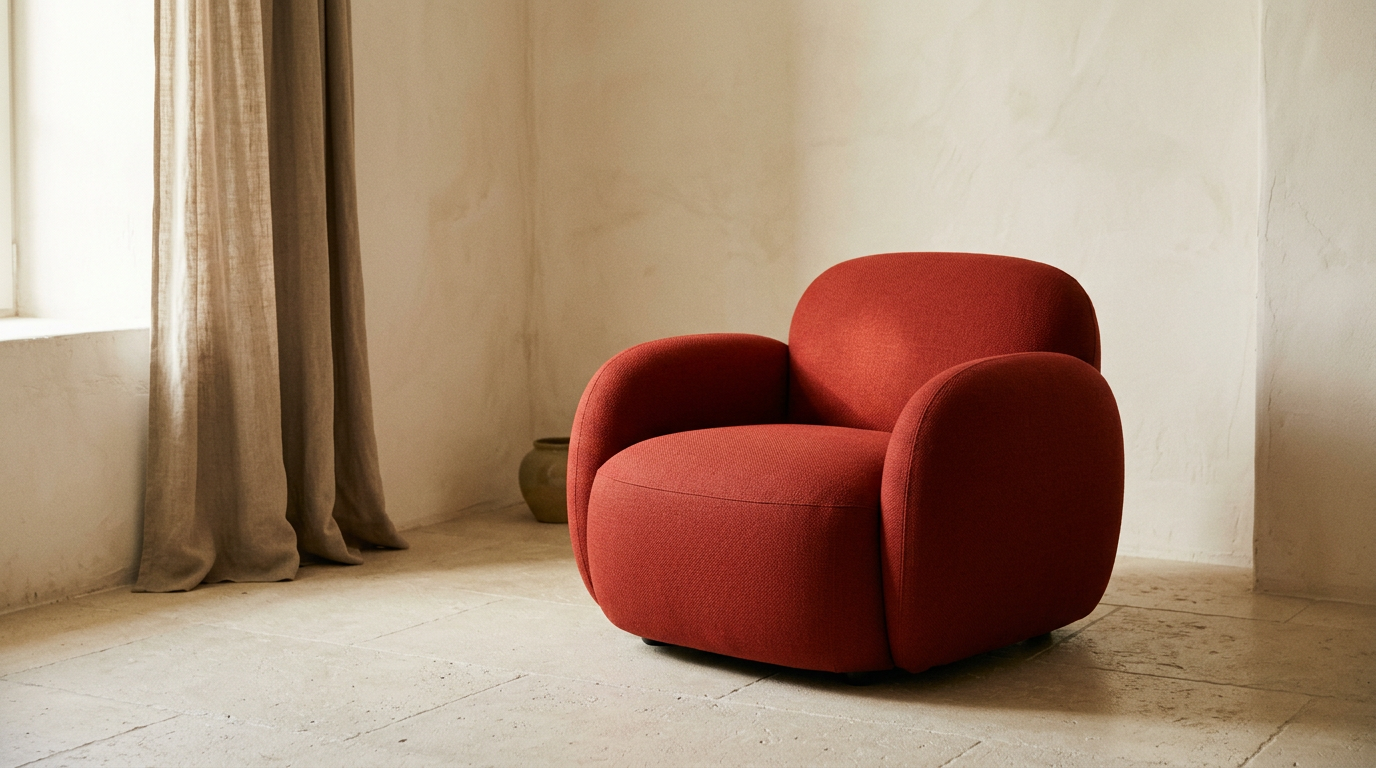
Since taking the creative reins at Chloé, Chemena Kamali has made the house's 1970s heritage the gravitational center of her tenure — a period defined by bohemian nonchalance, fluid silhouettes, and a certain irreverence toward convention. With the brand's latest move at Milan Design Week, Kamali is extending that sensibility beyond the runway and into the domestic sphere, reviving Christian Adam's 1970 Tomato Chair in collaboration with the Tuscan manufacturer Poltronova.
The chair — a bulbous, organic-form seat that reads more like a sculptural provocation than a piece of functional furniture — will be on display at Chloé's Milan boutique on Via della Spiga from April 22 to 26. Its reintroduction signals that Kamali's project at Chloé is not merely about clothing, but about constructing a broader aesthetic world in which fashion and design share the same vocabulary.
A Radical Object, Then and Now
When Christian Adam designed the Tomato Chair in 1970, it belonged to a wave of anti-functionalist experimentation in Italian design. Poltronova, the studio that originally produced it, had built its reputation through collaborations with architects and designers who treated furniture as a medium for cultural commentary rather than mere utility. The company's catalog from that era includes work by figures associated with Italy's Radical Design movement — a loose constellation of designers who rejected the sleek rationalism of postwar modernism in favor of objects that were playful, polemical, and deliberately strange.
The Tomato Chair fit squarely within that ethos. Its rounded, almost cartoonish silhouette was a deliberate rebuke to the angular precision that dominated mid-century interiors. It was furniture that refused to behave like furniture, inviting the user into a relationship that was more sensory than strictly ergonomic.
Reviving such an object in 2026 carries a different set of connotations. The design world has spent the better part of a decade rediscovering Radical Design and its adjacent movements, with auction prices for vintage Poltronova pieces climbing accordingly. For Chloé, the collaboration is less an act of archaeological recovery than a strategic alignment: the Tomato Chair's spirit of expressive irreverence maps neatly onto the bohemian codes Kamali has been reactivating across the brand's collections.
Fashion Houses and the Furniture Gambit
Chloé's move into design objects follows a well-established pattern among luxury fashion houses. Over the past decade, brands from Hermès to Loewe to Fendi have invested in furniture, home goods, and design collaborations — often using Milan Design Week as the stage. The logic is partly commercial, expanding a brand's addressable market beyond apparel and accessories. But it is also semiotic: a well-chosen design collaboration can reinforce a house's aesthetic identity in ways that a handbag campaign cannot.
The choice of Poltronova as a partner is notable in this context. Unlike the large-scale industrial manufacturers that some fashion brands have gravitated toward, Poltronova remains a relatively small, craft-oriented studio with deep roots in Italy's postwar design culture. The partnership lends Chloé a degree of credibility within the design community that a purely in-house furniture line might not achieve.
What remains to be seen is whether the Tomato Chair revival is a one-off gesture — a Milan Design Week moment designed to generate press and reinforce brand narrative — or the beginning of a more sustained engagement with interior design. Kamali's stated interest in extending Chloé's aesthetic into the living room suggests the latter, but the economics of small-batch artisanal furniture and the economics of global luxury fashion do not always align comfortably.
The tension is a productive one. On one side sits the desire for cultural authenticity — the kind that comes from partnering with a storied studio and reviving a genuinely radical object. On the other sits the machinery of luxury brand-building, which tends to absorb such objects into a larger commercial narrative. Whether the Tomato Chair retains its subversive charge inside a Via della Spiga boutique, or whether it becomes another artifact smoothed into lifestyle content, may say more about the current state of fashion-design crossover than any press release could.
With reporting from Hypebeast.
Source · Hypebeast