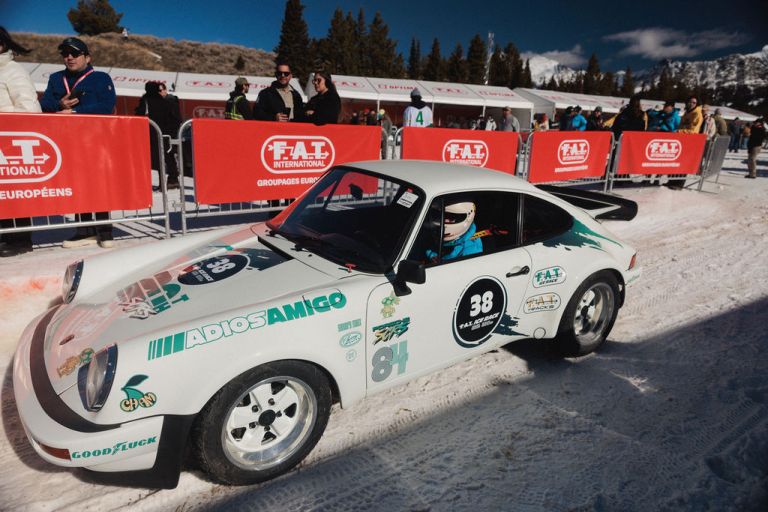
The FAT Ice Race, a revival of a mid-century alpine tradition organized by Ferdi Porsche's FAT International brand, made its Montana debut this winter at Big Sky. The event, now in its third North American edition after launching in Aspen two years ago, brought a mix of vintage rally cars and contemporary performance vehicles to a frozen course carved into the Montana landscape — despite a winter season that proved uncharacteristically warm and dry for the region.
The format remains deliberately loose: professional drivers share the ice with enthusiastic amateurs, and the emphasis falls less on competitive lap times than on the raw sensory theater of machines working at the limits of traction. Vehicles threw up plumes of snow for spectators gathered along the course, a choreography of controlled slides and lateral corrections that owes more to rally culture than to circuit racing.
Ice racing and the revival of analog spectacle
Ice racing has deep roots in European motorsport. The original GP Ice Race in Zell am See, Austria, dates to the late 1930s and ran intermittently through the postwar decades before fading from the calendar. Its revival in 2019 — with Ferdi Porsche, great-grandson of Ferdinand Porsche, as a central figure — tapped into a broader cultural moment: a growing appetite among automotive enthusiasts for events that foreground mechanical character and atmosphere over the clinical precision of modern professional racing.
The format belongs to a category of motorsport gathering that has gained traction over the past decade. Events like the Goodwood Revival in England, the Mille Miglia in Italy, and various concours-adjacent rallies have demonstrated that there is a substantial audience — and substantial commercial opportunity — in experiences built around automotive heritage, design curation, and participatory access. These are not traditional races in the competitive sense. They are closer to designed environments where the vehicle serves as both protagonist and cultural artifact.
The FAT Ice Race fits squarely within this lineage but adds a distinctive variable: the frozen surface itself. Low-friction dynamics transform even familiar machinery into something unpredictable. Throttle inputs that would produce clean acceleration on dry tarmac instead generate oversteer, requiring constant correction. The result is a leveling effect — the gap between a professional driver and a skilled amateur narrows when grip is scarce, which reinforces the event's inclusive, enthusiast-driven ethos.
Montana as a strategic canvas
The move from Aspen to Big Sky is worth examining beyond logistics. Aspen carries specific cultural connotations — luxury, exclusivity, a well-established social infrastructure for high-end winter events. Big Sky offers something different: scale, relative remoteness, and a landscape that reads as more rugged and less manicured. For an event that positions itself as an alternative to the polished formality of traditional motorsport, the setting communicates as much as the cars on the ice.
There is also a practical dimension. Montana's open terrain presumably allows for a more expansive course layout than what Aspen's geography could accommodate, giving organizers greater freedom in designing the spectator experience and the driving challenge alike. The warm winter conditions this year tested that premise — maintaining a viable frozen surface when temperatures do not cooperate is a logistical challenge that ice racing organizers in the Alps have also faced with increasing frequency as winters grow milder across the Northern Hemisphere.
The broader question the FAT Ice Race raises is whether niche motorsport events can sustain themselves as cultural products rather than purely competitive ones. The economics of such gatherings typically depend on sponsorship, hospitality revenue, and the willingness of participants to pay for access — a model closer to art fairs or design festivals than to traditional racing series. FAT International appears to be betting that the design of the environment, the curation of the vehicle field, and the social texture of the weekend matter as much as what happens on the course itself.
Whether that model scales — or whether it works best precisely because it does not — remains an open tension. The appeal of events like this often depends on a sense of intimacy and discovery that can erode as audiences grow. Big Sky offers room to expand, but expansion and exclusivity rarely coexist for long.
With reporting from Cool Hunting.
Source · Cool Hunting