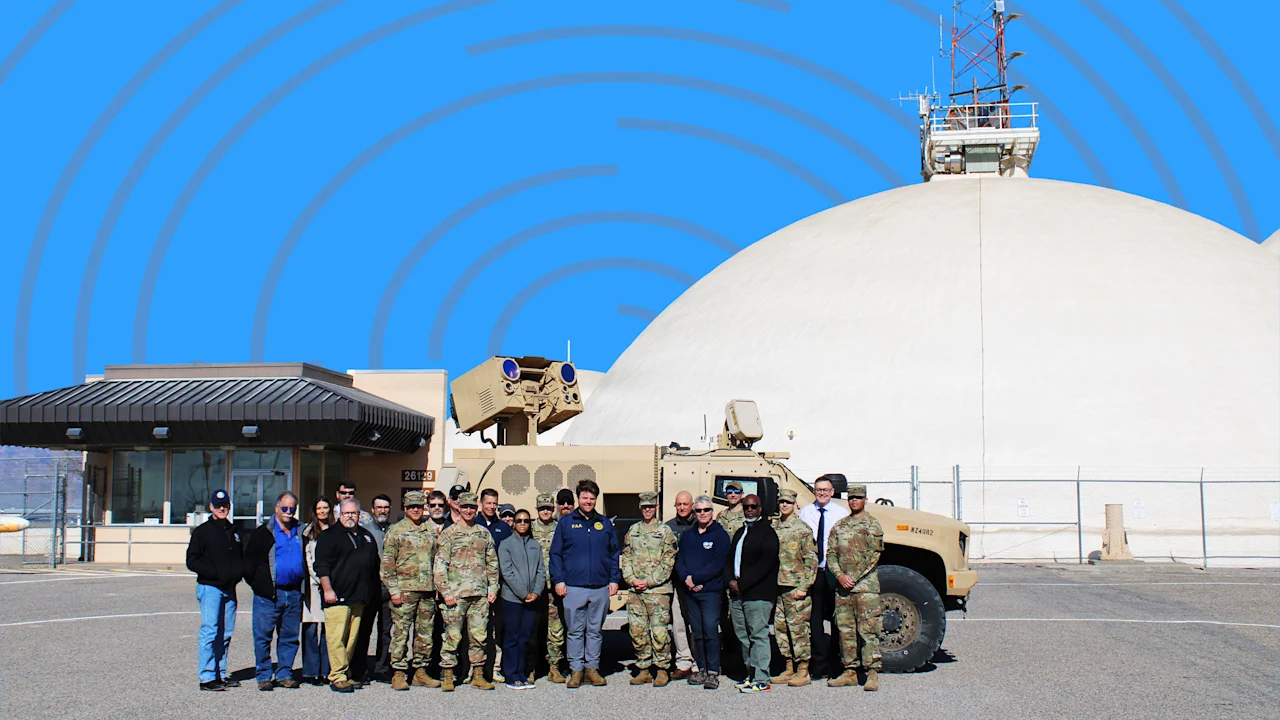
The conceptual "Laser Dome" is no longer a theoretical projection for distant battlefields. Following a series of incidents along the U.S.-Mexico border, the Federal Aviation Administration and the Department of Defense have reached what officials describe as a "landmark safety agreement" that paves the way for the regular deployment of high-energy laser weapons on American soil. The move reflects a growing urgency to counter the proliferation of low-cost, weaponized drones that now threaten domestic security infrastructure — and it raises questions about the long-term implications of integrating directed-energy weapons into civilian airspace.
The policy shift follows two specific engagements in February involving the Army's 20-kilowatt Multi-Purpose High Energy Laser (AMP-HEL), a vehicle-mounted system designed for rapid drone neutralization. In the first instance, an engagement near Fort Bliss triggered an abrupt airspace closure over El Paso. Weeks later, military personnel near Fort Hancock neutralized a drone that appeared threatening but was later identified as belonging to Customs and Border Protection. These incidents initially raised alarms about the impact of directed energy on civilian air traffic, but a subsequent FAA safety assessment concluded that the systems do not pose an "undue risk" to passenger aircraft.
From Battlefield Export to Homeland Fixture
Directed-energy weapons have occupied a peculiar position in defense procurement for decades: perpetually promising, rarely operational at scale. Laser systems were long constrained by size, power supply, and atmospheric interference — problems that made them viable in laboratory demonstrations but impractical in the field. The shift toward counter-drone applications changed that calculus. Small unmanned aerial systems, or sUAS, present a target profile that plays to the strengths of high-energy lasers: short range, slow speed, and low durability. A laser operating at 20 kilowatts can disable a commercial-grade drone in seconds at a fraction of the cost of a conventional interceptor missile.
The AMP-HEL system deployed along the southern border represents one of several directed-energy platforms the Pentagon has advanced in recent years. Its vehicle-mounted form factor allows rapid repositioning, a feature suited to the unpredictable geography of border security. The FAA-DoD agreement effectively creates a regulatory framework for these systems to operate in proximity to civilian flight corridors — a step that had no precedent in U.S. airspace management. Until now, the use of kinetic or directed-energy weapons within the national airspace system was governed by ad hoc coordination rather than standing protocol.
The broader context matters. Drone incursions over sensitive domestic sites — military bases, critical infrastructure, even urban centers — have increased in frequency and sophistication. Traditional countermeasures, including radio-frequency jamming and physical netting, have proven inconsistent against more capable platforms. The appeal of a laser-based solution lies in its precision, low cost per engagement, and the absence of physical debris — a meaningful advantage in populated areas.
The Identification Problem
Yet the Fort Hancock incident exposes a vulnerability that no amount of beam precision can resolve: target identification. The drone neutralized by military personnel turned out to belong to Customs and Border Protection, a sister federal agency. The failure was not one of hardware but of coordination — the inability to distinguish a friendly asset from a hostile one in a congested operational environment. This is not a novel problem in military operations; fratricide and misidentification have plagued every theater of conflict. But the domestic setting raises the stakes. The airspace over the U.S.-Mexico border is shared by law enforcement, commercial aviation, agricultural operators, and hobbyist pilots. A standing authority to fire directed-energy weapons into that environment demands identification protocols of a rigor that current systems may not yet deliver.
The FAA's conclusion that high-energy lasers do not pose an "undue risk" to passenger aircraft addresses one dimension of safety — the physics of beam propagation and its interaction with commercial flight paths. It does not, by itself, address the operational dimension: who decides what constitutes a threat, under what rules of engagement, and with what accountability when the assessment is wrong.
This agreement marks a quiet but significant evolution in the militarization of domestic airspace. By integrating directed-energy systems into the national defense architecture, the United States is moving toward a permanent, kinetic solution for drone incursions. The regulatory green light from the FAA resolves one set of obstacles. The harder set — reliable identification in cluttered airspace, interagency coordination under time pressure, and public accountability for engagements on home soil — remains open. How those tensions are managed will determine whether the Laser Dome becomes a model of precision defense or a source of the very incidents it was designed to prevent.
With reporting from Fast Company.
Source · Fast Company