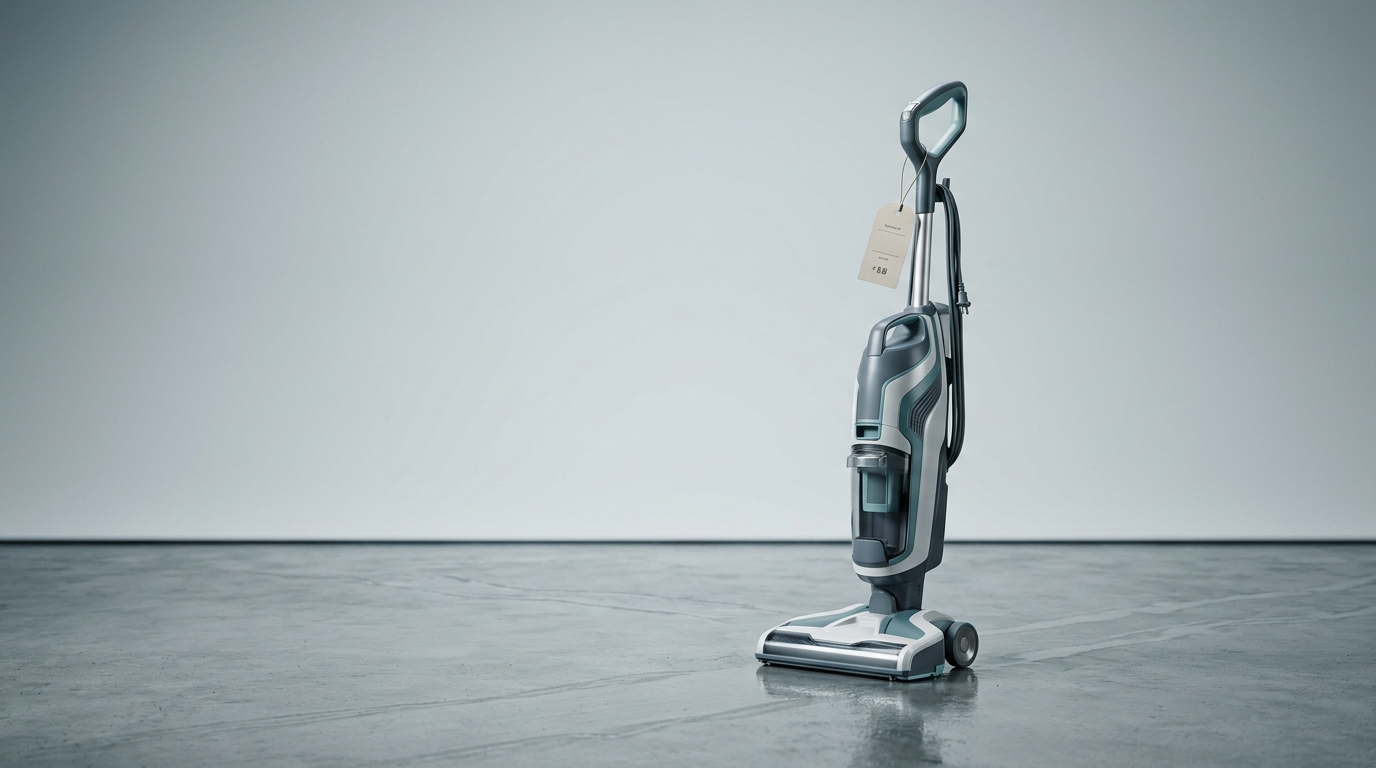
Dyson has entered a period of rapid product expansion. The British engineering firm, long defined by a deliberate cadence of premium launches, has introduced several new devices in quick succession: a handheld variant of its bladeless fan, a compact hair dryer designed for travel, a mopping-capable version of its slim PencilVac, and the Clean+Wash Hygiene, a wet floor cleaner positioned as a centerpiece of the company's evolving floor-care lineup.
The breadth of the rollout signals a strategic shift. Rather than anchoring each product cycle around a single flagship, Dyson appears to be pursuing category saturation — placing a branded device in every functional corner of the modern household. Yet one early data point complicates the narrative: the Clean+Wash Hygiene has already received a 20 percent discount shortly after launch, even as other recent releases hold their introductory prices.
The tension between velocity and premium positioning
Dyson's brand equity rests on a specific compact: consumers pay a significant premium in exchange for distinctive industrial design, proprietary motor technology, and the perception of engineering superiority. That compact has historically been reinforced by disciplined pricing. Discounts on Dyson hardware tend to arrive late in a product's lifecycle, often timed to clear inventory ahead of a successor model. An early markdown on a newly launched device is unusual for the company and raises questions about either demand calibration or competitive dynamics in the wet-cleaning segment.
The wet floor cleaner category itself has grown considerably in recent years. Competitors across a range of price points have introduced hybrid vacuum-and-mop systems that combine suction with water-based scrubbing, making the segment one of the more crowded areas of the home appliance market. For Dyson, entering this space means competing not only on brand cachet but on functional performance metrics — stain removal, water recovery, edge cleaning — where incumbents have already set consumer expectations. The early price correction on the Clean+Wash Hygiene may reflect the difficulty of commanding a steep premium in a category where utility benchmarks are well established and alternatives are plentiful.
Proliferation as strategy — and its risks
The broader pattern of Dyson's recent launches resembles a portfolio strategy more commonly associated with consumer electronics firms than with appliance makers. By releasing a handheld fan, a travel hair dryer, and multiple floor-care variants in close proximity, the company is behaving less like a focused engineering house and more like a platform brand seeking to maximize surface area across retail channels.
There are precedents for this approach. Consumer hardware companies that accelerate their product cadence often do so to defend shelf space, capture seasonal buying windows, or test price elasticity across segments. The risk is dilution — both of brand perception and of internal engineering focus. Dyson's historical strength has been the ability to charge a premium precisely because each product felt like the result of deep, singular attention. A faster release tempo may erode that perception, particularly if price adjustments become a recurring feature rather than an exception.
It is also worth noting that Dyson remains a privately held company, which historically has afforded it the patience to prioritize margins over volume. Whether the current acceleration reflects a deliberate strategic pivot or a response to external pressure — from competitors, from shifting consumer spending patterns, or from the need to sustain growth across a maturing product portfolio — is not yet clear.
What is visible is a company testing the boundaries of its own model. The Clean+Wash Hygiene discount, modest in isolation, sits at the intersection of two forces that do not resolve easily: the drive to expand into new categories at speed, and the need to preserve the pricing discipline that underwrites Dyson's brand. How those forces balance over the next product cycle will say more than any single markdown.
With reporting from The Verge.
Source · The Verge