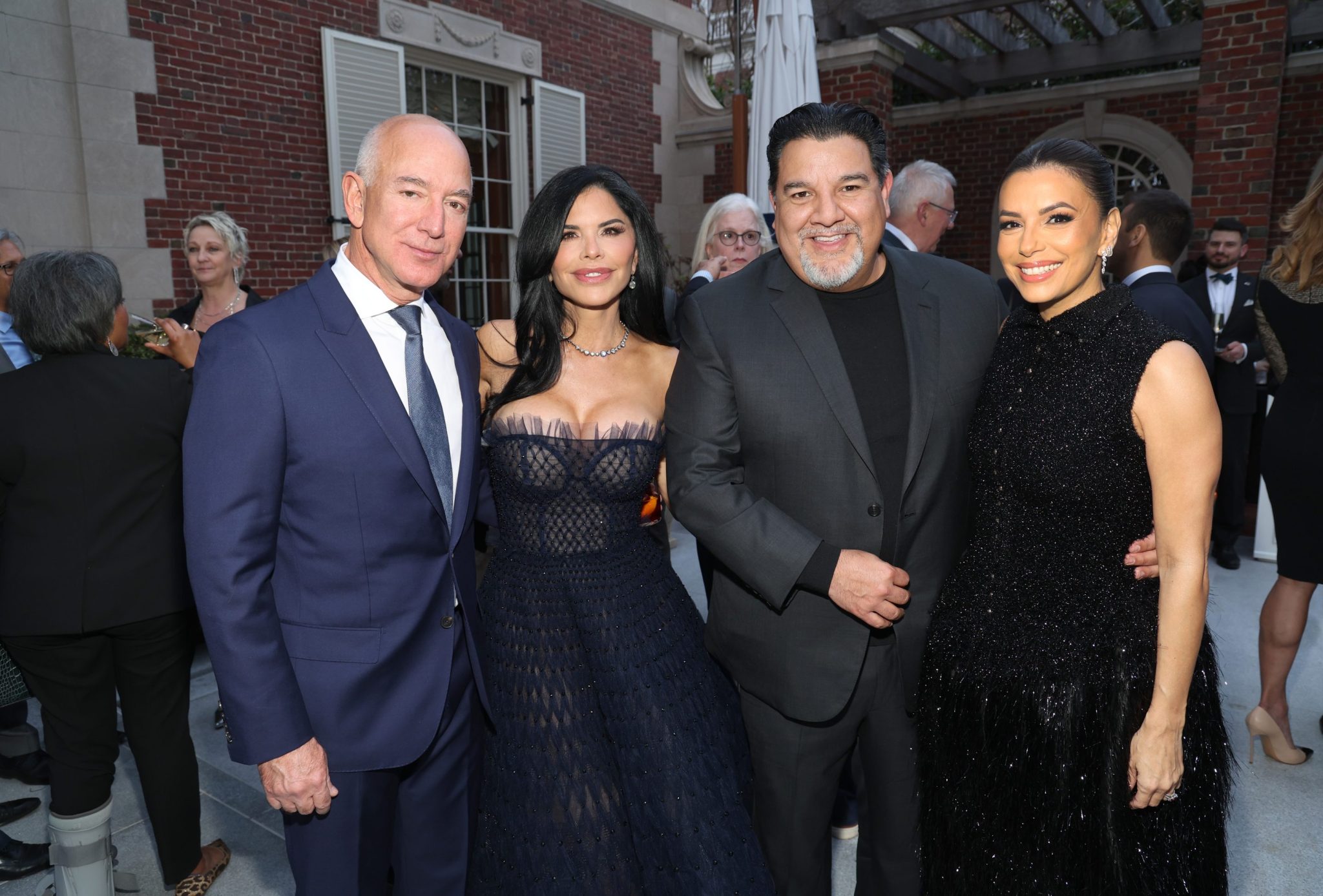
Two years after receiving a $50 million grant from Jeff Bezos's philanthropic fund, Eva Longoria is making a case that runs counter to the prevailing narrative around charitable giving: that meaningful social impact does not require a billionaire's balance sheet. In a media landscape where philanthropy coverage gravitates toward nine- and ten-figure pledges, Longoria's argument reframes the conversation around personal advocacy and what she describes as "street-level" change.
The grant Longoria received was part of a broader initiative by Bezos, who has distributed large sums to individuals and organizations he considers effective agents of change. The same round of funding also included Admiral William McRaven, the retired military commander associated with the operation that led to the capture of Osama bin Laden, each receiving $100 million in total philanthropic commitments. For Longoria, the funds have been directed toward causes she has championed for years — mentoring, small business support, and Latino community empowerment.
The philanthropy perception gap
Longoria's central contention — that giving back is not the exclusive domain of the ultra-wealthy — touches on a well-documented tension in how philanthropy is understood by the public. Large-scale donations from figures like Bezos, MacKenzie Scott, and Bill Gates tend to absorb the oxygen in media coverage of charitable work. This creates what some scholars of nonprofit economics call a "perception gap": the public comes to associate philanthropy with massive institutional giving, while smaller-scale, community-rooted efforts receive comparatively little attention.
The pattern has practical consequences. When philanthropy is perceived as a billionaire's activity, individuals with fewer resources may underestimate the value of their own contributions — whether financial, temporal, or relational. Longoria's framing pushes back against this by emphasizing how one "shows up" for others, a formulation that deliberately decouples impact from dollar amounts. Mentoring a young entrepreneur, connecting a small business owner with resources, or using a public platform to amplify overlooked communities — these are the forms of engagement she foregrounds.
This is not an entirely new argument. Community foundations, mutual aid networks, and grassroots organizations have long operated on the principle that distributed, local action produces durable change. What distinguishes Longoria's position is the platform from which she makes it. As a recipient of one of the most high-profile philanthropic grants in recent memory, her insistence that wealth is not a prerequisite for impact carries a particular kind of credibility — and a particular kind of irony that she appears willing to acknowledge.
Celebrity, capital, and the limits of scale
The relationship between celebrity and philanthropy is itself a subject of ongoing scrutiny. Public figures who engage in charitable work operate in a space where personal brand and social mission are difficult to fully separate. Longoria has navigated this terrain for more than a decade, with involvement in organizations focused on Latino education and economic mobility predating the Bezos grant by years.
The broader question her remarks raise is structural. Large philanthropic grants can accelerate existing work, but they also concentrate decision-making power in the hands of a small number of donors. When Bezos selects individual recipients for tens of millions of dollars, the selection itself becomes an act of agenda-setting. Longoria's emphasis on decentralized, community-driven impact can be read as a subtle counterweight to that dynamic — even as she benefits from it.
There is also the matter of sustainability. Street-level change, by its nature, depends on sustained relationships and local knowledge rather than one-time capital infusions. Whether large grants can effectively support that kind of work without distorting it remains an open question across the philanthropic sector.
The tension, then, is not between large and small giving, but between two models of how change happens — one driven by concentrated capital and institutional reach, the other by proximity, consistency, and personal commitment. Longoria appears to argue they are not mutually exclusive. Whether the philanthropic ecosystem as currently structured allows both to thrive on equal footing is a different matter entirely.
With reporting from Fortune.
Source · Fortune