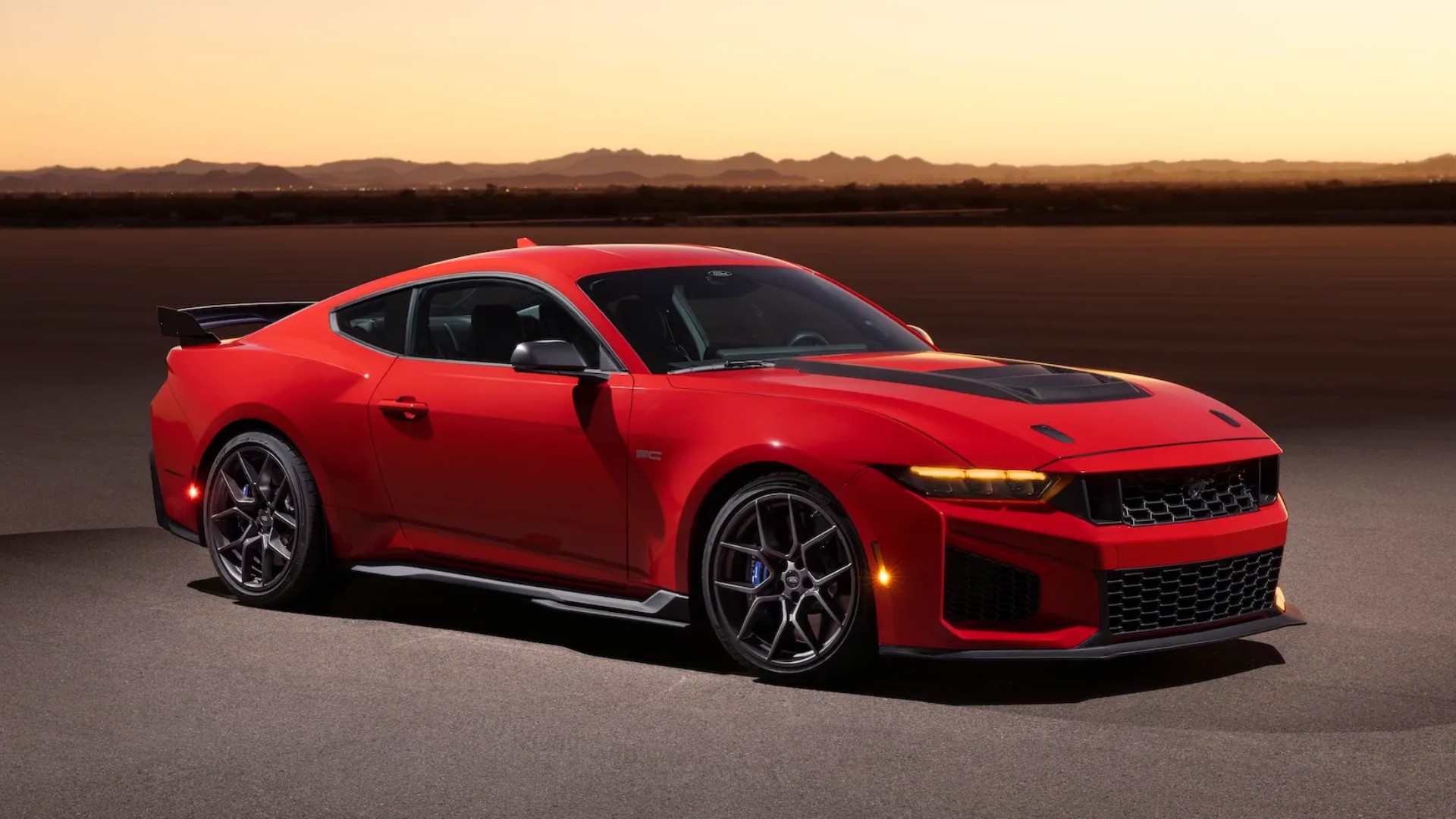
In the increasingly stratified world of high-performance internal combustion, Ford is carving out a precise middle path for its flagship pony car. The 2026 Mustang Dark Horse SC arrives as the spiritual successor to the discontinued Shelby GT500, delivering 795 horsepower and 660 pound-feet of torque from a supercharged 5.2-liter V8. It is a figure that approaches the absolute limit of what a rear-wheel-drive platform can effectively translate to the pavement without losing its composure.
Priced at $105,485, the SC occupies a strategic — if expensive — niche in the Mustang hierarchy. It sits comfortably above the standard Dark Horse while remaining roughly a third of the price of the $325,000 Mustang GTD. By moving away from the Shelby branding in favor of this internal nomenclature, Ford is streamlining its performance portfolio, offering a track-focused machine that serves as a bridge between mass-market muscle and the GTD's exotic ambitions.
The End of Shelby and the Logic of Tiered Performance
The decision to retire the Shelby name from this segment of the lineup is not merely cosmetic. For decades, the Shelby badge carried a distinct identity — one rooted in Carroll Shelby's racing legacy and the aftermarket ethos of the original GT350 and GT500. Ford's shift toward the "Dark Horse" nomenclature signals a consolidation of its performance branding under a single, factory-controlled umbrella. The move mirrors a broader industry pattern in which automakers seek tighter control over their halo products, reducing reliance on third-party heritage brands and bringing engineering, marketing, and pricing strategy under one roof.
This tiered approach — standard Mustang, Dark Horse, Dark Horse SC, GTD — resembles the kind of product ladder more commonly associated with European marques. Porsche has long operated this way with the 911 range, offering a carefully calibrated escalation from Carrera to GT3 RS to GT2 RS. Ford appears to be applying a similar logic to the Mustang, creating clear separation between each variant in terms of capability, price, and intended use case. The SC, in this framework, is not simply a faster Mustang; it is a deliberate product positioned to capture buyers who want track-grade performance without crossing into the rarefied territory of limited-production exotics.
Managing Power at the Limits of Traction
To manage its nearly 800-horsepower output through the rear wheels alone, the SC relies on a rigorous weight-reduction program and high-end componentry. The optional Track Pack replaces standard hardware with Brembo carbon-ceramic brakes and 20-inch carbon fiber wheels, significantly reducing unsprung mass at each corner. With the rear seats deleted and the addition of Michelin Pilot Sport Cup 2 R tires, the vehicle is 150 pounds lighter than its base counterpart, trading daily utility for the mechanical grip required to handle its own power.
The engineering challenge here is fundamental. Rear-wheel-drive cars face a hard physics ceiling: beyond a certain power threshold, additional horsepower yields diminishing returns in acceleration and cornering unless accompanied by proportional gains in tire contact patch, suspension geometry, and weight distribution. The GTD addresses this with active aerodynamics and a purpose-built chassis derived from the GT3 racing program. The SC, constrained by a more conventional platform, must rely instead on material science — lighter wheels, stickier rubber, better brakes — to keep the power usable rather than merely theatrical.
This distinction matters in a market where raw horsepower figures have become almost inflationary. Dodge's final Challenger SRT Demon 170 pushed past 1,000 horsepower; Chevrolet's Corvette ZR1 delivers over 1,000 from a flat-plane-crank V8 with hybrid-assisted torque management. In that context, 795 horsepower is notable less for its magnitude than for the discipline Ford claims to have applied in making it deployable on a rear-drive chassis without all-wheel-drive intervention.
The broader question the SC raises is whether the traditional American muscle car formula — big engine, rear wheels, manual or dual-clutch transmission — can continue to scale upward in a regulatory and market environment that increasingly favors electrified drivetrains. Ford has committed to the naturally aspirated and supercharged V8 for this generation of Mustang, but each successive variant pushes closer to the mechanical limits of the layout. Whether the next step requires electrification, active aero, or an entirely different platform architecture remains an open tension — one that the SC, for now, defers rather than resolves.
With reporting from The Drive.
Source · The Drive