Framework, the startup that has become the most visible advocate for repairable consumer electronics, is confronting a truth that modular design evangelists rarely discuss: the gap between conceptual elegance and physical comfort. In its latest round of updates to the Laptop 16, the company is addressing both the mundane and the ambitious — from smoothing over literal seams that snagged users' arm hairs to prototyping a high-bandwidth external GPU interface that could redefine what a modular laptop is for.
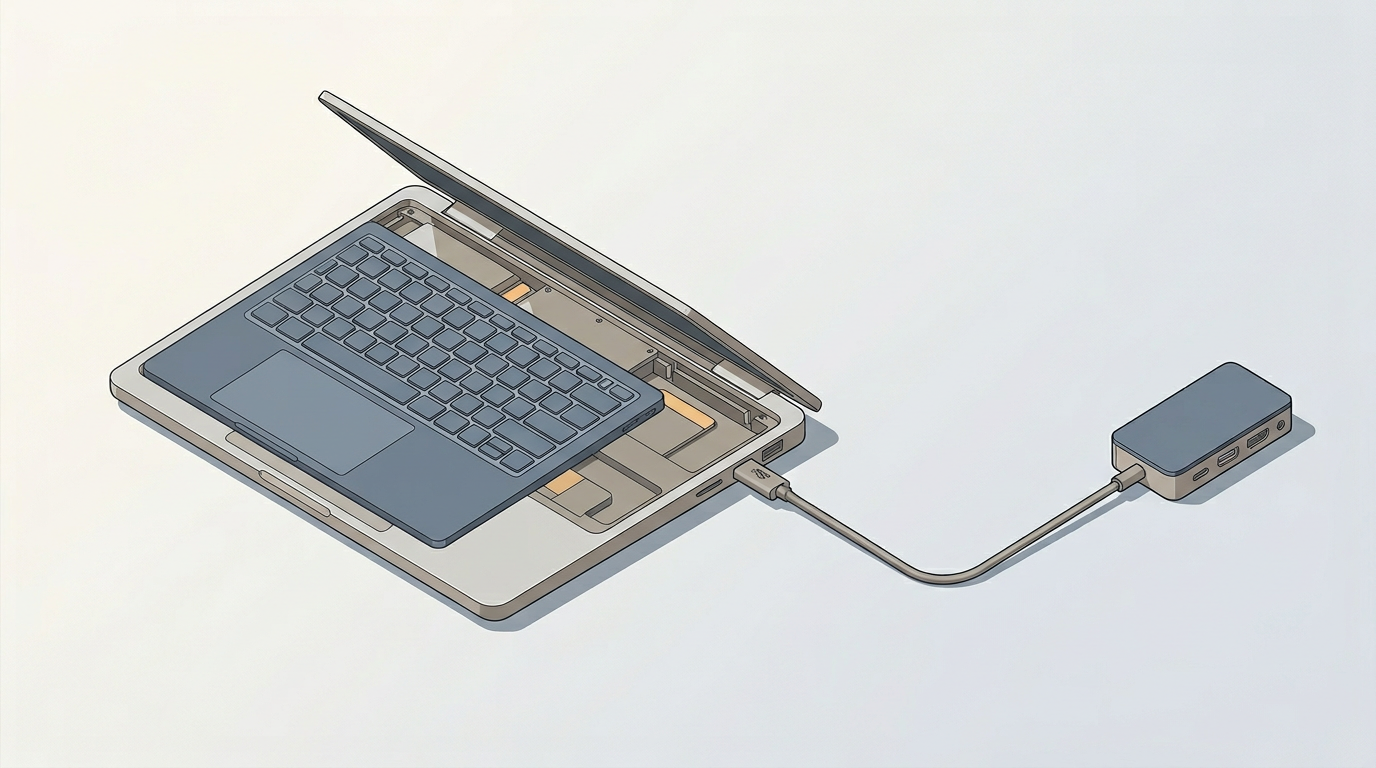
The Laptop 16, Framework's larger and more ambitious chassis, was designed around swappable input modules — a keyboard deck where components could be rearranged or replaced independently. The trade-off was physical: gaps between modules created edges that, in daily use, caught skin and hair against forearms. It is the kind of problem that does not appear on a spec sheet but erodes the experience of living with a device. Framework's fix is an all-in-one trackpad and keyboard cover that eliminates those seams entirely, while upgrading the trackpad to the haptic unit from the newer Laptop 13 Pro. The solution is pragmatic rather than radical — a concession that modularity at the input layer may matter less to most users than a smooth, unified surface.
Broadening the ecosystem
Alongside the ergonomic revision, Framework is expanding the Laptop 16's peripheral ecosystem in directions that suggest a maturing product strategy. A 10GB Ethernet expansion card addresses a long-standing request from users who need high-throughput wired networking — a constituency that skews toward developers, system administrators, and enterprise environments where wireless connectivity is insufficient. The addition of a Ryzen 5-powered entry-level mainboard for the Laptop 16 is equally telling. Until now, the Laptop 16 has occupied a position closer to the enthusiast end of the market, where buyers are willing to pay a premium for modularity and repairability. A lower-cost mainboard option signals that Framework sees a path to broader adoption, one that requires meeting budget-conscious buyers and institutional purchasers where they are.
This dual expansion — upward in capability, downward in price — mirrors a pattern familiar from other hardware platforms that began as niche propositions before finding wider footing. The parallel to early ThinkPad docking ecosystems or even the evolution of desktop PC standards is instructive: platforms gain durability not just through technical merit but through the breadth of use cases they can credibly serve.
The OCuLink question
The most forward-looking announcement is the OCuLink Dev Kit, a prototype expansion board designed for the Laptop 16's rear expansion slot. OCuLink — an interface specification originally developed for internal storage connections — provides a direct, high-bandwidth PCIe link to the motherboard. In this application, it opens a pathway to external GPU enclosures that bypass the bandwidth limitations of Thunderbolt, the interface most commonly used for eGPU setups today. For users who need portable computing during the day and workstation-class graphics performance when docked, the proposition is clear.
The "dev kit" framing is deliberate. Framework is not shipping a finished eGPU product; it is releasing a board for its community of hardware tinkerers and third-party developers to build on. This approach offloads some of the product development risk while testing demand before committing to a polished consumer offering. It is a strategy that depends heavily on the strength and engagement of Framework's user community — a resource the company has cultivated carefully since its founding.
Whether OCuLink eGPU configurations become a mainstream use case or remain a niche pursuit for enthusiasts will depend on factors partly outside Framework's control: GPU enclosure pricing, driver compatibility, and whether the performance gains over Thunderbolt-based alternatives prove meaningful enough in practice. What the dev kit does establish is that Framework views the Laptop 16 not as a static product but as an evolving platform — one where the boundary between laptop and desktop workstation is a design variable rather than a fixed constraint.
The tension at the heart of Framework's project remains unresolved, and perhaps productively so. Modularity introduces complexity — physical, logistical, experiential — that integrated designs avoid by definition. Each update the company ships is an implicit negotiation between the ideal of infinite configurability and the reality of what users will tolerate in daily use. The arm-hair problem was trivial in isolation; as a symbol of that negotiation, it was not.
With reporting from Engadget.
Source · Engadget