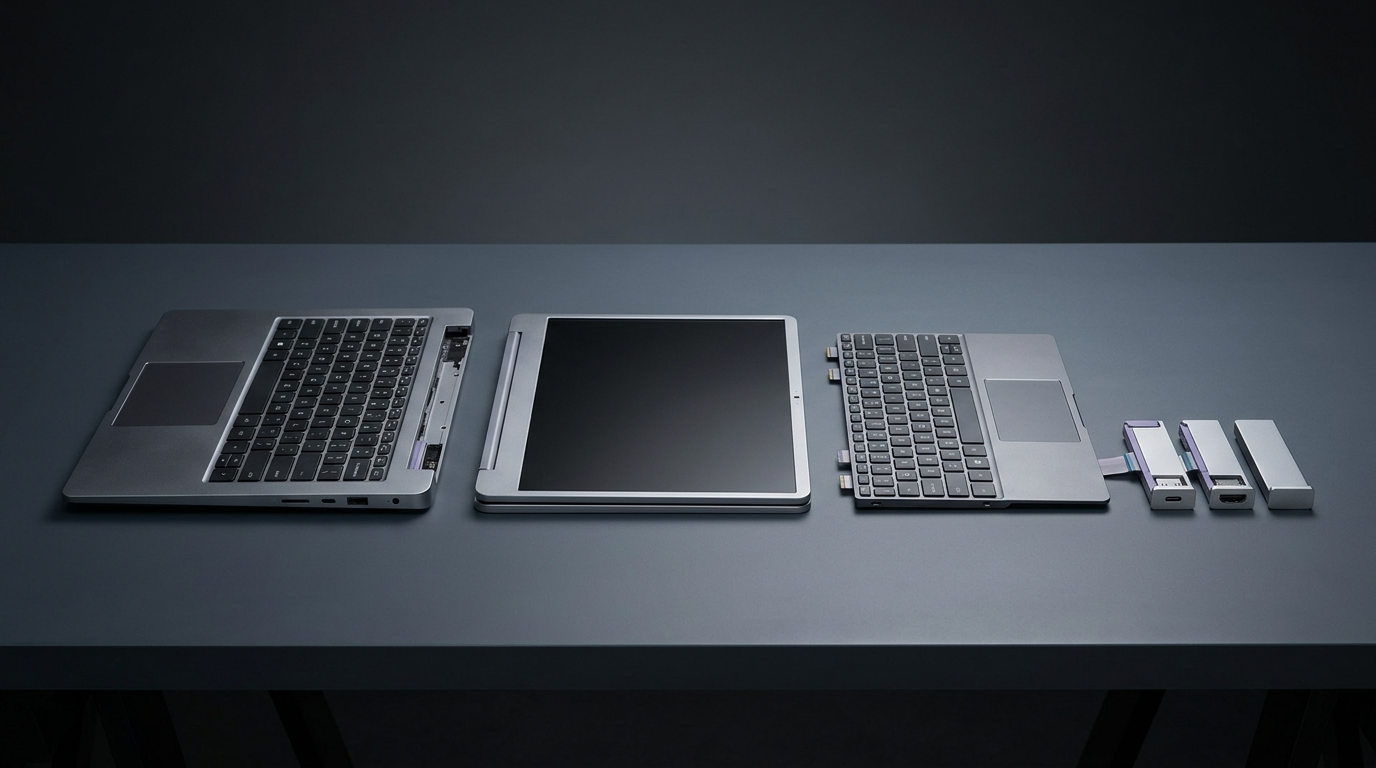
Framework has long occupied a unique niche in the hardware world, advocating for a future where a laptop is a collection of evolving parts rather than a disposable slab. Its most ambitious project, the Framework Laptop 16, has often felt like a proof of concept — a machine for the tinkerer willing to overlook a certain lack of finish in exchange for radical repairability. A series of recent updates suggests the company is now focused on smoothing those edges, moving the device closer to a polished consumer reality.
The most significant shift is the introduction of a new entry-level processor, the six-core Ryzen AI 5 340. By slotting this chip below the existing eight-core Ryzen AI 7, Framework has effectively lowered the financial barrier to its modular ecosystem. The DIY Edition now starts at $1,249, a meaningful reduction from its previous $1,499 entry point. While the volatility of the RAM and storage markets may eventually erode these savings, the move signals an effort to make high-performance modularity more accessible to a broader tier of professionals.
From Proof of Concept to Product
The trajectory of the Framework Laptop 16 mirrors a pattern familiar in hardware startups: ship the ambitious version first, then iterate toward refinement. When the device initially launched, reviewers noted its modular input deck and swappable GPU bay as genuinely novel engineering achievements — but also flagged uneven panel gaps, keyboard flex, and a general sense that the machine prioritized architecture over fit and finish. For early adopters steeped in the right-to-repair movement, these were acceptable trade-offs. For the broader professional market, they were disqualifying.
Framework appears to understand the distinction. Beyond the new processor tier, the company is addressing the machine's visual identity. A new "Translucent Smoke Gray" bezel joins the more vibrant orange and lavender options, offering a more understated aesthetic for professional environments. While seemingly minor, these cosmetic refinements reflect a maturation of the product. The Laptop 16 is beginning to shed its "unfinished" reputation, evolving into a more cohesive tool for those who value longevity as much as performance.
The broader context matters here. The right-to-repair movement has gained significant regulatory momentum in recent years, with the European Union's push for repairability standards and several U.S. states passing legislation that compels manufacturers to make parts and documentation available. Framework has benefited from this tailwind, positioning itself not merely as a niche hardware maker but as a company aligned with an emerging regulatory consensus. Each product refinement strengthens that alignment — it becomes harder to dismiss modular design as hobbyist indulgence when the device sitting on the desk looks and performs like a conventional workstation.
The Modularity Premium and Its Limits
The price reduction to $1,249 for the DIY Edition is strategically important, but it also highlights a persistent tension in Framework's model. Modular laptops carry an inherent structural overhead: the connectors, the standardized bays, the expansion card slots — all of these add cost, weight, and complexity that a traditional sealed design avoids. At $1,249, the Laptop 16 competes with well-established workstation-class machines from Lenovo, Dell, and HP that offer comparable raw specifications in thinner, lighter packages. Framework's value proposition rests on a longer time horizon — the argument that a machine whose CPU, GPU, and input modules can be swapped over years will ultimately cost less than a series of disposable replacements.
That argument is sound in theory but remains largely unproven at scale. Framework's smaller Laptop 13 has demonstrated the concept over several upgrade cycles, building credibility with a loyal user base. The Laptop 16, with its more complex modular GPU system, faces a harder test. Whether third-party module makers eventually enter the ecosystem — or whether Framework remains the sole supplier of its own upgrade path — will determine how far the modularity promise can stretch.
The tension between accessibility and ambition defines Framework's current moment. A lower entry price and a more polished shell remove two of the most common objections. What remains is the deeper question: whether modular computing can scale beyond its enthusiast core without compromising the openness that made it compelling in the first place. The answer likely depends less on any single product update and more on whether the next generation of modules delivers upgrades meaningful enough to justify the architecture's overhead.
With reporting from Ars Technica.
Source · Ars Technica