The consumer electronics industry has long operated on a cycle of planned obsolescence, where a single failing component or an aging processor necessitates the replacement of the entire machine. Framework, the startup that challenged this paradigm with its modular Laptop 13, is now evolving its core product. The newly announced Laptop 13 Pro represents a significant technical leap, powered by Intel's upcoming Panther Lake architecture, yet it remains anchored by a stubborn commitment to backward compatibility.
While Framework describes the 13 Pro as a "ground-up redesign," the company has managed a rare feat in industrial design: maintaining a physical architecture that allows parts from the new Pro model to be swapped into the original 2021 chassis. This persistence of form is more than a gimmick; it is an argument for a circular hardware economy. The new model introduces a haptic trackpad, a custom touch display, and a sleek black finish that evokes the utilitarian elegance of a classic ThinkPad — a comparison CEO Nirav Patel acknowledges as a deliberate nod to professional durability.
Modularity as competitive moat
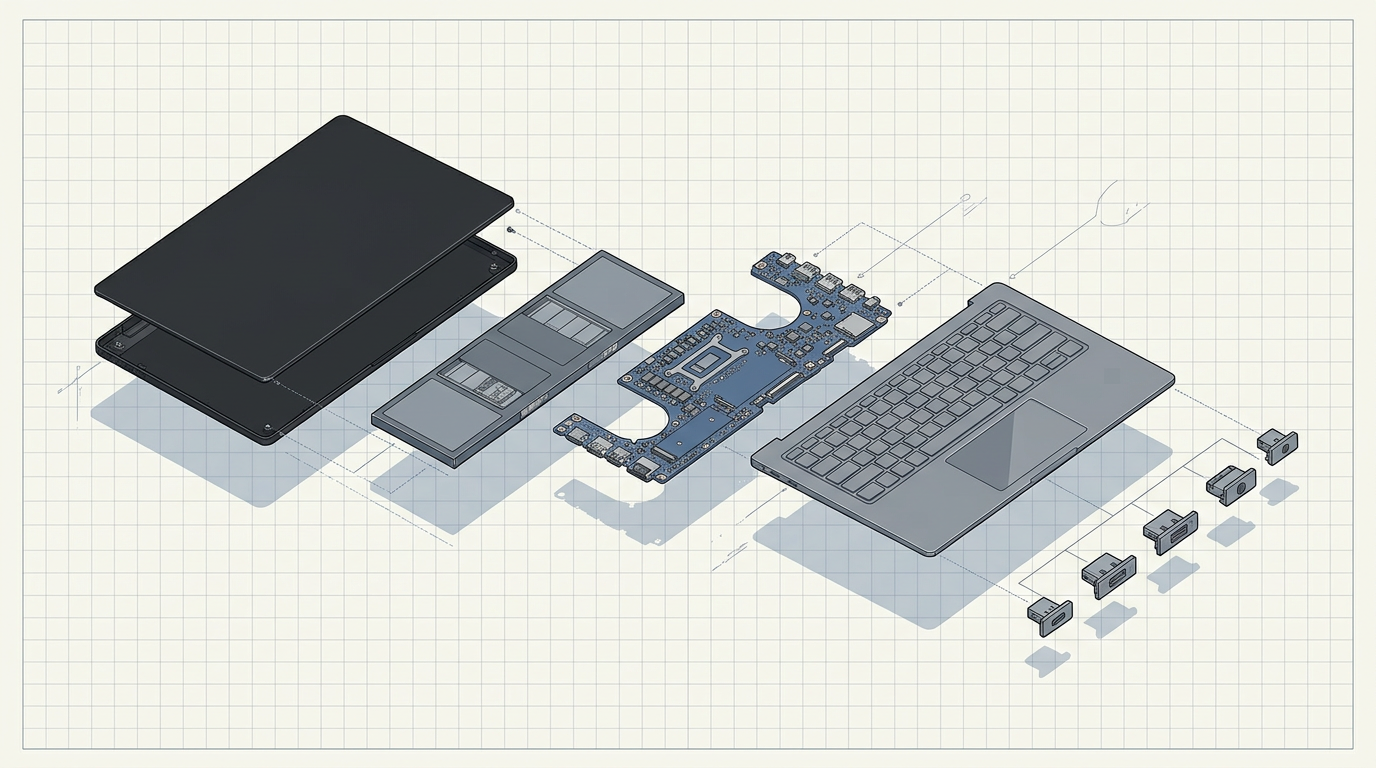
Framework's founding thesis — that laptops should be repairable, upgradeable, and long-lived — arrived at a moment when right-to-repair legislation was gaining traction across the United States and the European Union. The company's original Laptop 13, launched in 2021, demonstrated that a modular consumer notebook could be more than a proof of concept. Its expansion card system, which allows users to reconfigure ports by slotting different modules into the chassis, became the most visible expression of that philosophy.
The Laptop 13 Pro extends this logic into a segment traditionally dominated by Apple's MacBook Pro and Lenovo's ThinkPad X1 line — machines engineered for performance but largely hostile to user servicing. By pairing Intel's Panther Lake chips with the same modular expansion framework, the 13 Pro attempts to demonstrate that professional-grade computing and component-level repairability are not mutually exclusive propositions. Panther Lake, Intel's next-generation mobile architecture, is expected to bring meaningful improvements in power efficiency and integrated graphics performance, which positions the 13 Pro to compete on raw capability rather than ideology alone.
The strategic question for Framework is whether modularity can scale into a market where buyers prioritize thinness, battery endurance, and display quality alongside repairability. The 13 Pro's spec sheet suggests the company is aware of this tension. Its custom touch display and haptic trackpad are the kinds of refinements that signal an ambition beyond the enthusiast niche — a bid for the everyday professional who has no particular attachment to the right-to-repair movement but does want a laptop that feels polished.
The battery problem, addressed
The most pragmatic upgrade addresses the primary critique of previous iterations: battery life. By redesigning the bottom of the chassis and filling out the chamfered edges, Framework has squeezed in a 74Wh battery, a substantial increase from the original 55Wh cell. The company claims this will translate to roughly 20 hours of 4K streaming. If that figure holds under real-world conditions, it would place the 13 Pro in the upper tier of ultraportable endurance — territory that has historically belonged to Apple's M-series MacBooks.
Battery capacity has been a persistent weak point for modular designs. The physical constraints of a chassis built to accommodate swappable components leave less room for cells, and Framework's earlier models reflected that tradeoff. The 74Wh figure suggests the engineering team found space without abandoning the modularity that defines the product. Whether this required compromises elsewhere — in weight, in thermal headroom, in the number of internal components a user can access — remains to be seen once independent reviews arrive.
In an era where hardware is increasingly sealed and soldered, the 13 Pro suggests that "pro" performance does not have to come at the cost of repairability. The broader industry has moved in the opposite direction: Apple's latest MacBooks score poorly on independent repairability indexes, and most Windows ultrabooks have followed suit with soldered RAM and glued-in batteries. Framework's bet is that a growing segment of buyers — whether motivated by sustainability, economics, or simple stubbornness — will choose differently. The tension between that bet and the mainstream market's revealed preference for seamless, disposable design is the dynamic worth watching.
With reporting from Engadget.
Source · Engadget