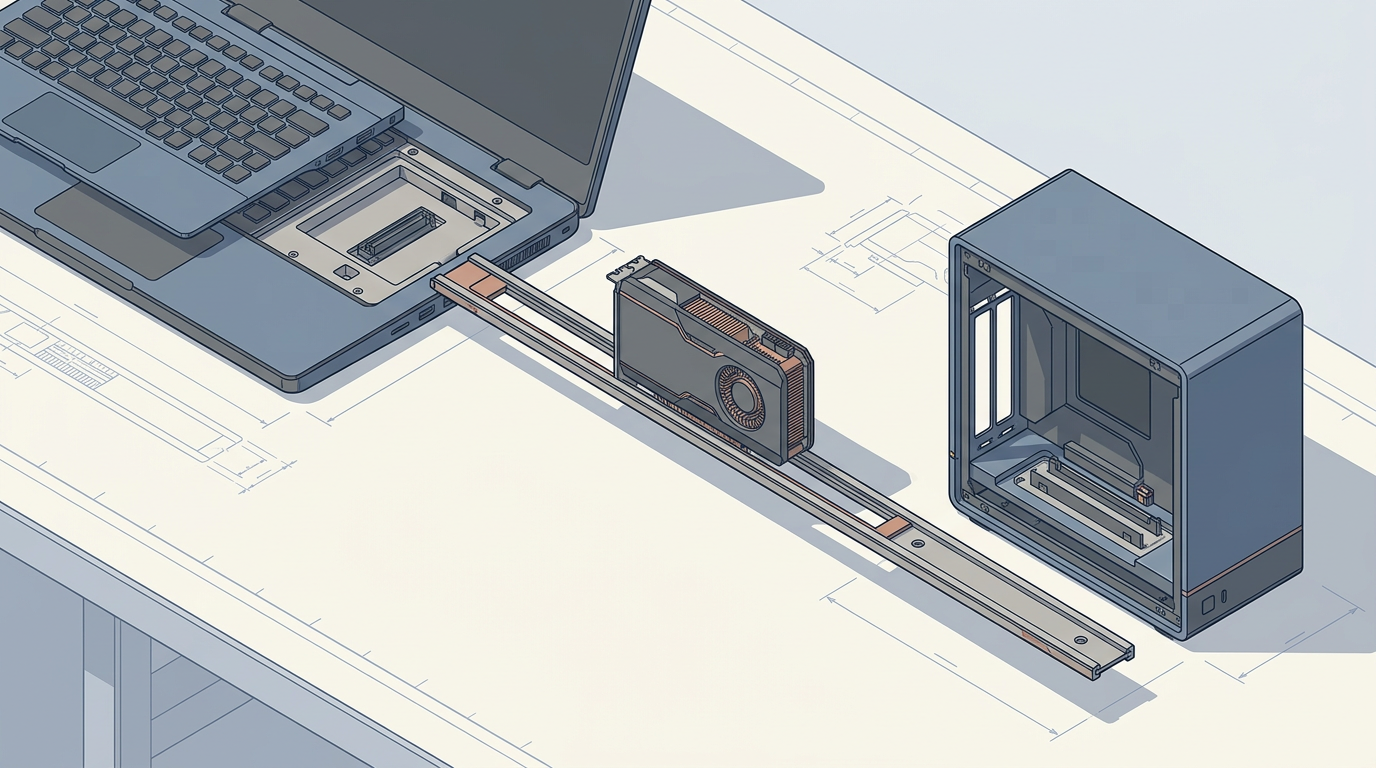
Framework has built its reputation on a counter-cultural premise: that a laptop should be a collection of replaceable parts rather than a sealed, disposable slab. The company's latest release extends that modular philosophy beyond the chassis itself. Framework is now launching external GPU (eGPU) enclosures designed to house the same discrete graphics modules found in its flagship Laptop 16 — turning what would otherwise become obsolete internal components into functional desktop peripherals.
The hardware serves a dual purpose within the Framework ecosystem. For owners of the Laptop 16, the enclosure allows them to upgrade their internal graphics card and repurpose the older module as an external unit rather than letting it gather dust or end up in a recycling bin. For those with smaller machines — including Framework's own Laptop 13 — it provides a path to high-end rendering power through a single cable connection, effectively bridging the gap between portable and stationary computing.
Modularity as industrial strategy
The transition from internal component to external tool represents a meaningful shift in how hardware companies can think about product architecture. By standardizing the form factor of the GPU module across use cases, Framework is attempting to foster a circular lifecycle for high-performance components. A graphics card purchased for a laptop today does not become waste when the next generation arrives; it migrates to a second role on a desk.
This approach stands in contrast to the dominant model in consumer electronics, where components are soldered, glued, and integrated so tightly that upgrading one part means replacing the entire device. Apple's MacBook line, for instance, has moved steadily toward unified memory and non-removable storage — a design philosophy that optimizes thinness and thermal efficiency at the cost of repairability and longevity. Framework occupies the opposite end of that spectrum, betting that a meaningful segment of buyers will accept modest trade-offs in form factor for the ability to maintain, upgrade, and repurpose their hardware over time.
The eGPU concept itself is not new. External graphics enclosures have existed for years, primarily using Thunderbolt connections to link desktop-class GPUs to laptops. But those solutions typically require purchasing a full-size desktop graphics card and a separate enclosure — a combination that can be bulky and expensive. Framework's version is notable because it closes the loop within its own ecosystem: the same module that ships inside a laptop is the module that slots into the external housing. No adapter, no compatibility layer, no second purchase of redundant silicon.
The e-waste calculus
The environmental argument underpinning Framework's strategy is pragmatic rather than aspirational. Electronic waste remains one of the fastest-growing waste streams globally, and high-performance computing components — GPUs in particular — carry a significant environmental footprint in terms of raw materials, energy-intensive fabrication, and short useful lifespans driven by rapid generational improvements. A single lagging component often necessitates the replacement of an entire, otherwise functional system. Framework's modular architecture is designed to interrupt that cycle at the component level.
Whether this model can scale beyond a niche audience remains an open question. Framework's customer base skews toward technically literate buyers who value repairability and are comfortable swapping modules — a profile that does not yet describe the mass market. The company's challenge is not merely engineering; it is persuading a broader consumer base that modularity is worth the effort, and convincing enough component suppliers and software partners to support a standardized module ecosystem that remains viable across multiple hardware generations.
The tension is structural: the economics of consumer electronics reward integration and planned obsolescence, while Framework's model rewards longevity and reuse. The eGPU enclosure is a small but concrete test of whether that second set of incentives can sustain a hardware business — or whether it remains a principled but marginal alternative to the industry's prevailing logic.
With reporting from The Verge.
Source · The Verge