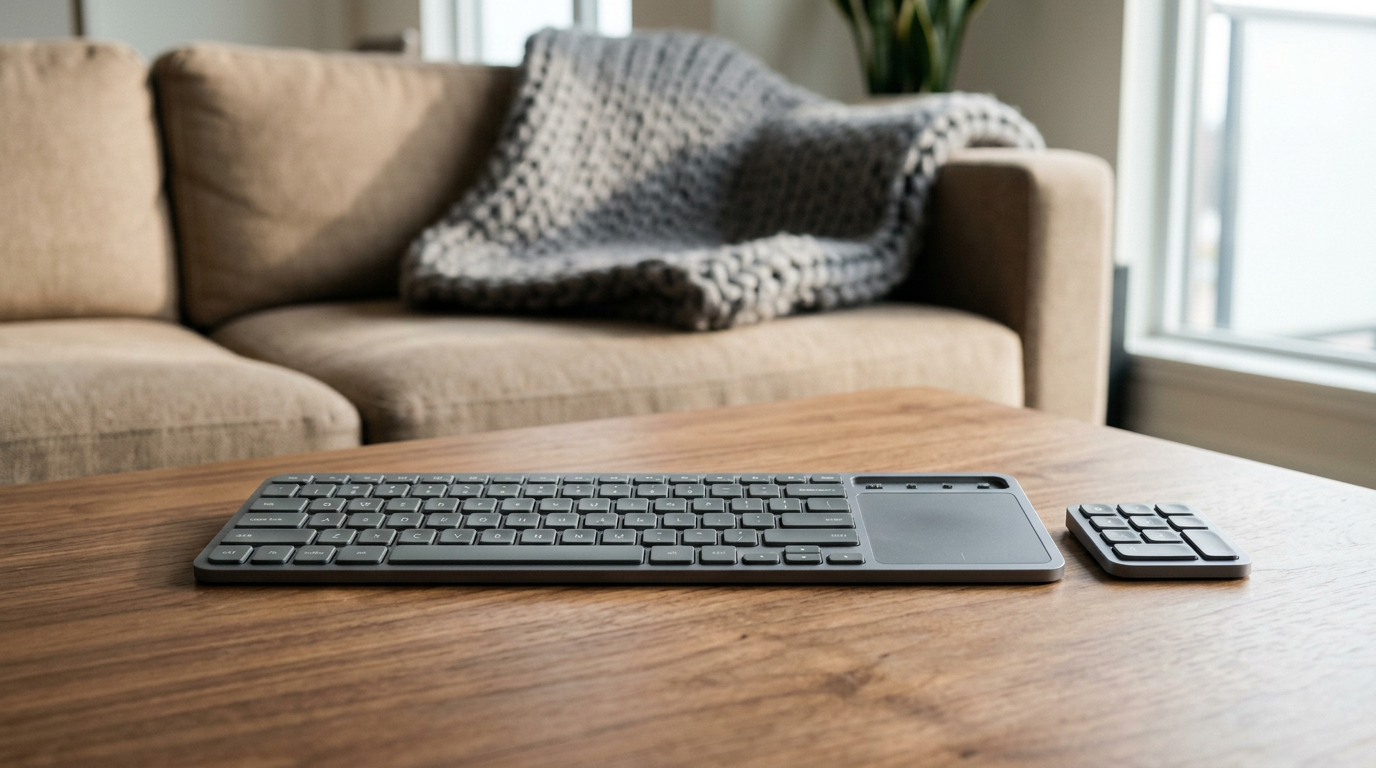
For years, the Logitech K400 has been the undisputed, if unloved, king of the living room. It is a utilitarian slab of plastic — a keyboard-and-trackpad hybrid designed for the specific, low-frequency friction of navigating a PC from a sofa. It is functional, inexpensive, and, according to Framework CEO Nirav Patel, fundamentally unsatisfying to use.
Framework, the startup that gained a cult following for its modular, repairable laptops, is now preparing to challenge that stagnation. Patel's thesis is straightforward: users deserve a better interface for their home-theater setups than the flimsy peripherals currently available. By applying the company's design language to a couch keyboard, Framework aims to turn a neglected hardware niche into a more intentional experience.
A company built on modularity looks for new surfaces
Framework's identity has been defined by a single, persistent argument: consumer electronics should be repairable, upgradeable, and built to last. The company's laptops ship with replaceable ports, swappable input modules, and documented repair guides — a direct rebuke to the sealed-chassis orthodoxy that dominates the notebook market. That philosophy attracted a devoted community of enthusiasts and, more importantly, demonstrated that a small hardware company could carve out a viable position by serving users who feel underserved by incumbents.
A living room keyboard is a logical, if unexpected, extension of that thesis. The home-theater PC market occupies an odd corner of consumer electronics. It sits at the intersection of media consumption, casual computing, and smart-home control — a space where most users default to whatever wireless keyboard is cheapest and most readily available. The Logitech K400 series has filled that role for over a decade, not because it excels at any particular task, but because almost nothing else competes for the job. The category has attracted little serious design attention from major peripheral makers, who tend to focus R&D budgets on gaming keyboards, productivity mice, and other segments with higher margins and more vocal demand.
Framework's entry signals a bet that the audience for thoughtful hardware extends beyond the laptop. If users are willing to pay a premium for a repairable notebook, the reasoning goes, at least a subset of them will pay for a living room peripheral that offers better key feel, a superior trackpad, and the kind of build quality that doesn't feel disposable after six months on a coffee table.
The harder question: market size versus mission
The strategic risk is obvious. Couch keyboards are a niche within a niche. Home-theater PCs themselves represent a small fraction of the broader PC market, and the subset of users who care deeply about input quality in that context is smaller still. Framework would need to price the product high enough to justify the engineering investment while keeping it accessible enough to attract buyers who currently spend a fraction of that amount on a K400.
There is also the question of what modularity means in this form factor. Framework's laptops benefit from a clear upgrade path — new processors, additional memory, fresh displays. A keyboard offers fewer obvious vectors for modular expansion, though swappable wireless modules, replaceable key switches, or configurable macro layouts could provide differentiation.
The broader pattern, however, may matter more than the individual product. Across consumer hardware, a segment of buyers has been migrating toward products that emphasize longevity and tactile satisfaction over disposability and low cost. Mechanical keyboard culture, once a narrow hobbyist pursuit, has grown into a substantial market. The right-to-repair movement has shifted from activist slogan to legislative reality in multiple jurisdictions. Framework's couch keyboard sits at the convergence of these currents — a small product that tests whether the company's philosophy can travel beyond its original category.
Whether the living room represents a meaningful growth vector for Framework or a distraction from its core laptop business depends on execution and on how large the audience for premium peripherals in casual settings turns out to be. The K400 has reigned not because users love it, but because no one has offered a credible alternative. Framework is now asking whether that absence reflects a lack of demand — or a lack of ambition.
With reporting from The Verge.
Source · The Verge