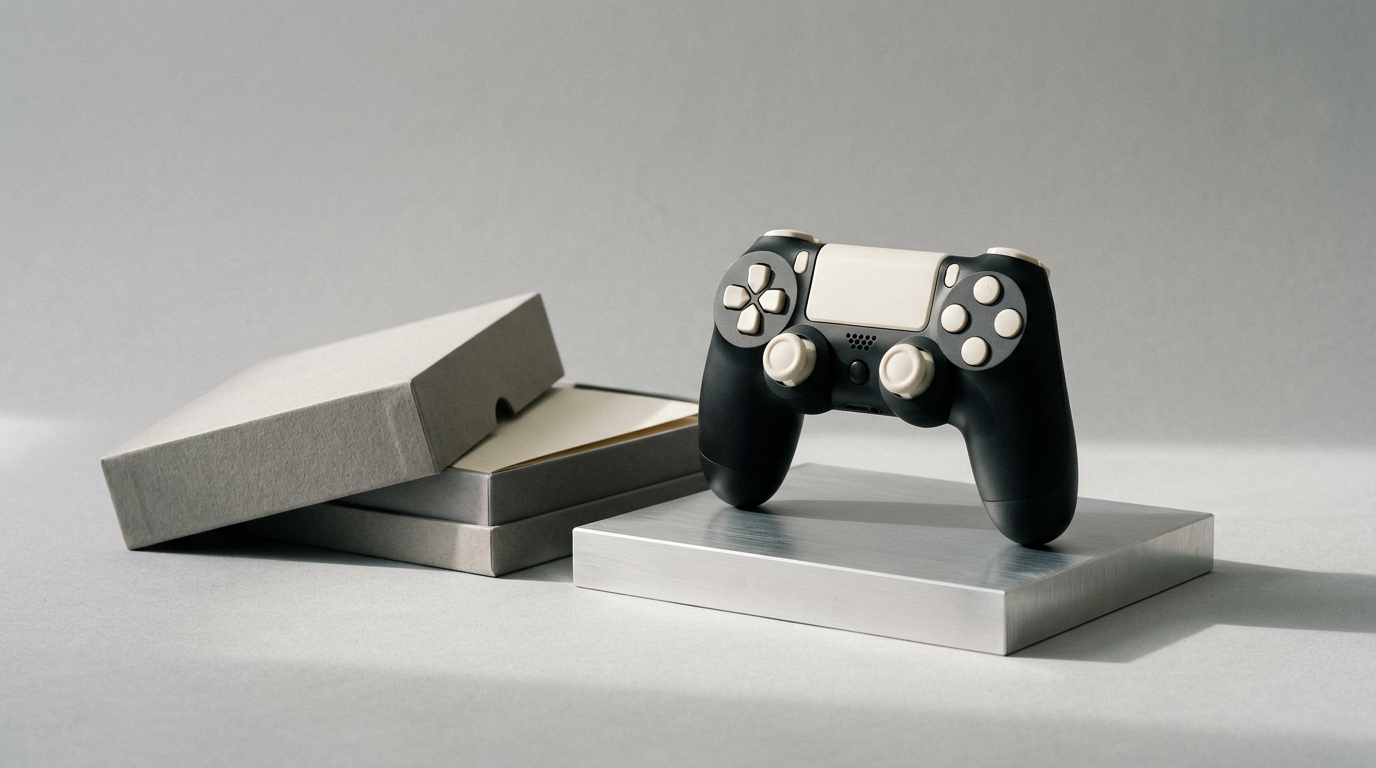
Sony has released a limited-edition DualSense controller themed around Ghost of Yotei, the anticipated sequel to 2020's Ghost of Tsushima. The bundle pairs the redesigned controller with a copy of the game and is currently listed at Brazilian retailers for R$ 699. On its surface, the package is a standard promotional tie-in. Beneath it lies a question that has quietly reshaped the console business: when does a peripheral stop being an accessory and start becoming part of the narrative itself?
The controller features a stark black-and-white motif drawn from the visual language of the Ghost of Yotei universe. Its internal hardware remains identical to the standard DualSense — haptic feedback, adaptive triggers, integrated microphone, motion sensors — but the exterior design is calibrated to evoke the atmosphere of the game's setting. For Sony, this is not a new playbook. The company has released themed DualSense variants for titles like God of War Ragnarök and Spider-Man 2, each time treating the controller shell as a canvas for the franchise's visual identity.
The Peripheral as Cultural Object
The gaming industry's relationship with limited-edition hardware has evolved considerably over the past decade. What began as simple color variants — a red console here, a blue controller there — has matured into a design practice where peripherals are conceived alongside the software they accompany. Nintendo pioneered elements of this approach with special-edition Game Boy units in the late 1990s, but Sony and Microsoft have since turned it into a recurring commercial strategy with higher production values and tighter aesthetic integration.
The underlying logic is partly economic, partly cultural. Limited-run hardware commands a premium not because of superior technical specifications — the internals are unchanged — but because scarcity and design specificity create perceived value. For a segment of consumers, these objects function simultaneously as tools and as artifacts: items that belong on a shelf as much as in a player's hands. The secondary market for sealed limited-edition controllers and consoles reinforces this dynamic, with certain variants appreciating in value well beyond their original retail price.
Sony's DualSense is particularly well-suited to this strategy. Since the PlayStation 5's launch, the controller has served as the flagship demonstration of the console's sensory capabilities. Haptic feedback translates on-screen events into granular physical sensations — the texture of terrain, the tension of a bowstring, the impact of a strike. Adaptive triggers add variable mechanical resistance that maps to in-game actions. In a title rooted in melee combat and environmental exploration, as Ghost of Yotei is expected to be, these features carry meaningful gameplay implications. The themed shell, then, is not merely decorative; it frames the entire tactile experience within the game's world before the console is even powered on.
Where Industrial Design Meets World-Building
The broader trend points to an industry that increasingly treats hardware launches and software launches as unified events. Platform holders benefit from the arrangement in multiple ways: bundles drive attachment rates for new titles, limited editions generate media coverage disproportionate to their production volume, and themed peripherals reinforce brand identity across physical and digital touchpoints.
Yet the strategy also carries tension. Each limited-edition release must balance exclusivity against accessibility. Price the bundle too high or produce too few units, and the offering risks alienating the core audience it is meant to energize. Produce too many, and the scarcity premium — along with the collector appeal — evaporates. Sony has generally erred on the side of constraint, keeping production runs tight enough to sustain demand without creating the kind of supply frustration that generates backlash.
The Ghost of Yotei DualSense bundle is, in isolation, a modest commercial product. But it sits at the intersection of several forces reshaping how games are sold and experienced: the elevation of peripherals into cultural objects, the use of industrial design as narrative extension, and the ongoing bet that physical sensation — not just visual fidelity — defines the next generation of play. Whether that bet continues to justify premium pricing as the console cycle matures remains an open question, one that each new limited edition quietly tests.
With reporting from Canaltech.
Source · Canaltech