Seth Rogen's Houseplant has long operated at a deliberate distance from the stereotypes of cannabis retail. Since its founding, the brand has positioned itself not around the plant alone but around the environment in which it is consumed — the furniture, the tableware, the ritual. Its latest collaboration with Carbone Fine Food, the consumer-packaged-goods extension of Mario Carbone's restaurant empire, is the clearest articulation yet of that thesis: cannabis belongs at the dinner table, not apart from it.
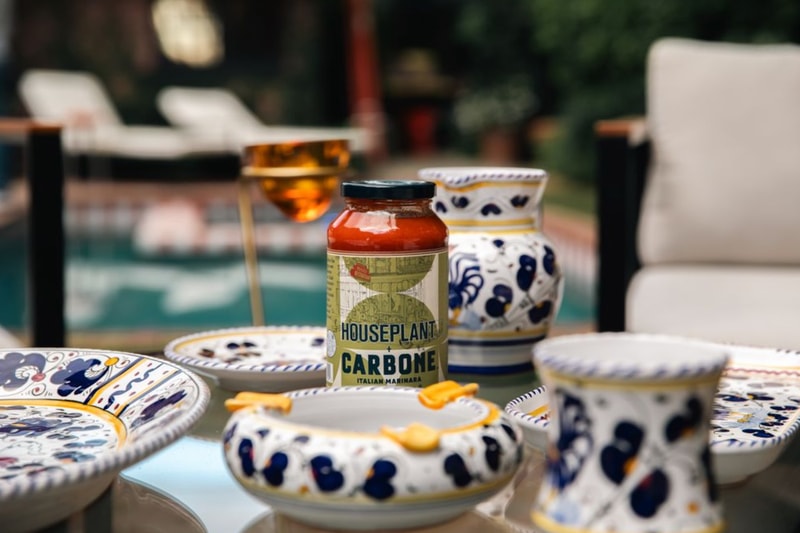
The joint collection, titled "La Dolce Vita," arrived in time with April 20, the date that has served as an unofficial holiday for cannabis culture for decades. Its contents — a co-branded marinara sauce made with Italian tomatoes grown in volcanic ash, a sachet of premium oregano packaged as a "dime bag," a Blood Orange THC beverage inspired by Sicilian citrus, and hand-painted ceramics from the Italian town of Deruta — read less like a merchandise drop and more like the mise en place for a very specific kind of evening.
From Counterculture to Dinner Course
The collaboration is legible only against the backdrop of two parallel shifts. The first is the normalization of cannabis in American consumer life. As legal markets have expanded across dozens of states, the industry's branding challenge has migrated from persuading people to try the product to persuading them it fits into the life they already lead. Early dispensary aesthetics — clinical packaging, reggae iconography, ironic stoner humor — have given way to a design language borrowed from specialty coffee, natural wine, and artisanal food. Houseplant was among the first brands to recognize that the real competition was not other cannabis companies but other lifestyle objects vying for shelf space in a discerning consumer's home.
The second shift is the expansion of restaurant brands into retail. Carbone Fine Food follows a path carved by figures across the hospitality industry who have translated dining-room cachet into grocery-aisle products. Pasta sauces, olive oils, and spice blends bearing the names of celebrated restaurants now occupy a growing segment of the premium packaged-food market. For Carbone, the Houseplant partnership extends that logic one step further: the brand's identity is no longer confined to a red-sauce restaurant on Thompson Street but can travel wherever its products do — including into contexts that a traditional Italian fine-dining establishment might once have considered off-brand.
The "dime bag" of oregano is the collection's most self-aware gesture. It borrows the visual language of illicit cannabis packaging and fills it with a culinary herb, collapsing the distance between the two worlds the collaboration seeks to bridge. It is a joke, but a structurally revealing one: the same small bag that once signaled transgression now signals domesticity.
Craft as Credential
The inclusion of hand-painted Deruta ceramics, featuring the traditional Renaissance-era Orvieto Rooster motif, serves a different function. Where the marinara sauce and THC beverage are consumable — ephemeral by nature — the ceramics are durable goods that anchor the collection in material craft. Deruta has been a center of Italian maiolica production for centuries, and invoking that lineage is a deliberate choice. It positions the collaboration not as novelty but as continuity, suggesting that cannabis accessories can carry the same cultural weight as heirloom tableware.
The Blood Orange THC beverage, meanwhile, points toward a category that remains in its early stages: cannabis-infused drinks designed to occupy the social role of alcohol. Framing the drink through the lens of the Italian aperitivo — a pre-dinner ritual built around bitterness, citrus, and conviviality — is an attempt to give THC consumption a social script that already exists, rather than asking consumers to invent a new one.
Whether the broader market follows this particular template remains an open question. The economics of limited-edition lifestyle collaborations differ sharply from those of mass-market cannabis retail, where price compression and regulatory fragmentation remain persistent challenges. What the Houseplant-Carbone collection does illustrate is a specific theory of how cannabis brands gain cultural legitimacy: not by insisting on the distinctiveness of the category, but by dissolving it into adjacent ones — food, design, hospitality — until the plant is simply one ingredient among many on a well-set table. The tension between that aspiration and the regulatory, social, and commercial realities of the cannabis industry is where the most interesting questions remain.
With reporting from Hypebeast.
Source · Hypebeast