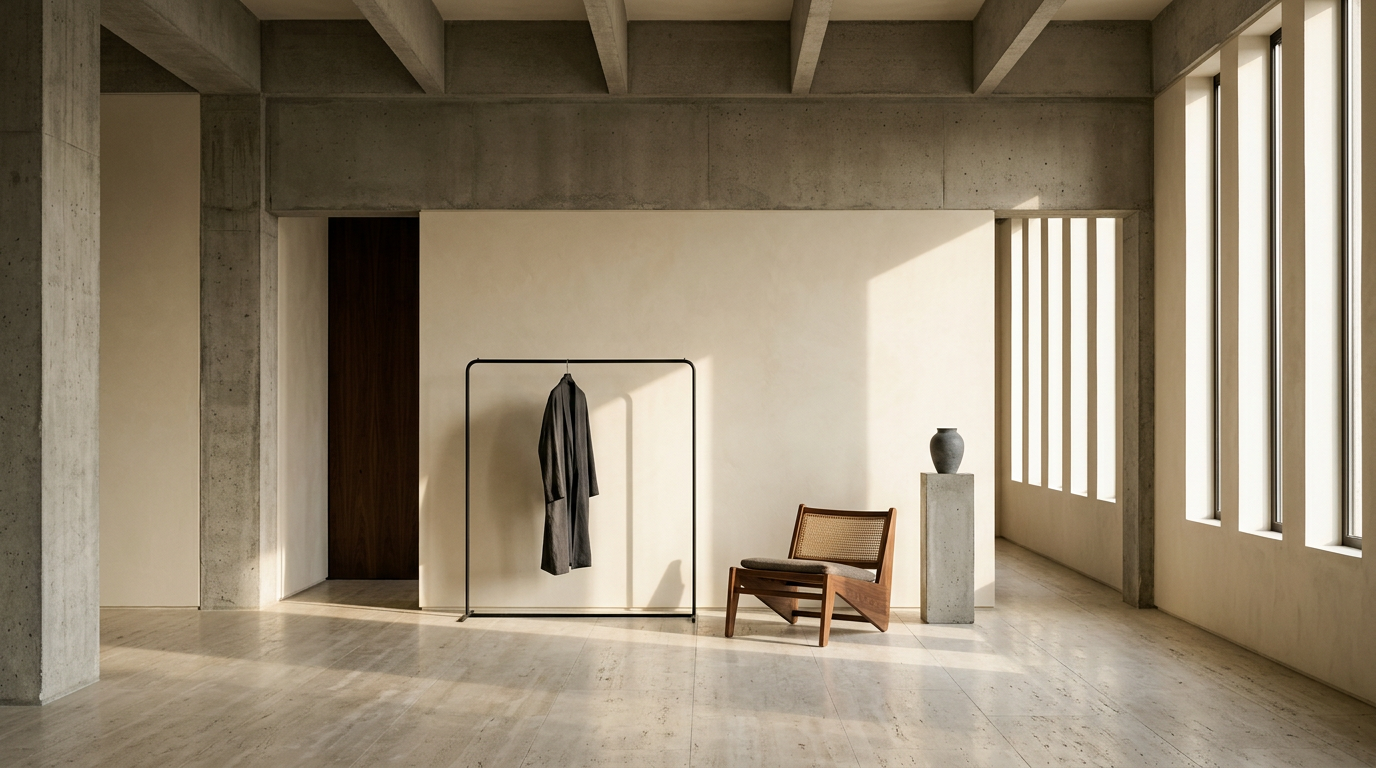
The inherent unpredictability of timber has long presented a challenge for large-scale architecture. While raw veneers offer an organic warmth that synthetic laminates cannot replicate, they often lack the durability and consistency required for high-traffic retail environments or expansive residential projects. Belgian brand Decospan is addressing this friction with its Shinnoki Terra Sapele panels, a prefinished surfacing solution that treats real wood with the rigors of industrial manufacturing.
The panels are defined by a deep mahogany hue and a grain pattern carefully curated to avoid the repetitive, mirrored aesthetics of traditional book-matching. By applying six layers of matte varnish, Decospan achieves a surface that is both scratch-resistant and tactile, preserving the natural texture of the sapele timber while eliminating the glare typically associated with heavy protective coatings.
The prefinished panel as industrial proposition
Sapele — a tropical hardwood native to West and Central Africa, prized for its interlocking grain and reddish-brown depth — has historically occupied a middle ground in architectural specification. It is more affordable than mahogany, more visually complex than oak, yet notoriously difficult to finish on site due to its tendency to tear during sanding. For decades, this made sapele a material better suited to bespoke joinery than to repeatable, large-format applications.
Decospan's approach effectively relocates the finishing process from the construction site to the factory floor. The multi-layer varnishing is applied under controlled conditions before the panels ship, removing the variability that site-applied finishes introduce — humidity fluctuations, dust contamination, inconsistent application thickness. The result is a product that behaves less like a natural material and more like an engineered component, while retaining the visual and tactile qualities that make real wood desirable in the first place.
This is not a new idea in principle. The broader trajectory of architectural surfacing over the past two decades has moved steadily toward prefinished systems, driven by tighter construction timelines and the rising cost of skilled site labor. What distinguishes the Shinnoki line is its insistence on using real veneer rather than printed reproductions. Where many competitors have shifted to digitally printed surfaces that simulate wood grain on melamine or vinyl substrates, Decospan maintains a material link to actual timber — a distinction that matters to specifiers who view authenticity as a non-negotiable quality.
Continuity as design strategy
The practical implications extend beyond surface durability. In applications such as RR Interieur's Kalvekeetdijk residence, the panels are integrated alongside matching edge banding and laminates to create seamless transitions between cabinetry, doors, and walls. This kind of material continuity — where the same species, tone, and finish read consistently across multiple building elements — is difficult to achieve with raw materials alone. Batch-to-batch variation in unfinished veneer can produce visible mismatches when different components are fabricated at different times or by different workshops.
By offering a coordinated system of panels, edge treatments, and laminate counterparts, Decospan is positioning itself not merely as a material supplier but as a specification ecosystem. The logic mirrors what has already occurred in engineered stone and porcelain slab markets, where manufacturers increasingly sell not a single product but a family of matched components designed to work together across an entire interior.
The tension embedded in this approach is worth noting. Prefinished systems optimize for consistency, but consistency is precisely what distinguishes industrial products from craft objects. The warmth that architects seek in natural wood is partly a function of its irregularity — the way light catches a hand-oiled surface differently from one corner of a room to another, the subtle variation that signals human touch. Whether a factory-applied matte varnish, however sophisticated, can fully preserve that quality at scale remains an open question. The answer may depend less on the material itself than on how designers choose to deploy it: as a backdrop that recedes, or as a surface expected to carry the full sensory weight of a space.
With reporting from Dezeen.
Source · Dezeen