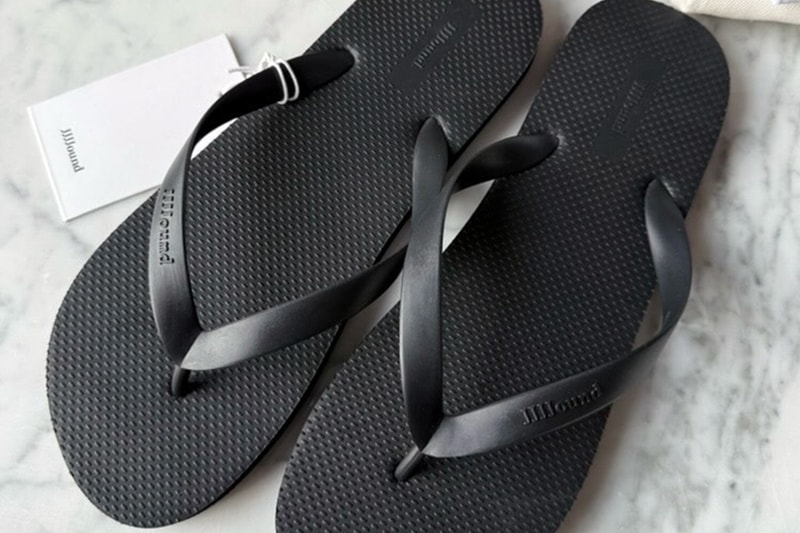
JJJJound, the Montreal-based design studio led by Justin Saunders, has built a formidable reputation not by inventing new forms, but by refining existing ones. Its aesthetic — a digital-age translation of mid-century modernism — favors restraint over ornamentation, turning the "mood board" into a physical product line that prioritizes the essential over the superfluous. The studio's latest teaser, a monochromatic all-black flip flop, is among its most distilled propositions yet: warm-weather footwear reduced to a singular dark silhouette, stripped of technical straps, visible branding, and decorative intent.
While JJJJound is most frequently cited for its high-profile collaborations with footwear giants like New Balance and ASICS — partnerships that often command significant premiums on the secondary market — its in-house lifestyle offerings remain the purest expression of its "elevated basic" ethos. The flip flop teaser signals that the studio's center of gravity may be shifting, or at least broadening, from technical sneaker collaborations toward essentialist lifestyle products that live closer to the body and further from hype cycles.
The flip flop as design object
The flip flop occupies an unusual position in the footwear hierarchy. It is arguably the oldest shoe construction in human history — variations appear in ancient Egyptian murals and Japanese wooden geta — yet it carries almost no design prestige in the contemporary market. It is the garment equivalent of a commodity: ubiquitous, disposable, and largely undifferentiated. That very status is what makes it an attractive canvas for a studio like JJJJound, whose operating logic depends on locating overlooked objects and subjecting them to a disciplined editorial eye.
The approach has precedent elsewhere in fashion and design. Maison Margiela turned the paint-splattered German Army Trainer into a collectible. Muji built a global retail empire on the premise that everyday household goods deserve the same care as luxury items. JJJJound operates in a similar conceptual space, though its distribution model — limited drops, sparse communication, heavy reliance on visual curation through social media — borrows more from streetwear mechanics than from traditional retail. The tension between those two impulses, minimalist design philosophy and scarcity-driven demand, has defined the studio's commercial identity for years.
Applying that framework to a flip flop tests whether the JJJJound proposition can hold without the structural complexity of a sneaker collaboration. A New Balance 990 or an ASICS Gel-Kayano offers material layers — suede, mesh, midsole foam — that provide tangible surfaces for design intervention. A flip flop offers almost nothing: a sole, a thong strap, and a footbed. The design decisions that remain are color, material density, and proportion. In that sense, the product functions less as footwear and more as a statement about how far reduction can go before an object loses its capacity to communicate intent.
Essentials as strategy
The move also reflects a broader current in contemporary fashion, where studios and brands increasingly treat mundane categories — socks, undershirts, slides — with the same rigor once reserved for outerwear and tailoring. This shift is partly commercial: basics offer higher margins, lower production complexity, and year-round relevance. But it is also cultural. As consumer attention fragments across an ever-expanding universe of product drops, the brands that endure tend to be those that anchor themselves in repeatable, recognizable propositions rather than seasonal novelty.
For JJJJound, the flip flop teaser raises a question that extends beyond any single product. The studio's collaborations have demonstrated that its curatorial lens can elevate complex silhouettes with established fan bases. Whether that same lens can sustain interest — and justify a premium — when applied to an object with almost no material or structural differentiation is a different proposition entirely. The answer will depend less on the flip flop itself and more on whether JJJJound's audience values the philosophy behind the product as much as the product itself.
With reporting from Hypebeast.
Source · Hypebeast