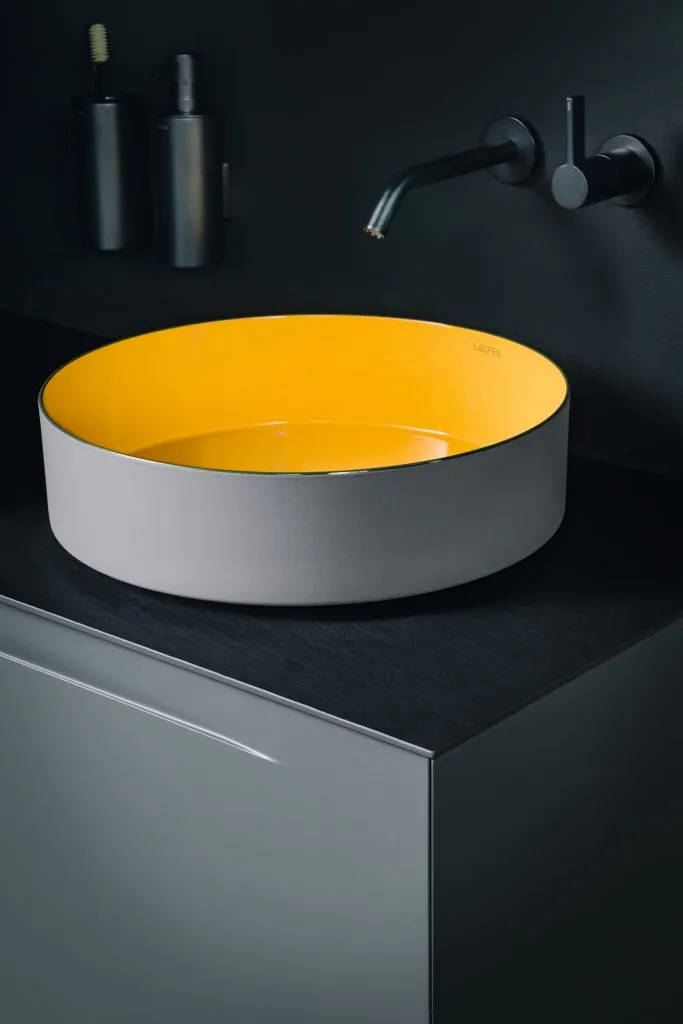
Swiss manufacturer Laufen, long associated with ceramic bathroom fixtures, has introduced a new product range built around colorful glazed steel. The collection marks a material departure for the brand, pairing the structural properties of steel with a vitreous enamel finish — a technique that fuses powdered glass onto metal at high temperatures to produce a smooth, durable surface. The move positions Laufen at an intersection where industrial material science meets the increasingly design-conscious bathroom market.
Glazed steel, sometimes referred to as enameled steel, is not a new material. It has a long history in architecture and industrial design, from early twentieth-century kitchen and hospital fittings to the exterior cladding panels of Jean Prouvé's postwar buildings. What is notable is its reappearance in a premium bathroom context, where ceramics and solid surface composites have dominated for decades.
A material bet beyond ceramics
Laufen built its reputation on fine ceramics, particularly its proprietary SaphirKeramik material, which allowed thinner, more geometrically precise forms than traditional fired clay. Expanding into glazed steel represents a different kind of proposition. Steel substrates can be pressed into shapes that ceramics cannot easily achieve, and the resulting products tend to be lighter and more resistant to impact. The glazed coating, meanwhile, offers the smooth, non-porous surface that bathroom environments demand — resistant to staining, chemicals, and thermal shock.
The emphasis on color is worth noting. Ceramic bathroom fixtures have historically defaulted to white, with matte black emerging as a secondary option in recent years. Glazed steel opens a broader palette because the enamel coating can be formulated in a wide spectrum of hues without the constraints that high-temperature ceramic firing imposes on pigment stability. For architects and interior designers working on hospitality or residential projects where material identity matters, the expanded color range is a functional differentiator, not merely a cosmetic one.
Context in a shifting market
The broader bathroom fixtures industry has been moving toward material diversification for some time. Manufacturers across Europe and Asia have experimented with natural stone, concrete, composite resins, and various metal finishes to distinguish their offerings in a market where form factor alone provides diminishing returns. Laufen's decision to invest in glazed steel fits within this pattern — a search for materials that can deliver both aesthetic range and the performance characteristics that specifiers require.
There is also a sustainability dimension, though one that resists simple conclusions. Steel is recyclable at high rates and glazed steel products can have long service lives, which compares favorably with some composite alternatives. However, the energy intensity of steel production and the vitreous enameling process itself carry their own environmental costs. Whether the lifecycle calculus favors glazed steel over ceramics depends on variables — sourcing, manufacturing energy mix, product longevity — that are difficult to generalize.
For Laufen, the strategic logic may be as much about positioning as about any single material advantage. The Swiss brand competes in a segment where differentiation increasingly depends on offering architects a coherent material vocabulary that extends across basins, bathtubs, and accessories. A glazed steel line that complements rather than replaces the ceramic portfolio gives specifiers more options within a single brand ecosystem.
What remains to be seen is how the architecture and design community responds. Glazed steel carries associations — utilitarian, industrial, mid-century — that may appeal to some aesthetic sensibilities and clash with others. The material's reception will likely depend less on its technical merits, which are well established, than on whether designers find compelling formal language in what it makes possible. The tension between a material's heritage and its contemporary reinterpretation is, in the end, a design problem rather than an engineering one.
With reporting from Architectural Review.
Source · Architectural Review