At Milan's Palazzo Serbelloni, Louis Vuitton has staged a quiet intervention into its own history. For the latest iteration of its "Objets Nomades" collection — the design program the house has maintained since 2012 to explore furniture and objects beyond its core leather goods — the brand has reached back to the 1920s to reissue pieces by Pierre Legrain, the Art Deco designer responsible for Louis Vuitton's first foray into furniture. The exhibition, unveiled during Milan Design Week, functions as a temporal bridge, placing archival trunks alongside contemporary experiments to explore how the language of travel adapts to the domestic sphere.
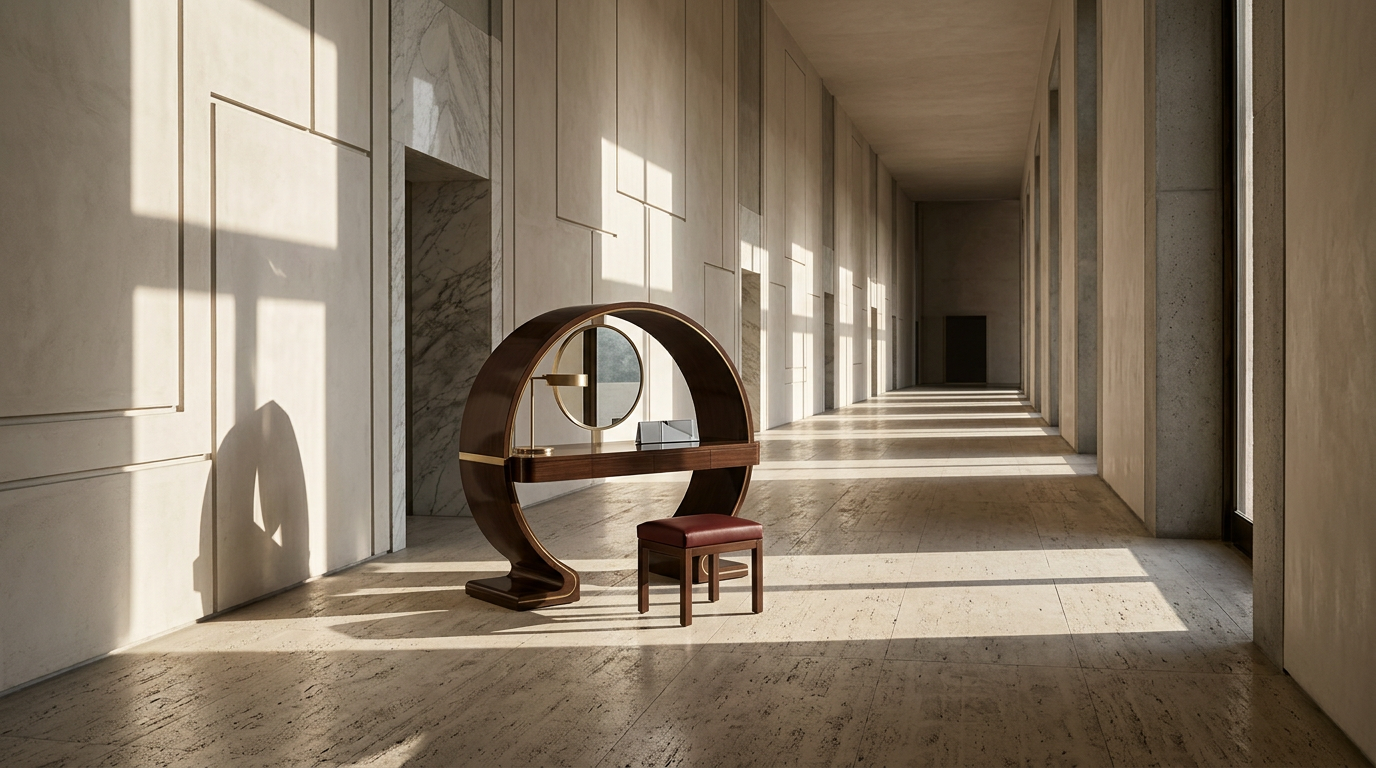
The centerpiece of the retrospective is the "Celeste" dressing table, a reissue of Legrain's debut piece for the house. Defined by its signature Omega silhouette, the table utilizes lacquered wood and Nomade leather to evoke the geometric rigor of the Art Deco era. Nearby, the "Riviera Chilienne" chair — another Legrain resurrection — incorporates wood, leather, and mother-of-pearl marquetry, serving as a reminder of that period's obsession with material opulence and structural clarity.
Legrain and the Art Deco Furniture Tradition
Pierre Legrain occupies an unusual position in the history of decorative arts. Active primarily in the 1920s, he was known first as a bookbinder before expanding into furniture, bringing with him an acute sensitivity to surface, geometry, and the interplay between craft and form. His work for Louis Vuitton represented an early experiment by a luxury maison in extending its identity beyond personal accessories and into the built environment — a move that was far from obvious at the time. The Art Deco movement, which reached its apex at the 1925 Exposition Internationale des Arts Décoratifs in Paris, prized exactly the kind of synthesis Legrain practiced: rigorous geometry softened by rich materials, industrial ambition tempered by artisanal execution.
Reissuing Legrain's pieces is not merely an exercise in nostalgia. It positions Louis Vuitton's current design ambitions within a lineage that predates the contemporary fashion industry's turn toward lifestyle branding by nearly a century. Where many luxury houses have entered furniture and home goods in the past two decades — often through licensing arrangements or collaborations with established design studios — Louis Vuitton can credibly claim a deeper genealogy. The Legrain reissues make that claim tangible.
Contemporary Counterpoints and the Logic of "Objets Nomades"
This historical grounding provides a counterpoint to the more speculative contemporary works on display. In the Boudoir section of the exhibition, Estudio Campana's "Cabinet Kaléidoscope" and the shimmering "Cocoon Dichroic" chair represent a shift toward fluid, almost organic forms. While Legrain's work focused on the architectural stability of the early twentieth century, these modern additions suggest a vocabulary of iridescent surfaces and intricate leather marquetry that owes more to digital aesthetics than to Parisian ateliers.
The curatorial choice to house these disparate eras within a period-style train car and the grand halls of the Palazzo is deliberate. It frames luxury not as a static style, but as a continuous evolution of craftsmanship — one in which the trunk, Louis Vuitton's founding object, serves as a recurring motif. The trunk was always a container for movement; the "Objets Nomades" program extends that logic, asking what happens when the ethos of travel — portability, adaptability, material resilience — is applied to domestic furniture.
The broader context matters as well. Milan Design Week has become the primary stage on which fashion houses compete for cultural authority beyond the runway. Hermès, Loewe, Dior, and others have all invested heavily in design exhibitions during the annual Salone del Mobile. The stakes are partly commercial — furniture and home goods represent a growing revenue category for luxury conglomerates — but also symbolic. A credible presence in design signals depth of craft and institutional seriousness in ways that seasonal fashion collections, by their nature ephemeral, cannot.
Louis Vuitton's decision to anchor its Milan presentation in archival reissues rather than pure novelty sets a distinct tone. It suggests confidence in the house's own history as a source of creative authority — and raises an implicit question about the rest of the luxury sector's design ambitions: how many of them can point to a comparable heritage, and how many are building from scratch?
With reporting from Hypebeast.
Source · Hypebeast