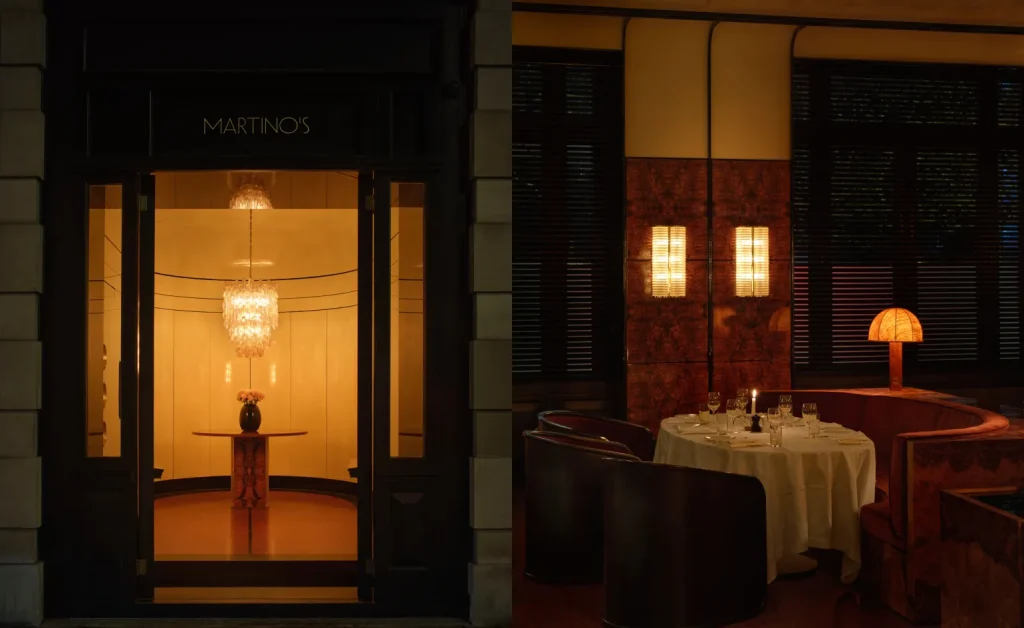
In the carefully manicured landscape of London's Sloane Square, the newly opened Martino's attempts a difficult architectural feat: appearing as if it has always been there. Developed by restaurateur Martin Kuczmarski—the mind behind Mayfair's The Dover—the space eschews the fleeting trends of modern hospitality in favor of a grounded, Milanese-inflected permanence. It is a room designed for the long arc of the day, transitioning from the sharp clarity of breakfast to the amber-lit intimacy of late-night service.
The interior, a collaboration with Milanese firm Studio Dragò, reflects a sophisticated material literacy. Lead designer Fanny Baeur Grung has assembled a palette that balances mid-century warmth with a rigorous geometric restraint. Glossy timber paneling is set against burgundy Venetian terrazzo floors, while black lacquered accents provide a structural frame that feels both historic and contemporary. The lighting—custom Murano glass lamps—serves as a soft, atmospheric glue, holding the various textures of the room in a quiet, flattering equilibrium.
The Architecture of an All-Day Room
At the center of the floor plan sits a sweeping, curved bar wrapped in dark timber and brass. This architectural anchor dictates the flow of the room, serving as a pivot point between the casual pace of a morning espresso and the more formal rituals of the dining room. The all-day format is itself a design problem as much as an operational one: a space must read differently at noon than it does at ten in the evening, yet remain coherent across those shifts. Martino's addresses this through material choices that respond to changing light rather than through reconfigurable furniture or theatrical set-pieces. Terrazzo, timber, and lacquer each absorb and reflect daylight and candlelight in distinct ways, giving the room a chromatic range that unfolds passively over the course of a service.
This approach has a lineage. The Milanese bar tradition—exemplified by institutions such as Bar Basso and Caffè Cova—has long treated the all-day venue as a civic space rather than a purely commercial one. The design grammar of those interiors tends toward durable materials, restrained palettes, and furniture scaled for long occupation. Studio Dragò's work at Martino's draws on that tradition without replicating it literally, translating a Mediterranean spatial logic into a Chelsea context where the surrounding streetscape is Georgian rather than Rationalist.
Here, executive chef Valentino Pepe offers a confident interpretation of Italian classics, providing a culinary weight that matches the gravity of the surroundings. The kitchen's role in the overall design equation should not be understated: an all-day room that lacks a menu capable of sustaining the same tonal shifts risks becoming a beautiful but underused lobby.
Restraint as Strategy in London's Hospitality Market
London's high-end restaurant scene has, in recent years, oscillated between two poles. One favors maximalist spectacle—immersive interiors, dramatic lighting rigs, open kitchens staged as theater. The other leans toward a studied minimalism that can, at its worst, feel austere and unwelcoming. Martino's occupies a narrow corridor between the two, relying on material richness rather than visual volume. The burgundy terrazzo, the Murano glass, the brass detailing—these are not minimal choices, but they are deployed with enough discipline to avoid the cluttered opulence that characterizes many of Chelsea's dining rooms.
Kuczmarski's previous work at The Dover suggests a consistent interest in this middle register: spaces that feel considered without feeling curated for a camera. It is a distinction that matters commercially as well as aesthetically. Restaurants designed primarily for photographic reproduction often age poorly once the initial social-media cycle fades. Spaces built around tactile material quality and spatial proportion tend to accrue character over time, rewarding repeat visits rather than one-time documentation.
Whether Martino's can sustain that sense of settled permanence will depend on factors beyond its walls—the rhythms of the neighborhood, the durability of its kitchen, the willingness of its clientele to treat it as a local fixture rather than a destination. The design has done its part by refusing to announce itself too loudly. What remains to be seen is whether a room built to feel timeless can earn that quality in a city where the next opening is always a few weeks away.
With reporting from The Cool Hunter.
Source · The Cool Hunter