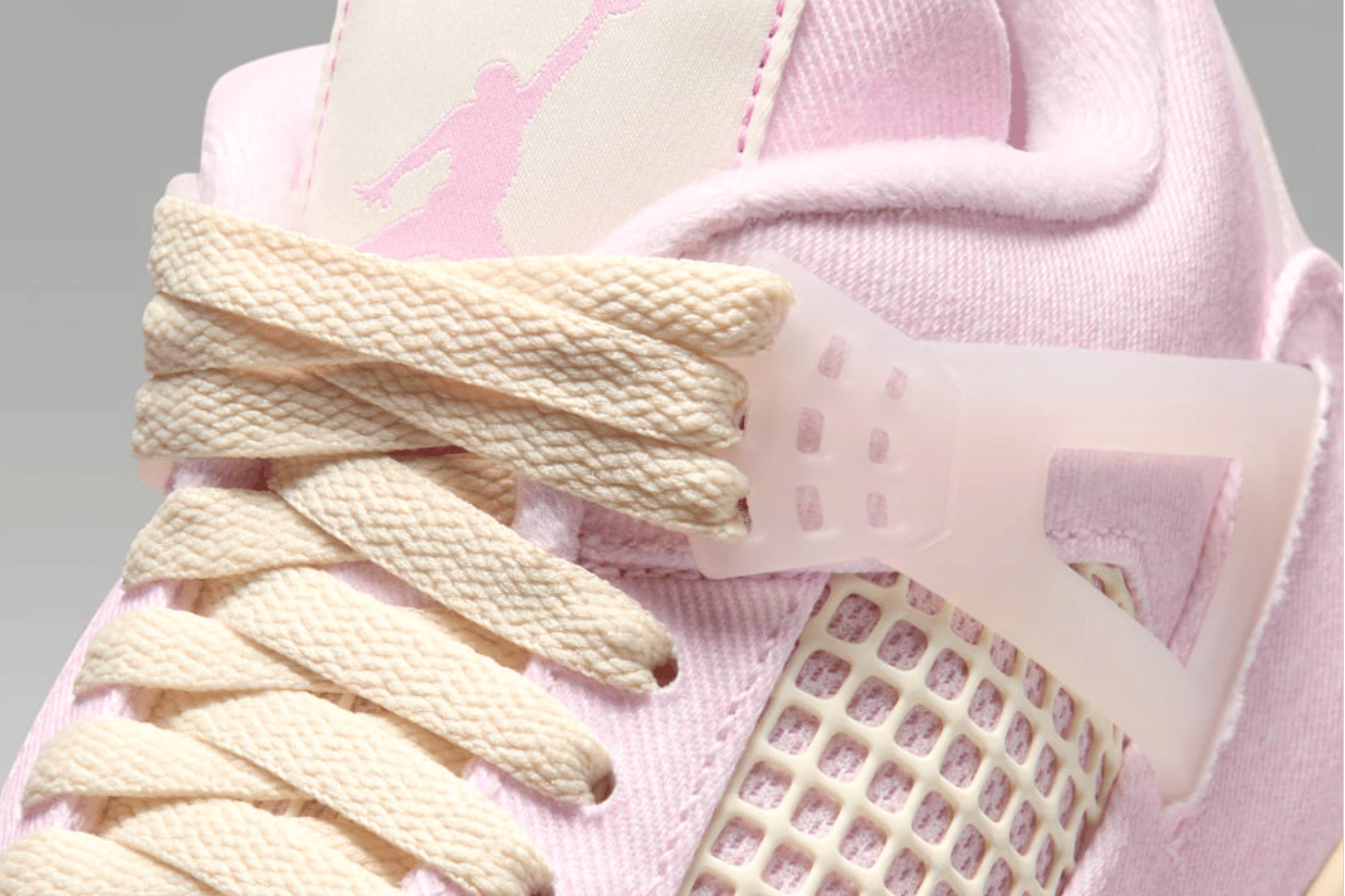
The Air Jordan 4, a silhouette that has served as a foundational pillar of sneaker culture since 1989, often oscillates between archival reverence and experimental risk. The upcoming "Pearl Pink and Iced Carmine" edition falls decisively into the latter category, eschewing standard leather uppers for a more complex, tactile arrangement of synthetic leather and denim. The shoe launches April 23 for $220, but the release merits attention less for its price point than for what it signals about how Nike continues to extract cultural relevance from a design that is now more than three decades old.
The design relies on a nuanced interplay of texture rather than mere color blocking. By layering denim against a soft pink base, the shoe achieves a structural depth that feels more intentional than a simple palette swap. The inclusion of "Iced Carmine" accents provides a sharp visual anchor, preventing the pastel tones from feeling overly delicate or washed out. Beneath the experimental exterior, the shoe retains its functional DNA — standard Nike Air cushioning in the heel, a foam midsole, and a durable rubber outsole.
Materiality as strategy
The decision to build an Air Jordan 4 around denim is not without precedent in Nike's broader catalog. The brand has periodically introduced non-standard textiles across its retro lineup — canvas, woven nylon, corduroy — as a way to recontextualize familiar shapes without altering their proportions. The logic is straightforward: when a silhouette's geometry is culturally fixed, the primary lever for novelty becomes surface treatment. Materiality, in this framework, functions as a design language in its own right.
Denim carries particular weight in that equation. It is among the most culturally loaded textiles in Western fashion — associated with workwear heritage, counterculture, and a kind of democratic casualness that maps neatly onto sneaker culture's own self-image. Placing it on the Air Jordan 4, a shoe originally designed by Tinker Hatfield with performance basketball in mind, creates a deliberate friction between athletic origin and lifestyle destination. That friction is the point. It signals that the shoe exists not to be played in, but to be read — as an object with references that extend beyond the court.
The "Pearl Pink" colorway reinforces this positioning. Pastel palettes on men's sneakers have moved from novelty to near-default over the past several years, driven in part by broader shifts in menswear toward softer tones and less rigid color conventions. A pink denim Jordan 4 would have been a provocation a decade ago. Today it reads as fluent in the prevailing aesthetic vocabulary, which itself says something about how quickly the boundaries of acceptable sneaker design have expanded.
The retro silhouette as canvas
Nike's approach to the Air Jordan 4 reflects a wider industry pattern in which legacy silhouettes are treated less as products to be faithfully reproduced and more as platforms for iterative experimentation. Adidas has pursued a similar logic with the Samba and Gazelle, while New Balance has done so with the 990 series — each brand cycling through colorways, collaborations, and material swaps to sustain commercial velocity on shapes that are, structurally, decades old.
The economic rationale is clear. Retro silhouettes carry built-in recognition and emotional equity, which reduces the marketing burden required to generate demand. Each new material or color treatment functions as a limited editorial statement layered onto a known form, allowing the brand to occupy shelf space continuously without the risk profile of an entirely new design. The question is whether this model has a ceiling — whether consumers will eventually tire of seeing the same geometry in new clothing, or whether the depth of cultural attachment to shapes like the Jordan 4 is effectively inexhaustible.
For now, the "Pearl Pink and Iced Carmine" release suggests Nike is betting on the latter. The shoe does not attempt to reinvent the Air Jordan 4. It asks, instead, how many different things the Air Jordan 4 can become while remaining recognizably itself. The answer to that question will depend not only on design ingenuity but on whether the consumer appetite for legacy sneakers continues at its current pace — or whether the next shift in taste favors shapes that have no archive to reference at all.
With reporting from Highsnobiety.
Source · Highsnobiety