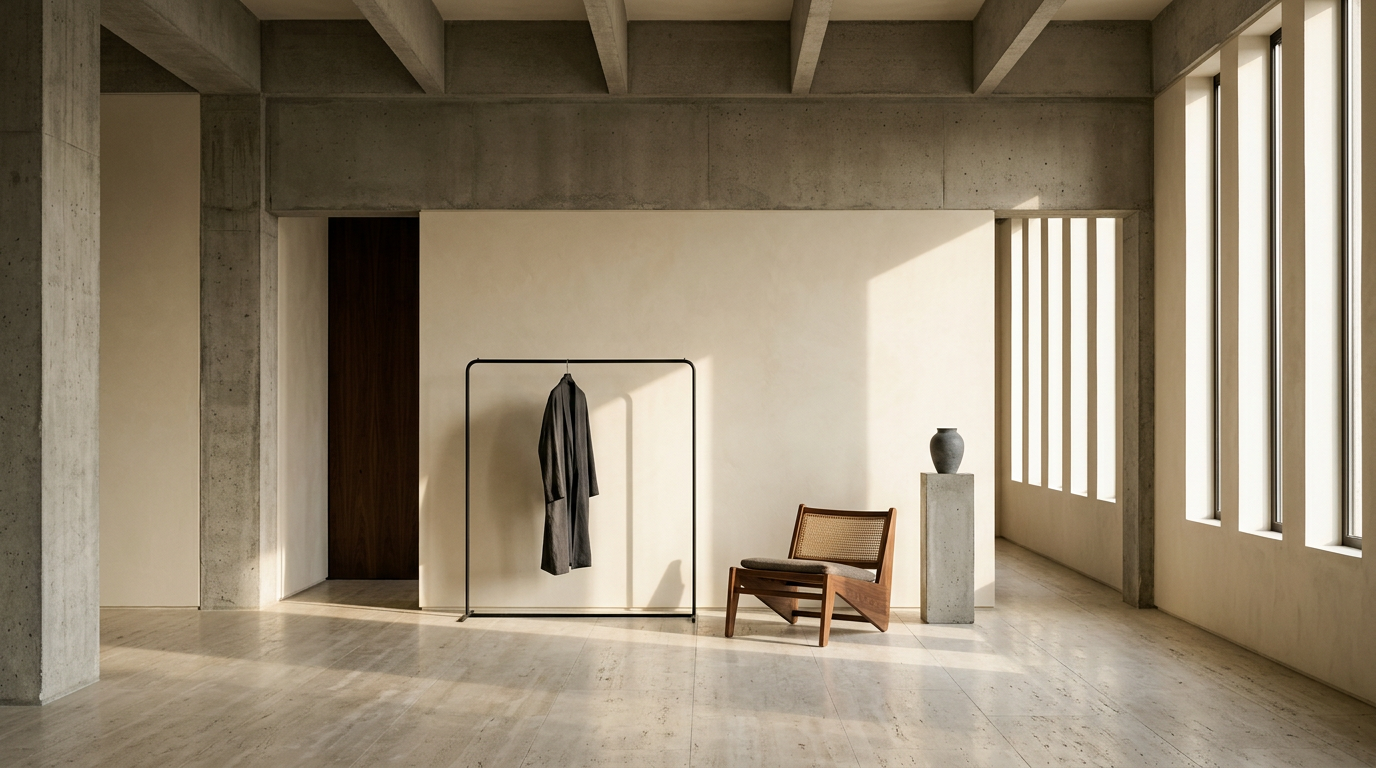
At Milan Design Week 2026, the "Soft Matters" installation marks an inflection point for the Italian furniture brand Secolo. For the first time in its history, the label has opened its design process to an external collaborator, partnering with the Copenhagen-based studio Tableau. The resulting collection is a study in controlled spontaneity — furniture defined by undulating silhouettes and hand-drawn floral patterns applied without sight — presented within a space framed by butter-colored foam blocks and playful illustrations.
The collaboration pairs two studios with distinct lineages. Secolo has built its reputation on Italian manufacturing precision, producing furniture that leans on clean geometry and lacquer finishes. Tableau, founded by Julius Værnes Iversen, operates from a more experimental register, with a body of work that treats furniture and objects as carriers of personal ritual. The decision by Secolo to invite an outside creative voice into its process signals a willingness to test the boundaries of a brand identity built on controlled refinement.
Blind Drawing as Design Method
The conceptual anchor of "Soft Matters" is a technique Iversen calls "blind drawing." For a decade, he has practiced sketching flowers from memory with his eyes covered — a process he describes as a form of meditation. The method strips away the self-editing that typically governs design work, producing marks that are loose, imperfect, and unrepeatable. For this collection, Iversen invited Secolo's founders to participate in the ritual, applying these intuitive, sightless drawings directly onto furniture surfaces before lacquering sealed them in place.
The approach sits within a broader current in contemporary design that privileges process over polish. Practices such as automatic drawing, long associated with Surrealism and mid-century ceramics, have resurfaced in recent years as designers seek to differentiate handmade work from the uniformity of digital fabrication. What distinguishes Iversen's method is its deliberate constraint: the closed eyes enforce a surrender of visual control that even the most gestural freehand drawing does not require. Each resulting piece — including the Pingu side table, which carries one-of-a-kind floral patterns — becomes a record of a specific moment of attention rather than a designed motif.
The technique also raises practical questions about scalability. A pattern that cannot be reproduced sits uneasily within the economics of furniture manufacturing, where consistency across production runs is a baseline expectation. Whether "Soft Matters" remains a limited-edition statement or informs Secolo's broader catalog will say much about how the brand intends to balance craft narrative with commercial reality.
The Trace Sofa and the Politics of Form
Beyond the graphic elements, the partnership introduced the Trace sofa, an undulating form designed to disrupt traditional seating arrangements. Iversen characterizes the piece as a "conversation starter," prioritizing impactful, organic geometry over standard utility. The sofa's curves resist the rectilinear logic that dominates most residential layouts, demanding that a room be organized around it rather than absorbing it into an existing scheme.
This kind of formal assertiveness has precedent. Designers from Gaetano Pesce to the Campana Brothers have long used exaggerated, biomorphic shapes to challenge the assumption that furniture should be spatially neutral. The Trace sofa operates in that tradition, though filtered through a Scandinavian restraint that keeps the proportions livable rather than sculptural. The tension between Italian material ambition and Danish formal discipline gives the piece its particular character — neither fully maximalist nor minimal, but occupying a deliberate middle register.
The broader signal from "Soft Matters" concerns the evolving definition of luxury in furniture. For decades, the category has been anchored in material quality and manufacturing precision. A growing number of collaborations at Milan — and across the design calendar — suggest that the idiosyncratic mark of the human hand now carries its own premium. The question is whether that premium attaches to the object itself or to the story surrounding it, and whether consumers will value imperfection at the price points Italian manufacturing commands. Secolo's experiment does not answer that question, but it sharpens the terms of the debate.
With reporting from Dezeen.
Source · Dezeen