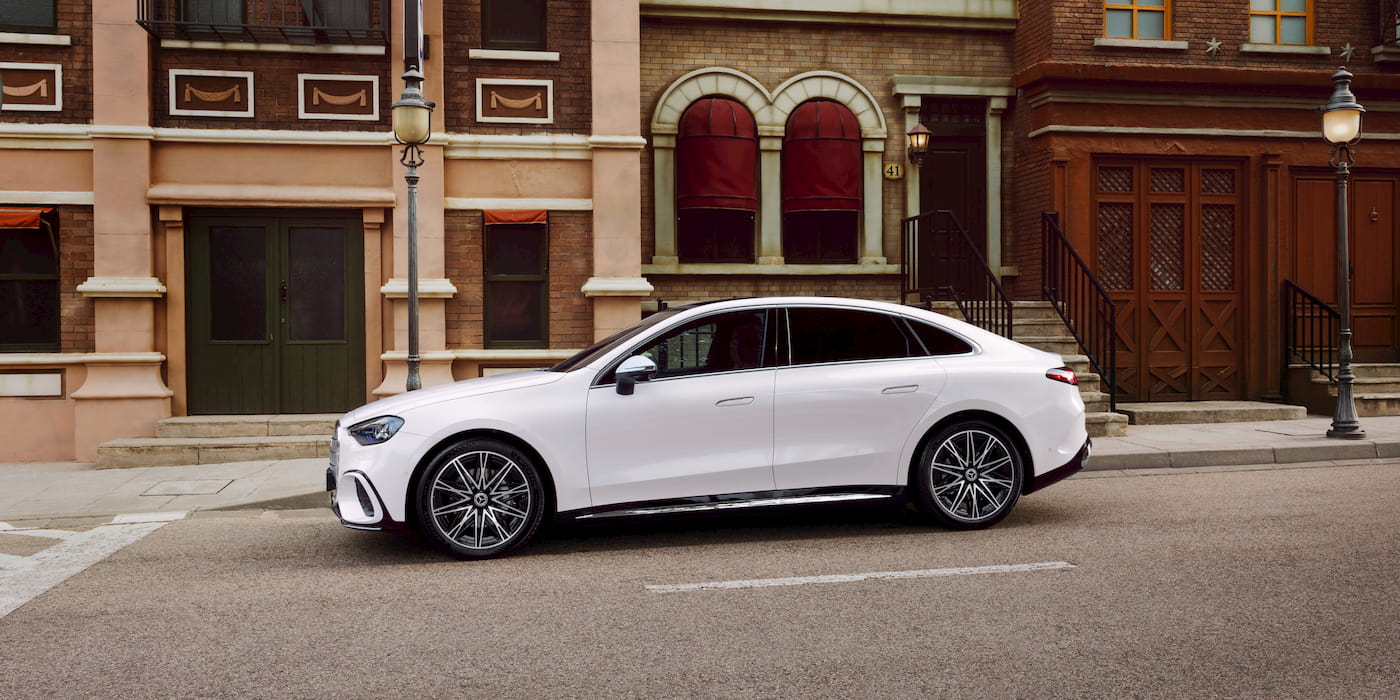
The C-Class has long served as the commercial backbone of Mercedes-Benz — a sedan that translated the brand's luxury credentials into a high-volume proposition accessible to a broader segment of buyers. With the debut of an all-electric version, the German automaker is making a pointed strategic statement: the entry point to the Mercedes sedan lineup should no longer feel like a compromise.
The electric C-Class, unveiled with a claimed range of 473 miles on a single charge, pairs that headline figure with engineering ambitions that reach well above its price segment. Early reports describe a ride quality calibrated to rival the S-Class, the brand's flagship limousine and long-standing benchmark for refinement. Inside, an expansive digital display dominates the dashboard, extending the "digital-first" interior philosophy Mercedes-Benz has been rolling out across its portfolio since the EQS launched several years ago.
Closing the Gap Between Entry and Flagship
The traditional logic of automotive luxury has always relied on clear stratification. Buyers paid more for the S-Class because it offered meaningfully superior comfort, technology, and isolation from the road. The C-Class, by contrast, was expected to be "good enough" — refined relative to competitors, but visibly a tier below the brand's own flagship.
Electrification disrupts that hierarchy in ways that are difficult for legacy automakers to manage. Electric drivetrains are inherently smoother and quieter than combustion engines, which means the baseline experience in any well-engineered EV already approaches what only the most expensive sedans could deliver a decade ago. If the electric C-Class genuinely narrows the experiential gap with the S-Class, Mercedes-Benz faces a familiar tension in the luxury industry: how to justify premium pricing on higher-tier models when the underlying technology democratizes the core product attributes.
This is not a problem unique to Mercedes. BMW has navigated similar questions with its i4 and i7 lineup, and Audi's electric sedans have blurred the boundaries between the A6 and A8 segments. The broader pattern across German luxury brands is one of convergence — electric platforms flatten the traditional performance and comfort curves that once separated model tiers cleanly.
Range as a Competitive Lever
The 473-mile range figure, if it holds under real-world conditions, would position the electric C-Class at the upper end of what mid-size electric sedans currently offer. Range remains one of the most scrutinized metrics among buyers considering the switch from internal combustion, particularly in the luxury segment where long-distance driving expectations are high and tolerance for inconvenience is low.
Mercedes-Benz has invested heavily in battery chemistry and aerodynamic efficiency across its EV lineup, and the C-Class appears to benefit from those cumulative gains. A sleeker exterior profile — a departure from the more conservative silhouette of its combustion predecessors — suggests that aerodynamic optimization played a significant role in achieving the range target.
The competitive context matters. The mid-size luxury sedan segment has been losing ground to electric crossovers and SUVs for years. Tesla's Model 3 redefined expectations for what an electric sedan could offer at scale, while brands like BMW and Polestar have staked out positions in the same space. Mercedes-Benz is betting that a combination of range leadership, ride quality, and brand prestige can defend the sedan form factor in a market that has been drifting toward higher-riding alternatives.
Whether that bet pays off depends on factors beyond the vehicle itself — charging infrastructure maturity, pricing relative to crossover alternatives, and whether buyers in this segment still value the traditional sedan proposition. The electric C-Class makes a strong technical case for itself. The open question is whether the market it targets is growing or contracting, and whether closing the gap with the S-Class creates as many problems for Mercedes-Benz's lineup coherence as it solves.
With reporting from Electrek.
Source · Electrek