In the Flatiron District's historic United Charities Building, London-based specialty coffee brand WatchHouse has opened its third Manhattan location — a space that eschews the typical rustic warmth of modern coffee shops for a rigorous, minimalist material palette. Designed by UK studio Thomas-McBrien Architects, the 1,800-square-foot interior draws heavily from the mid-century architectural language of New York and the geometric precision of artist Donald Judd. The project marks a continued transatlantic expansion for a brand that built its reputation in London's Bermondsey neighbourhood, where its original café occupies a converted 19th-century watch tower.
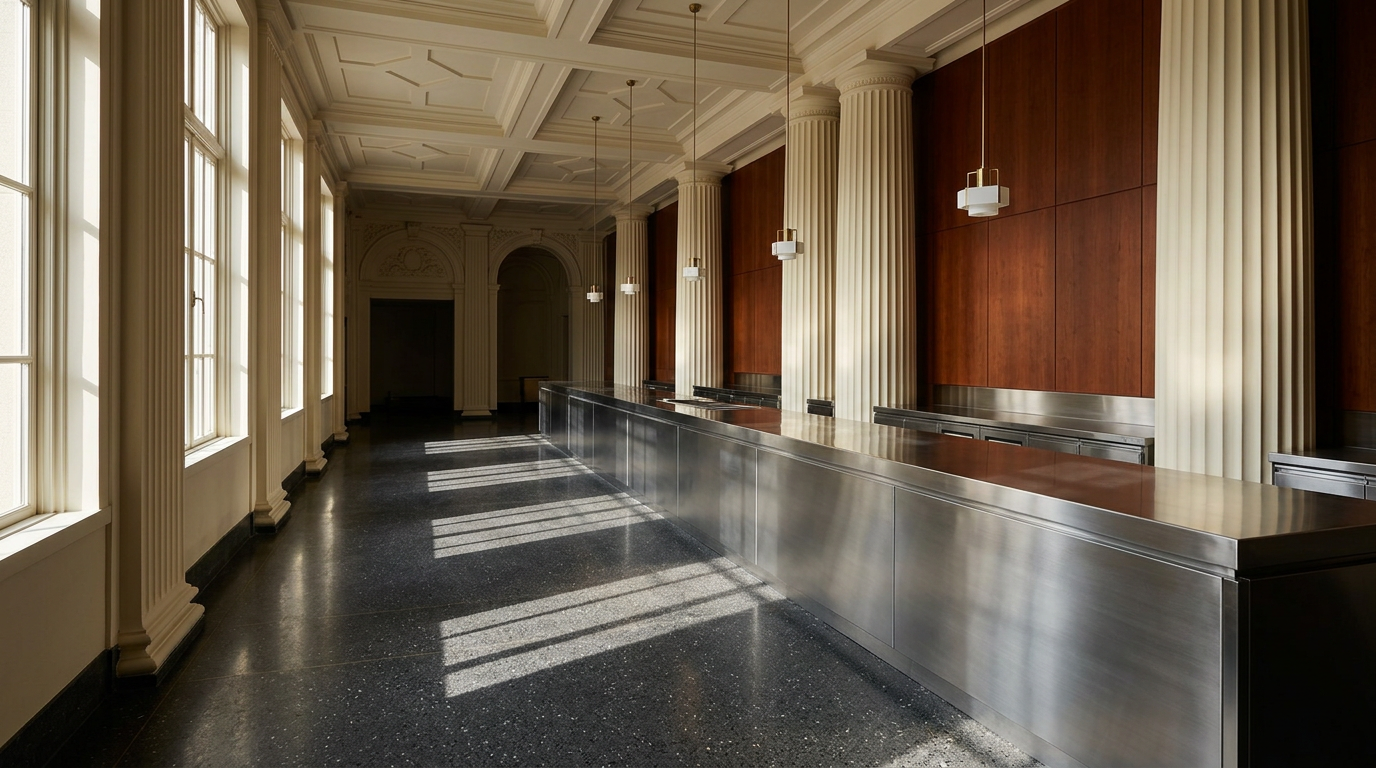
The choice of the United Charities Building — a Beaux-Arts structure completed in 1893 on Park Avenue South — is itself a statement. Rather than neutralising the building's neoclassical bones with contemporary cladding or exposed-brick informality, Thomas-McBrien has chosen to work in dialogue with them. Cherry wood paneling, dark terrazzo flooring, and polished stainless steel are set against grand pillars and ornamental mouldings, producing a tension between historical grandeur and contemporary restraint that defines the entire project.
Judd as Design Logic, Not Decoration
Donald Judd, the American sculptor and furniture designer who died in 1994, has become a recurring reference point in high-end hospitality and retail design. His influence typically surfaces as a shorthand for clean geometry and industrial materials. What distinguishes the WatchHouse project is the degree to which the reference appears structural rather than ornamental. The polished steel service counters that anchor the main room are not merely Judd-adjacent in their proportions — they function as spatial dividers and focal points in much the same way Judd's "specific objects" occupied gallery floors: asserting volume and surface without narrative embellishment.
The lighting reinforces this logic. Rectangular pendant fixtures hover above the counters in a cadence that echoes the modular repetition central to Judd's practice. The effect is deliberate: the café reads less as a retail environment dressed in art-world references and more as a space where the ordering of materials follows a coherent sculptural grammar.
This approach carries risk. Minimalism in hospitality can easily tip into coldness, producing spaces that photograph well but discourage lingering. Thomas-McBrien's mitigation appears to lie in the warmth of the cherry wood, which lines windows and doorways, and in the layout itself — a linear procession of connected rooms that separates the high-traffic ordering and preparation zones from quieter seating areas. The sequencing invites a shift in tempo as visitors move deeper into the space, a technique with clear precedent in gallery and museum design.
Material Confidence and the Specialty Coffee Arms Race
The design is defined by what co-founder Barry McBrien calls a "materially confident" approach — a phrase that signals a broader shift in how specialty coffee brands position themselves architecturally. The sector's early aesthetic identity leaned on reclaimed timber, subway tile, and Edison bulbs — visual codes borrowed from Brooklyn's industrial conversion boom of the early 2010s. A second wave introduced Scandinavian-inflected minimalism: pale wood, matte ceramics, restrained palettes. WatchHouse's Manhattan interiors suggest a third register: one that borrows from fine art and mid-century modernism to assert cultural seriousness.
This is not without commercial logic. As specialty coffee expands into premium urban real estate — Park Avenue South rents are among the highest in Manhattan — the interior must justify the price of both the lease and the product. A space that reads as curated rather than casual supports higher price points and longer brand recall. It also differentiates WatchHouse from competitors operating in the same neighbourhoods, where the visual language of coffee retail has become increasingly homogeneous.
Whether this level of architectural ambition translates into a sustainable hospitality model or remains a branding exercise dressed in terrazzo and steel is a question the market will answer over time. The tension is real: the same restraint that gives the WatchHouse interior its coherence also narrows the emotional range available to the space. A gallery rewards contemplation; a café must also reward comfort. How those two imperatives coexist — or whether one eventually subordinates the other — is worth watching as the brand continues to scale.
With reporting from Dezeen.
Source · Dezeen