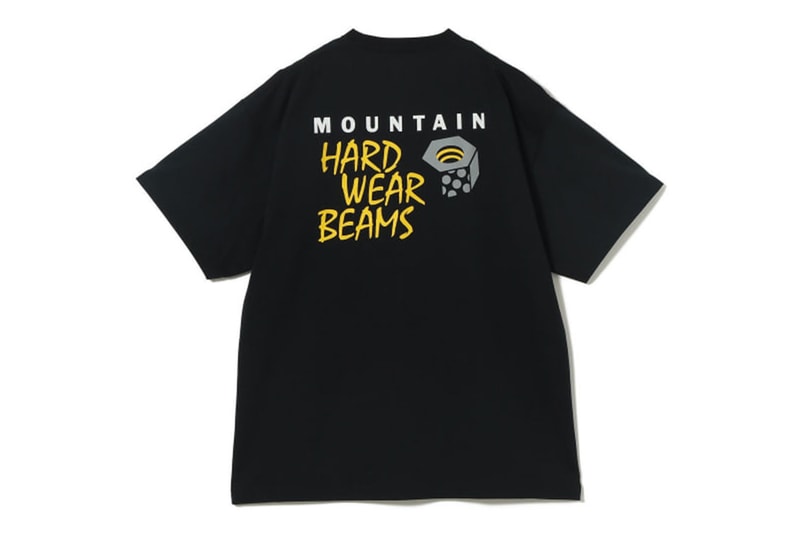
The intersection of technical performance and Japanese retail influence finds a new expression in the latest collaboration between Mountain Hardwear and BEAMS. Marking the 50th anniversary of the Tokyo-based retailer, the Spring/Summer 2026 capsule introduces the first co-branded logo in the history of the two brands — a detail that signals more than a routine seasonal drop. It suggests a deepening of a creative relationship that has quietly persisted across multiple product cycles.
The collection is centered on two graphic T-shirts that serve as visual histories of Mountain Hardwear's utilitarian roots. One design reimagines the brand's traditional logo through a deconstructed lens, while the other pays homage to the Alakazam 45L Backpack — a rugged fixture of long-distance trail culture. By abstracting these functional artifacts into graphic motifs, the capsule translates the language of the alpine into a lifestyle context. Constructed from a blend of cotton and polyester, the garments are positioned for what the brands describe as a "seamless transition" between technical environments and the street. The capsule is scheduled for release on April 29 through BEAMS' digital and physical outposts.
BEAMS at 50: Curation as Brand Identity
BEAMS has spent five decades building a retail model that treats curation itself as a form of design. Founded in 1976 in Tokyo's Harajuku district, the company grew from a single shop selling American casual wear into a sprawling multi-label operation with dozens of sub-lines and international partnerships. Its influence on Japanese fashion — and, by extension, on global streetwear and outdoor aesthetics — is difficult to overstate. Where many retailers function as passive distributors, BEAMS has consistently operated as an editorial voice, selecting and recontextualizing products from heritage brands in ways that reshape how those brands are perceived.
The Mountain Hardwear partnership fits neatly into this tradition. BEAMS has long maintained a particular affinity for American outdoor and workwear labels, filtering their functional DNA through a Japanese sensibility that prizes restraint, material quality, and graphic precision. Past collaborations with brands such as The North Face, Arc'teryx, and Patagonia have followed a similar logic: take a product rooted in technical performance, strip it to its essential visual language, and present it as an object of urban culture. The 50th anniversary provides a natural occasion to formalize this approach with a co-branded mark — a gesture that elevates the collaboration from a licensing arrangement to something closer to a shared creative statement.
The Gorpcore Continuum
The capsule arrives at a moment when the broader movement sometimes labeled "gorpcore" — the adoption of outdoor and technical gear as everyday fashion — has matured past its initial novelty. What began in the late 2010s as a trend driven by irony and visual contrast has settled into a durable segment of the menswear market. Trail runners appear on office floors. Shell jackets function as commuter outerwear. The aesthetic no longer requires explanation.
Within this landscape, the Mountain Hardwear x BEAMS capsule occupies a specific niche. Rather than offering fully technical garments repackaged for the city, it distills the iconography of mountaineering into graphic form. The Alakazam 45L Backpack, for instance, is not included in the collection — its silhouette is rendered as a printed motif on a T-shirt. The product is not the gear; the product is the cultural memory of the gear. This is a meaningful distinction. It positions the collaboration less as functional crossover and more as a form of brand storytelling, where the heritage of one partner is interpreted through the curatorial lens of the other.
Whether this approach represents the next phase of outdoor-lifestyle convergence or a signal that the category is beginning to exhaust its material possibilities remains an open question. When the garment itself is no longer technical — when the mountain exists only as a graphic — the tension between function and fashion shifts entirely to the symbolic register. The durability of that register, and the willingness of consumers to pay for narrative rather than performance, is the underlying bet.
With reporting from Hypebeast.
Source · Hypebeast