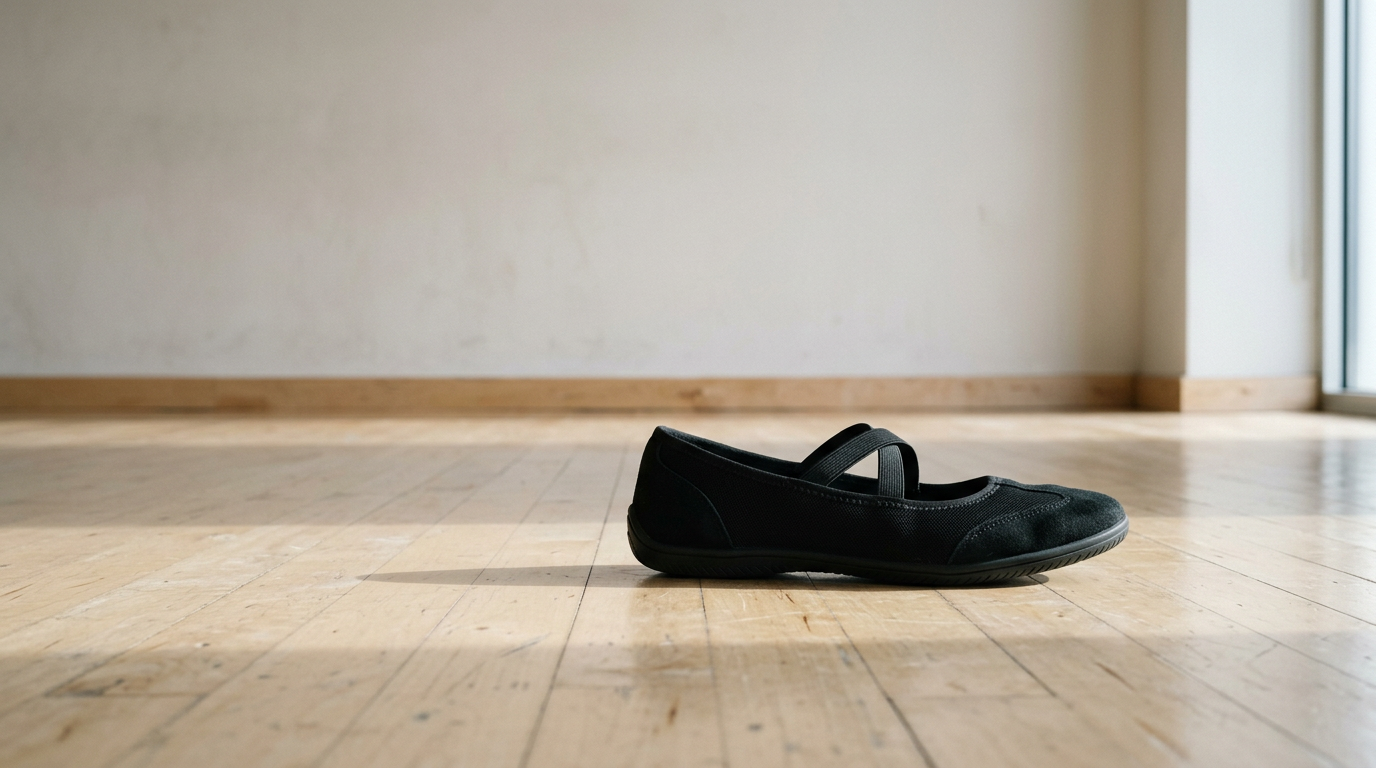
The convergence of performance sportswear and delicate, studio-inspired silhouettes continues to reshape contemporary footwear. adidas's latest iteration of this trend centers on the Ghost Sprint, a once-standard runner that has been stripped of its athletic utility and reimagined as a ballet flat. The transformation is less a total redesign and more a surgical extraction: by removing the tongue and laces and introducing elastic Mary Jane-style straps, the brand has leaned into the "balletcore" aesthetic that has dominated recent seasons. Priced at $100 and available in black, lavender, and beige, the Ghost Sprint Ballet arrives as a compact thesis statement on where performance-adjacent footwear is heading.
The Ghost Sprint was an ideal candidate for this metamorphosis. Its original design already featured a remarkably low profile and a flat rubber sole, mimicking the grounded feel of a traditional dance slipper. By retaining the shoe's slim shape and smooth suede-like uppers, the Ghost Sprint Ballet maintains a ghost of its athletic past while firmly occupying the space of a lifestyle hybrid. It joins a growing catalog of similar experiments from adidas, including the Samba Jane and the Taekwondo Mei Elite — each a deliberate attempt to extract a softer, more minimal silhouette from a shoe originally designed for sport.
The arc from maximalism to reduction
The broader context for the Ghost Sprint Ballet is a multi-season pivot away from the chunky, heavily cushioned sneakers that defined much of the previous decade. The so-called "dad shoe" wave, which peaked with exaggerated midsoles and aggressive proportions, has gradually given way to slimmer, lower-profile designs. Ballet flats, once confined to luxury fashion houses and fast-fashion racks alike, re-entered the cultural conversation through runway collections and social media aesthetics that prized quiet, understated forms over visual loudness.
For athletic brands, this shift presents both an opportunity and a tension. The engineering logic of performance footwear — cushioning, support, traction — runs counter to the stripped-back ethos of a ballet flat. What adidas and its competitors have discovered is that archival models with already-minimal profiles can be adapted more credibly than building a ballet silhouette from scratch. The result is a category of shoe that borrows the cultural authority of sport without delivering its functional promises. The consumer, in turn, is buying heritage and shape rather than performance.
This is not entirely new territory. The fashion system has long recycled athletic silhouettes for lifestyle purposes — the Stan Smith's journey from tennis court to Parisian street style being perhaps the most cited example. What distinguishes the current wave is the specificity of the reference point. Where earlier crossovers softened a sport shoe into a casual sneaker, the Ghost Sprint Ballet crosses a further threshold: it transforms a runner into something that reads closer to dancewear than to anything found on a track.
What the hybrid signals for footwear strategy
adidas has been particularly active in this space, and the pattern suggests a deliberate portfolio strategy. Rather than launching entirely new lifestyle models, the brand is mining its performance archive for shapes that can be surgically altered — a strap added here, a tongue removed there — to create products that feel novel without requiring the investment of a ground-up design. The Samba's resurgence over recent seasons demonstrated the commercial power of recontextualizing a sport shoe for a fashion audience; the Ghost Sprint Ballet extends that logic further down the minimalism spectrum.
The risk, as with any trend-driven product, is saturation. The ballet flat revival has already produced a crowded field, and the distinction between one brand's Mary Jane hybrid and another's grows thinner with each release. For adidas, the differentiator lies in the specificity of the source material — the Ghost Sprint's particular proportions, its sole geometry, the texture of its upper — details that give the shoe a traceable lineage rather than a generic silhouette.
Whether the appetite for deconstructed athletic footwear sustains beyond the current cycle or proves to be a transitional aesthetic between two louder eras remains an open question. The forces pulling in opposite directions — consumer desire for minimalism against the industry's need for visible novelty — are not easily reconciled. The Ghost Sprint Ballet sits precisely at that intersection, and its commercial reception may say as much about where the market is going as any trend forecast.
With reporting from Highsnobiety.
Source · Highsnobiety