The intersection of prestige television and streetwear has matured from simple merchandising into a sophisticated exercise in brand world-building. New Era's upcoming Spring/Summer 2026 collection, a collaboration with Netflix's Stranger Things, serves as a testament to the enduring gravity of the show's 1980s-inflected aesthetic. By anchoring the lineup in the series' iconic typography and supernatural motifs, the collection attempts to capture the specific brand of Midwestern gothic that has defined the series across its multi-season run.
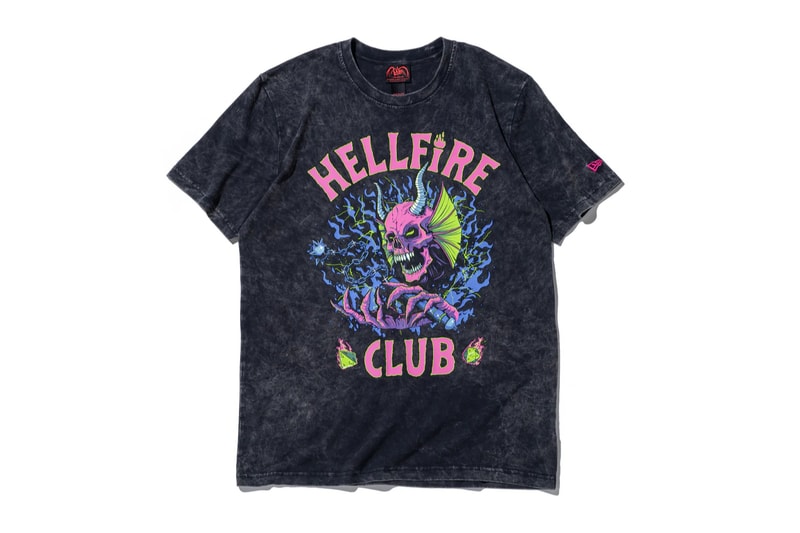
The capsule is centered on New Era's foundational silhouettes, most notably the 59FIFTY fitted cap. The designs lean into the show's internal lore, featuring the Hellfire Club insignia and Demogorgon illustrations. These are paired with 19TWENTY trucker hats — a choice that reinforces the vintage Americana vibe essential to the Hawkins, Indiana, setting. The apparel side remains understated, focusing on cotton graphic t-shirts that function as wearable artifacts for the show's dedicated fanbase.
Entertainment IP as Streetwear Currency
The collaboration sits within a well-established pattern in which entertainment intellectual property has become a load-bearing pillar of streetwear's release calendar. Over the past decade, the line between licensed merchandise and fashion collaboration has blurred considerably. Where branded television apparel once occupied bargain bins and theme-park gift shops, it now commands drop-style releases, limited production runs, and the attendant secondary-market premiums. New Era itself has been a consistent practitioner of this model, maintaining long-running partnerships across sports leagues, film franchises, and cultural properties.
What distinguishes the Stranger Things collaboration is the specificity of its source material. The show's visual identity — rooted in Spielbergian suburbia, analog technology, and a particular palette of faded reds and earth tones — provides a design language that aligns naturally with vintage-inflected streetwear. The Hellfire Club, a fictional Dungeons & Dragons group within the series, has already achieved a degree of iconographic recognition that extends well beyond the show's viewership, appearing on unofficial merchandise and fan-made apparel for years. By formalizing that imagery on a 59FIFTY cap, New Era is effectively codifying what the secondary market has already validated.
The choice of the 19TWENTY trucker hat is similarly deliberate. The silhouette evokes the rural, working-class texture of the show's fictional Indiana setting, and its mesh-back construction carries connotations of the early 1980s that predate the trucker-hat revival of the mid-2000s. In this sense, the product design does more than reference the show — it attempts to inhabit its world.
Nostalgia as a Long-Tail Asset
While Stranger Things moves toward its narrative conclusion, its influence on the retail landscape shows no signs of waning. Netflix has treated the franchise as a case study in sustained commercial activation, licensing the property across categories ranging from video games to fast-food promotions. The show's cultural footprint has arguably outlasted the momentum of its episodic releases, sustained by a fanbase that treats its mythology with the kind of devotion typically reserved for legacy sci-fi and fantasy franchises.
This dynamic raises a broader question about the shelf life of entertainment IP in fashion. Properties like Star Wars and Harry Potter have demonstrated that nostalgia can function as a renewable resource, generating collaborative collections decades after their original cultural moment. Stranger Things, despite being a comparatively recent creation, appears to be following a similar trajectory — its 1980s setting granting it a double layer of nostalgia, both for the era it depicts and for the era in which audiences first encountered it.
For New Era, the calculus is straightforward: the brand's core product — the fitted cap — is a canvas that benefits from narrative weight. A logo means more when it carries a story. The question is whether properties born in the streaming age can sustain the kind of multi-generational attachment that keeps collaboration pipelines productive. The final season of Stranger Things will test whether the show's iconography endures as cultural shorthand or fades into the long tail of content libraries. The retail market, as ever, is placing its bets early.
With reporting from Hypebeast.
Source · Hypebeast