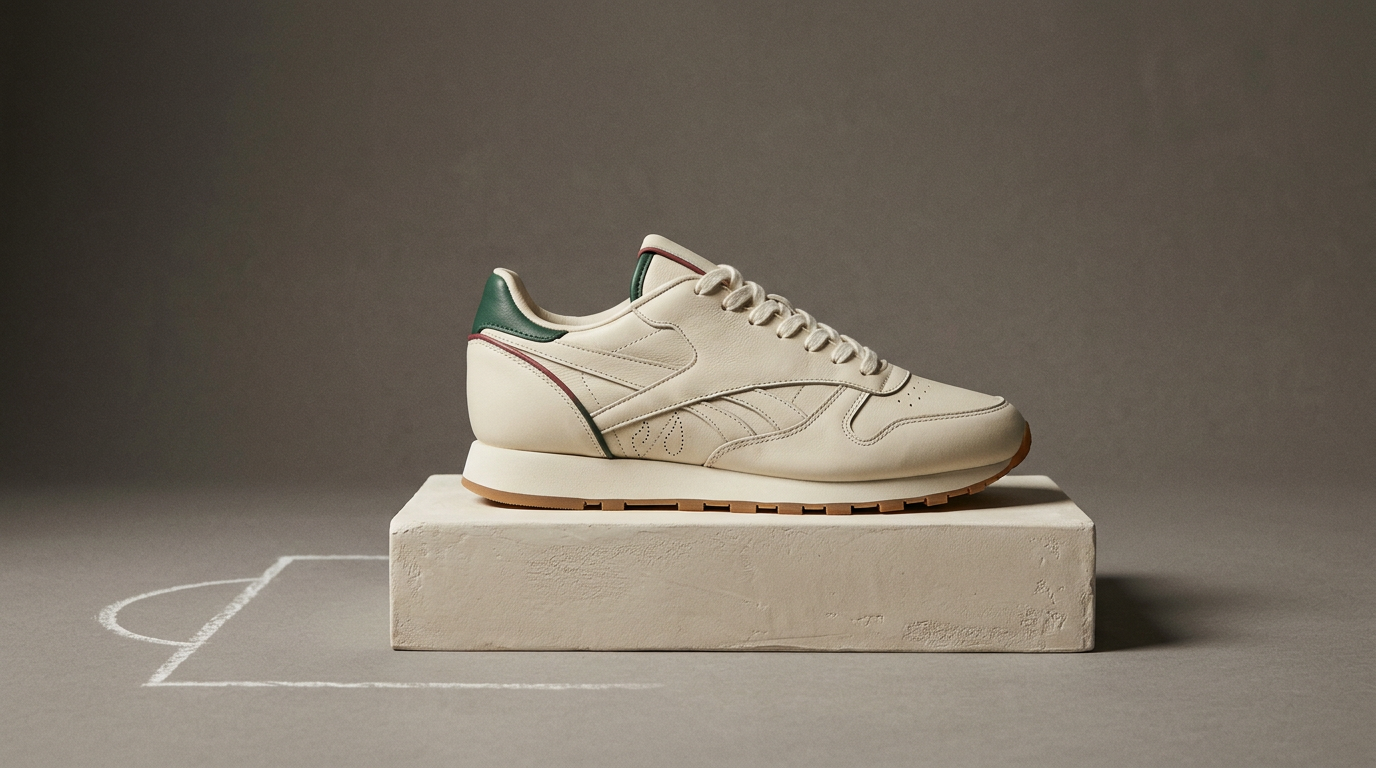
As the global soccer calendar accelerates toward its next major tournament, sportswear giants are increasingly looking for ways to capture the fervor of national identity without necessarily holding the official keys to the kit. Nike's latest release, a specialized Air Max 95, serves as a case study in this kind of aesthetic proximity. Though the Mexican national team is officially an Adidas partner, Nike's new "Mexico" iteration manages to evoke the spirit of El Tri through a carefully curated palette of cream, red, and green — the unmistakable colors of the Mexican flag, deployed with enough restraint to stay on the right side of trademark law.
The design is characterized by its discipline. Eschewing the literalism of team crests — a necessity given the legal boundaries of sponsorship — the sneaker relies on texture and iconography. Layers of cream leather are accented by a flame graphic composed of minute dots, a subtle nod to the intensity of the sport. The heel bears the stamp "El Tiempo F.C.," a fictional club designation that allows Nike to participate in the cultural moment while sidestepping direct trademark infringement. The Air Max 95 "Mexico" is currently available for $200.
The Sponsorship Workaround as Brand Strategy
The practice of evoking a national team's identity without holding its official sponsorship deal is not new, but Nike has refined it into something approaching an art form. The sportswear industry operates under a well-established division: official kit sponsors control match-day jerseys, training gear, and federation-level branding. Everything else — the broader cultural territory surrounding a team's fanbase — remains contested ground. Nike's approach with the Air Max 95 "Mexico" occupies precisely this contested space.
By channeling national colors and soccer-adjacent branding through a lifestyle silhouette rather than performance footwear, Nike avoids the legal tripwires that come with replicating official team assets. The fictional "El Tiempo F.C." moniker functions as a creative buffer, signaling affiliation to anyone paying attention while offering plausible separation from the Mexican Football Federation's intellectual property. It is a strategy that depends on cultural literacy — the consumer recognizes what the shoe represents, even if the shoe never says it outright.
This is part of a broader pattern ahead of the World Cup. Similar treatments have been applied to Air Max silhouettes representing England and other major footballing nations. Nike appears to be building a parallel ecosystem of nationally coded lifestyle products that run alongside — but never directly compete with — the official kit market. The logic is straightforward: fans who want to express national pride do not limit that expression to ninety minutes on the pitch. They want it in their daily rotation.
Lifestyle Footwear and the Fluidity of Fan Loyalty
The choice of the Air Max 95 as the vehicle for this release is itself significant. Originally designed by Sergio Lozano in 1995, the silhouette has long held currency in streetwear circles, particularly in markets where sneaker culture and soccer culture overlap. In cities like Los Angeles, Houston, and Chicago — home to large Mexican-American communities with deep ties to both El Tri and sneaker collecting — a Mexico-themed Air Max 95 sits at a natural intersection of identity and commerce.
This points to a broader tension in sports sponsorship. Official partnerships grant exclusivity over team branding, but they do not grant exclusivity over national sentiment. Adidas controls the crest; it does not control the flag. Nike's strategy exploits this gap with precision, targeting the lifestyle layer where consumer loyalty is shaped less by federation contracts and more by cultural resonance and product design.
The question this raises is whether the lifestyle flanking strategy erodes the value of official sponsorship deals over time. If a brand can capture meaningful market share around a national team without paying federation fees, the calculus for future sponsorship negotiations shifts. Federations may need to reconsider what exclusivity actually means — and what, exactly, they are selling — as the boundary between official merchandise and culturally coded product continues to blur.
With reporting from Highsnobiety.
Source · Highsnobiety