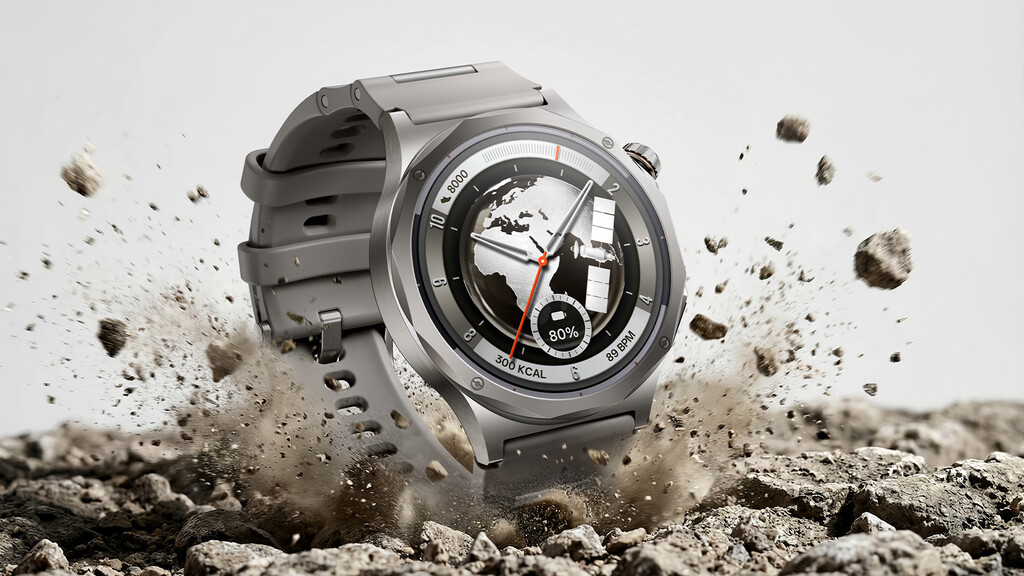
The wearable market has long been defined by a series of trade-offs between display clarity, battery life, and processing power. With the introduction of the Watch X3, launched alongside its flagship Find X9 Pro, OPPO is attempting to minimize those compromises through sheer hardware density. The device centers on a 1.5-inch LTPO AMOLED screen capable of reaching a peak brightness of 3,000 nits — a figure designed to ensure legibility in the harshest direct sunlight, addressing a traditional pain point for wrist-worn optics. In a category where incremental improvements are the norm, the specification sheet alone signals that OPPO views the premium smartwatch tier as a credible battleground.
Dual Architecture as a Design Philosophy
Under the sapphire crystal, the Watch X3 utilizes the Snapdragon W5 Gen 1 platform paired with 2GB of RAM. Perhaps more interesting is the dual-system approach: while it runs Wear OS with its Color OS overlay for primary functions, it includes a dedicated 4GB eMMC for a Real-Time Operating System (RTOS). This architecture allows the device to offload low-power tasks — continuous heart rate monitoring, step counting, sleep tracking — to a secondary, energy-efficient processor while reserving the primary chipset for app-heavy workloads. The result is a claimed 16 days of battery life in power-saving mode, even while supporting a comprehensive suite of sensors ranging from oximetry to skin temperature.
The dual-architecture concept is not entirely new in consumer electronics. Smartphones have employed big.LITTLE processor configurations for over a decade, routing lightweight operations to efficient cores and reserving performance cores for demanding tasks. In the wearable space, however, the approach remains less common at this level of integration. Most competitors choose one operating system and optimize around it. OPPO's decision to run a full Wear OS stack alongside a dedicated RTOS suggests a bet that users want both the app ecosystem of a general-purpose smartwatch and the endurance profile of a fitness-first device — without having to choose between them.
Whether this translates into a seamless user experience or an awkward cohabitation of two software paradigms is a question that specifications alone cannot answer. The history of dual-OS devices in other form factors — laptops that attempted to bridge Windows and Android, for instance — is mixed at best. Execution will matter more than architecture.
Hardware Density in a Crowded Field
The physical design leans into the ruggedized aesthetic now common in the premium segment. Featuring a rotating crown, a dedicated action button, and MIL-STD-810H durability certification — a U.S. military standard for environmental stress testing — the Watch X3 is positioned as a versatile tool for both urban environments and more demanding outdoor use. At 43 grams, the device remains notably light for a watch carrying this level of specification.
OPPO's strategy appears to be one of technical exhaustion: packing nearly every available sensor and specification into a single frame, then competing on the sum of parts. It is a familiar playbook in the Android ecosystem, where hardware differentiation has historically served as the primary lever against Apple's integrated software-hardware advantage. In the smartwatch category, Apple Watch Ultra occupies a similar niche of ruggedized premium, while Samsung's Galaxy Watch series and Garmin's endurance-focused lineup each carve out distinct positions. The question for OPPO is whether specification leadership alone can dislodge entrenched preferences, particularly outside China where its wearable brand recognition remains thinner.
The broader signal from the Watch X3 is that the ceiling for wearable hardware continues to rise. Display brightness figures that would have been flagship-tier on smartphones just a few years ago are now appearing on wrist-worn devices. Sensor suites grow denser with each generation. Battery life claims stretch further. Yet the competitive dynamics of the smartwatch market remain stubbornly tied to ecosystem lock-in — the gravitational pull of iOS or Android, of health platforms and notification pipelines, of the apps a user already depends on. OPPO can build a technically formidable device. The harder question is whether technical formidability, absent a differentiated software story, is sufficient to shift buying decisions in a market where the wrist has become an extension of the phone in the pocket.
With reporting from Xataka.
Source · Xataka