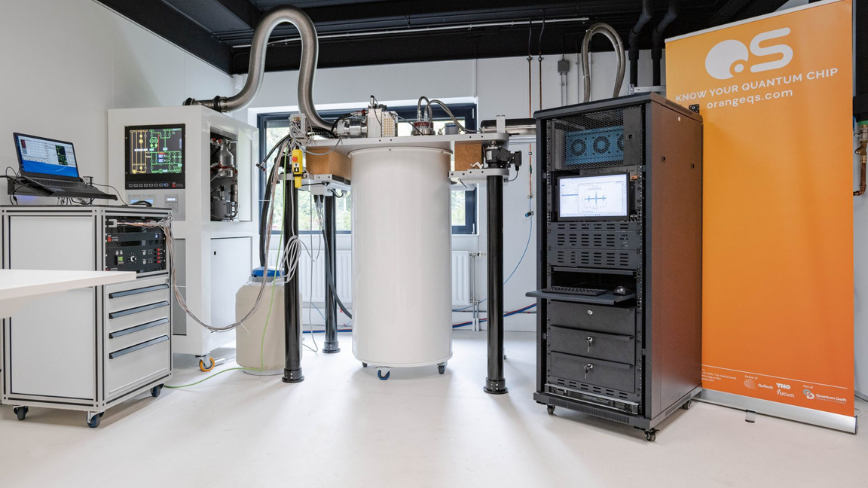
As quantum computing transitions from theoretical physics to industrial engineering, the industry faces a mundane but critical hurdle: how to verify that a chip actually works. Testing quantum processors remains a bespoke, time-consuming process that tethers researchers to laboratory environments designed for discovery, not throughput. OrangeQS, a startup based in Delft — the Dutch city that has become a gravitational center for European quantum research — aims to standardize this phase of the hardware lifecycle by providing high-throughput equipment capable of validating qubits at scale.
The company recently expanded its seed funding to a total of €15 million, bolstered by a €3 million injection from the European Innovation Council (EIC) Fund. OrangeQS occupies a rare niche as the only commercial entity focused exclusively on dedicated quantum chip testing solutions. By automating the characterization of chips, the company seeks to compress diagnostic periods from weeks to days — a prerequisite for any meaningful commercial rollout of quantum hardware.
The metrology gap in quantum's supply chain
The semiconductor industry learned decades ago that fabrication without rigorous, automated testing is fabrication without yield. Entire companies — Teradyne, Advantest, Keysight Technologies — built multi-billion-dollar businesses around the principle that every chip leaving a foundry must be electrically characterized before it ships. Quantum computing has not yet reached that level of industrial discipline. Most qubit characterization still happens inside dilution refrigerators operated by PhD researchers, using bespoke measurement setups assembled from general-purpose laboratory instruments. The process is slow, difficult to reproduce, and fundamentally incompatible with the volumes that quantum hardware companies will need as they move toward commercial deployment.
This is the gap OrangeQS is targeting. Rather than building quantum processors themselves, the company is building the infrastructure layer that sits between fabrication and deployment — the testing and validation toolchain. The strategic logic mirrors what happened in classical semiconductors: as chip design and chip manufacturing separated into distinct industries, testing equipment became the connective tissue that allowed the ecosystem to scale. If quantum hardware follows a similar trajectory — and there are structural reasons to expect it will — standardized test infrastructure becomes not a convenience but a bottleneck.
Delft's proximity to QuTech, the quantum research institute jointly operated by TU Delft and TNO, gives OrangeQS access to one of Europe's densest concentrations of quantum engineering talent. The EIC Fund's participation in the round also signals a broader European industrial policy interest in ensuring that quantum supply chain capabilities are built on the continent, rather than imported.
From vendor to ecosystem node
Beyond the capital raise, OrangeQS is launching what it calls the MAX Partnership Programme — an initiative that invites quantum hardware manufacturers to collaborate directly on the design of next-generation test equipment. The structure is notable. Rather than developing instruments in isolation and selling them to customers, the company is embedding itself in the development workflows of chip makers, absorbing their requirements and feeding them back into product design.
This approach carries echoes of how ASML, another Dutch company, built its dominance in lithography equipment: not by selling machines at arm's length, but by co-developing technology in tight partnership with leading chipmakers. The parallel is instructive, though the scale difference is vast. ASML operates in a mature market measured in hundreds of billions of dollars; the quantum hardware market is still measured in early revenue and government grants. The question for OrangeQS is whether the quantum industry will consolidate around standardized testing protocols quickly enough to sustain a dedicated equipment vendor — or whether the field's fragmentation across competing qubit modalities (superconducting, trapped ion, photonic, topological) will keep testing requirements too heterogeneous for a single platform to serve.
The tension is real. Standardization enables scale, but premature standardization can lock out the architectural diversity that the quantum field still needs. OrangeQS is betting that enough common ground exists across qubit types to make automated characterization viable as a horizontal capability. Whether that bet holds depends less on the company's engineering and more on how quickly the quantum hardware landscape converges — a question that remains, for now, genuinely open.
With reporting from The Next Web.
Source · The Next Web