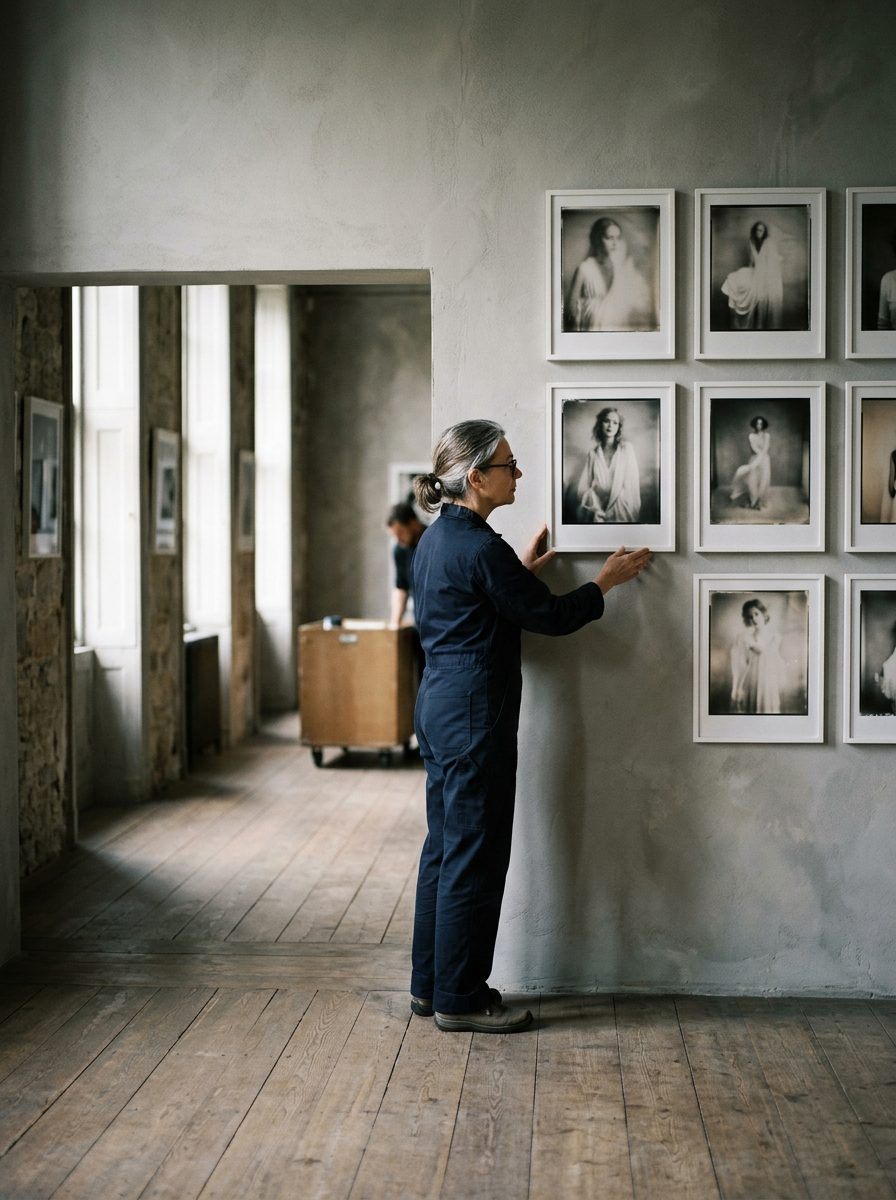
Spain's MOP Foundation will open "Paolo Roversi Doubts" on June 20 in A Coruña, dedicating an exhibition to the Italian fashion photographer whose work has become synonymous with a particular kind of visual restraint. The show centers on Roversi's long commitment to Polaroid film and his signature interplay of shadow, blur, and negative space — an aesthetic that has set him apart from the high-contrast, hyper-sharp conventions that dominate much of commercial fashion photography.
Roversi, who has spent decades working from Paris, built his reputation by treating fashion photography less as documentation and more as portraiture in the classical sense. His subjects — often shot with large-format Polaroid cameras — emerge from dark backgrounds with an almost painterly softness, a technique that owes as much to Renaissance chiaroscuro as to any photographic tradition. The title of the exhibition, "Doubts," appears to signal a curatorial interest in the uncertainty and ambiguity that define his method: images that refuse to resolve fully, that leave the viewer suspended between recognition and abstraction.
Polaroid as medium and philosophy
Roversi's attachment to Polaroid is not merely a technical preference but a conceptual stance. The Polaroid process produces a single, unrepeatable print — each exposure is both negative and final object. In an industry that has moved decisively toward digital capture, post-production manipulation, and volume-driven workflows, that commitment to a one-shot analog medium carries a certain philosophical weight. It imposes limits on control, introduces chemical unpredictability, and forces a slower, more deliberate pace of work.
This approach has earned Roversi a distinctive position within fashion's visual ecosystem. His images have appeared in major publications and campaigns over the years, yet they tend to resist the glossy immediacy that defines most commercial output. Where mainstream fashion photography often aims to flatten ambiguity — presenting garments and faces with maximum clarity — Roversi's work does the opposite, wrapping its subjects in atmosphere and leaving details to dissolve at the edges.
The decision to exhibit this body of work in A Coruña is notable in its own right. The Galician city is better known in fashion circles as the headquarters of Inditex, the parent company of Zara, than as a destination for fine-art photography. The MOP Foundation's programming suggests an effort to expand the city's cultural footprint beyond its commercial associations, positioning it as a venue for serious engagement with visual arts.
Fashion photography's uneasy place in the art world
The broader context for an exhibition like "Doubts" is the ongoing tension between fashion photography and the fine-art establishment. Fashion images are created under commercial constraints — commissioned by brands, shaped by editorial briefs, intended to sell. Yet photographers like Roversi, along with peers such as Peter Lindbergh and Sarah Moon, have long occupied a liminal space where the commercial and the artistic overlap without fully merging. Museums and foundations have increasingly exhibited fashion photography, but the genre still sits uneasily alongside work produced without commercial intent.
Roversi's Polaroid-based practice complicates this boundary further. The physicality of the Polaroid print — its status as a unique object rather than a reproducible file — gives it qualities more commonly associated with painting or printmaking. Whether that distinction is meaningful or merely fetishistic is a question the exhibition may invite visitors to consider for themselves.
What remains to be seen is how "Doubts" positions Roversi's work within these tensions: as fashion photography elevated to art, as art that happens to involve fashion, or as something that resists the distinction altogether. The answer may depend less on curatorial framing than on what viewers bring to the encounter.
With reporting from Business of Fashion.
Source · Business of Fashion