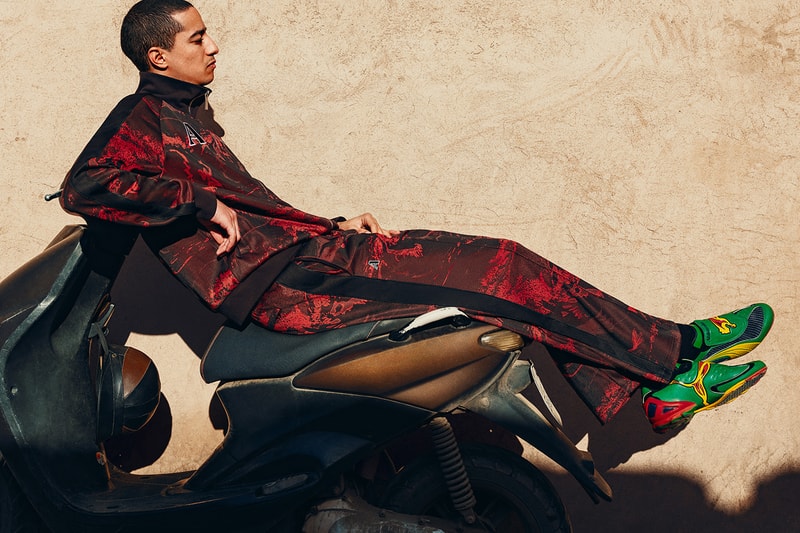
PUMA and London-based designer Priya Ahluwalia have released their second collaborative collection, a capsule that draws on the visual and material culture of African football fandom. Timed to arrive ahead of the 2026 FIFA World Cup, the range reworks archival PUMA silhouettes — most notably the T7 tracksuit and the V-S1 slip-on — through a lens shaped by Ahluwalia's ongoing engagement with her Indian-Nigerian heritage. The collection uses recycled fibers throughout and deploys Pan-African color palettes and custom graphics inspired by the collective energy of stadium crowds across the continent.
Ahluwalia, who founded her eponymous label in 2018 after completing a master's at the University of Westminster, has built a body of work defined by two commitments: cultural storytelling rooted in diaspora experience and a material practice centered on sustainability and textile reuse. Her first collaboration with PUMA established the template — sportswear as a vehicle for identity narratives rather than mere performance branding. This second outing deepens the approach, narrowing its focus to football as a site of communal expression in countries like Morocco and Nigeria.
Archival Silhouettes, Diasporic Context
The decision to rework the PUMA T7 tracksuit is telling. The T7, originally introduced in the 1970s, occupies a particular place in sportswear history: it became a staple of terrace culture in Europe and, through parallel adoption, a fixture in streetwear wardrobes across West Africa and the Caribbean. Ahluwalia's version overlays the familiar silhouette with abstracted crowd graphics — patterns that evoke mass movement without resorting to literal depiction. Textured knit sets in Nigerian green employ wave motifs that have recurred across Ahluwalia's collections, functioning almost as a house code that ties the sportswear collaboration back to her mainline work.
The footwear component follows a similar logic. The V-S1 slip-on, reworked with recycled materials, balances archival reverence with everyday utility. It is a shoe designed to reference PUMA's back catalog while remaining functional in the context of contemporary streetwear. The overall effect is a collection that treats the archive not as a museum but as raw material — something to be cut, recombined, and recontextualized.
Football Culture as Design Brief
The broader significance of the collaboration lies in what it signals about how global sportswear brands engage with regional identity. Football in much of Africa operates as more than a spectator sport; it functions as a social infrastructure, a space where national identity, community belonging, and aesthetic expression converge. Fan culture — the coordinated dress, the choreographed chants, the improvised stadium fashion — constitutes a visual language that has historically been consumed by global brands without meaningful attribution or creative partnership.
Ahluwalia's approach attempts something different. By centering what the collection's framing calls "cultural collectivism," the capsule positions the designer not as an outside interpreter but as someone working from within a lived tradition. The use of recycled fibers reinforces this posture: sustainability here is not an add-on marketing claim but an extension of the resourcefulness and material ingenuity that characterize textile practices across the African continent and its diaspora.
The timing matters, too. With the 2026 World Cup approaching, sportswear brands are competing for cultural relevance in markets where football is not just popular but foundational. The conventional playbook involves national team kits and athlete endorsements. A collaboration like this one suggests an alternative route — one that treats fan culture, rather than elite performance, as the primary source of creative authority.
Whether this model scales beyond capsule collections remains an open question. The tension between the artisanal specificity Ahluwalia brings and the volume-driven logic of a company like PUMA is structural, not incidental. A capsule can honor cultural nuance in ways that a mainline product range, distributed across dozens of markets, may struggle to replicate. The test is whether the design language developed here — the Pan-African palettes, the archival reworking, the sustainability commitments — filters into PUMA's broader output, or whether it remains a carefully bounded exercise in cultural credibility.
With reporting from Hypebeast.
Source · Hypebeast