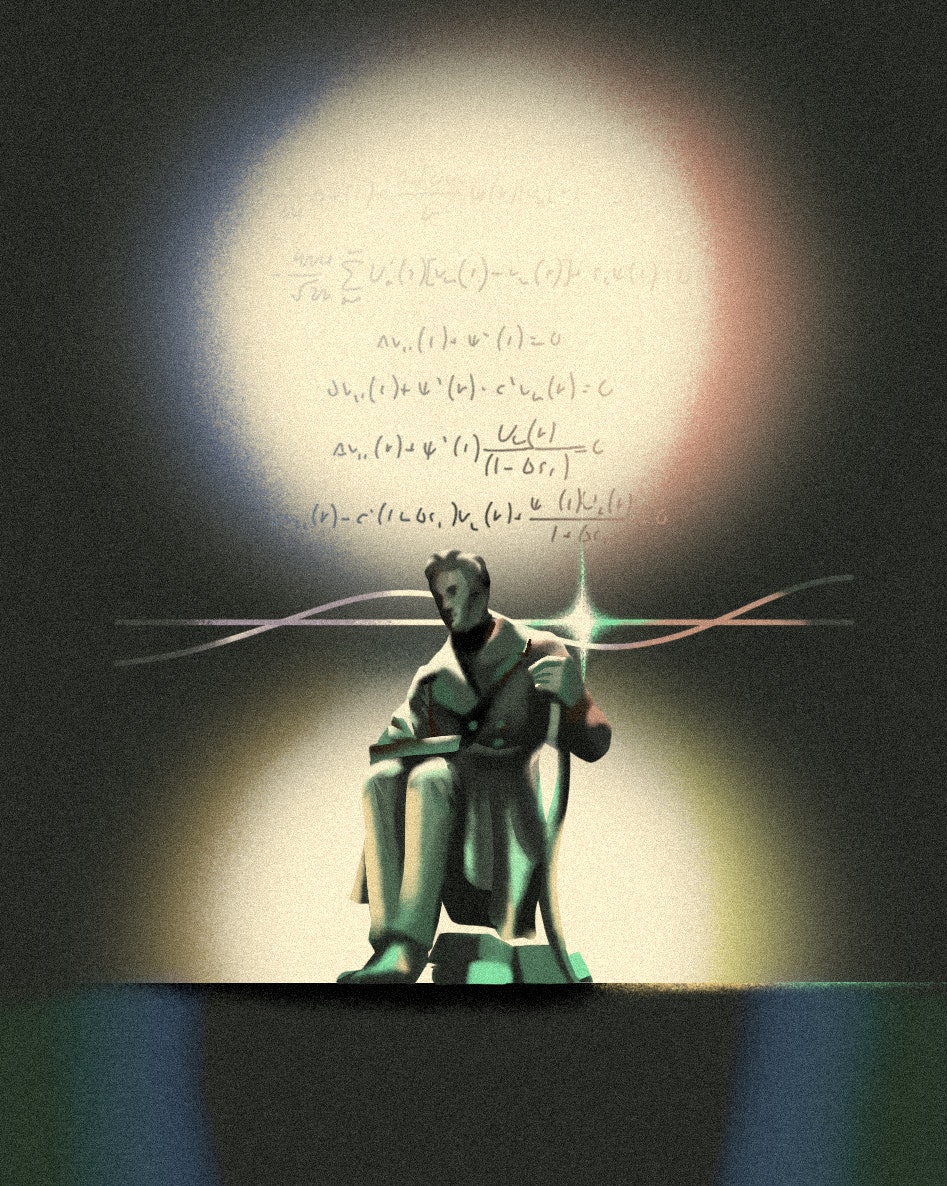
The central provocation of quantum physics is not merely that the world is small, but that it is fundamentally relational. Rather than uncovering a set of static, objective truths, the pioneers of the field realized that phenomena do not exist in isolation — they are defined by their interactions with the observer and the environment. This shift suggests that reality is a constant flux of contingent circumstances where human participation is not just observation but a co-constitution of the object itself.
In his book On the Equality of All Things: Physics and Philosophy, theoretical physicist Carlo Rovelli argues that these revolutionary ideas did not emerge in a vacuum. Rovelli posits that Niels Bohr, a titan of quantum science, was deeply influenced by his fellow countryman, the philosopher Søren Kierkegaard. Growing up in Denmark, Bohr was immersed in Kierkegaard's existentialism — a framework that prioritized individual perspective and the inherent limits of human knowledge over the rigid, all-encompassing rationalism of the Hegelian systems dominant in the 19th century.
The Philosophical Roots of a Scientific Revolution
The claim that philosophy shaped physics is not new, but Rovelli's specific genealogy — tracing a line from Kierkegaard's Copenhagen to Bohr's Copenhagen interpretation — adds a layer of intellectual history that is often overlooked in standard accounts of quantum mechanics. Kierkegaard, writing in the 1840s, broke with the dominant Hegelian tradition by insisting that truth could not be captured in a totalizing, impersonal system. For Kierkegaard, existence was irreducibly subjective: the individual's situated perspective was not a deficiency to be overcome but the very condition of understanding. Knowledge always came from somewhere, seen by someone, shaped by the limits of that vantage point.
This philosophical DNA is visible in the quantum rejection of "complete objectivity." When Bohr formulated his principle of complementarity — the idea that certain pairs of properties, like a particle's position and momentum, cannot be simultaneously measured with full precision — he was not merely describing a technical limitation of instruments. He was making a deeper epistemological claim: that the act of measurement constitutes the phenomenon. There is no particle with a definite position waiting behind the curtain; the position comes into being through the relational act of observation. The parallel with Kierkegaard's insistence on the primacy of the observer's standpoint is difficult to dismiss as coincidence, particularly given the shared intellectual milieu of Danish thought in which Bohr was educated.
The broader history of physics offers other instances of philosophical currents shaping scientific breakthroughs. Ernst Mach's positivism influenced Einstein's early thinking about relativity, particularly the rejection of absolute space and time. The logical positivists of the Vienna Circle drew on — and were drawn to — the new physics of the early twentieth century. Science and philosophy have never operated in sealed compartments, even when practitioners on both sides have sometimes pretended otherwise.
Relationality as a Lens for the Present
Rovelli's argument arrives at a moment when the question of what constitutes objective knowledge is under pressure from multiple directions. In artificial intelligence research, debates about whether large language models "understand" anything hinge on similar questions about the role of the observer and the relational nature of meaning. In climate science, the entanglement of the observer (human civilization) with the system being observed (the planetary climate) complicates any pretense of detached measurement. Rovelli's insistence that physics itself was built on the recognition of these entanglements lends the argument a certain weight.
By moving away from the idea of a predetermined universe, Bohr and his contemporaries opened the door to a reality defined by relationality and emergent possibilities. As Rovelli frames it, physicists rarely invent a new way of seeing the world without first finding the intellectual permission to do so within the pages of philosophy. The implication cuts in both directions: if philosophy gave physics the conceptual vocabulary for quantum mechanics, one might ask what conceptual vocabularies are still missing — and what revolutions in understanding remain locked behind philosophical doors that have not yet been opened.
The tension, then, is between two readings of the same history. One sees philosophy as a scaffolding that can be removed once the physics stands on its own. The other sees it as load-bearing structure — remove it, and the interpretation collapses into incoherence. Which reading holds may determine not just how the history of quantum mechanics is told, but how its next chapter is written.
With reporting from Noema Magazine.
Source · Noema Magazine